



Operational Roadmap to PCI DSS Compliance
Compliance with PCI DSS is not a one-off task. It’s a continuous security program that must be woven into daily operations.
Many organizations treat PCI as a checkbox exercise. They fix a few gaps, pass the audit, and move on. That approach fails. Threats evolve. Infrastructure shifts. New risks appear. Real compliance requires ongoing attention and operational discipline.
TrustNet provides a clear and practical roadmap that guides you through every phase of the PCI journey: scoping, readiness assessment, remediation, audit execution, and continuous monitoring. You’ll learn how to:
- Integrate PCI requirements into your routine security workflows
- Plan realistic timelines that match your team and environment
- Track costs and resources to avoid surprises
- Build a living PCI program — not a one-time project
Detailed Steps to Achieve PCI DSS Compliance
1. Scoping and Environment Discovery
Everything starts with scope. You can’t protect what you haven’t defined. Your first job is to identify every system that stores, processes, or transmits cardholder data. Map how that data moves across your network, applications, and third-party connections.
Then, look at the systems that connect to the Cardholder Data Environment (CDE). Even if they don’t handle payment data directly, they can still affect your security.
Keep your documentation accurate. Every time your network changes or a new vendor connects, update your scope. A clear, current scope prevents last-minute surprises when the audit begins.
Operational tip: Maintain a single master document for scope and data flows. It keeps everyone aligned and saves hours during assessment season.
2. Readiness and Risk Assessment
Once your scope is clear, assess your current position. Compare your environment against the PCI DSS v4.0.1 controls to see what’s missing or weak.
Use automated tools for vulnerability scans and configuration checks. Then, validate critical controls manually, especially where automation falls short.
A good readiness assessment highlights what to fix first. It also helps you plan time and resources before your formal audit starts.
Operational tip: Treat readiness as a rehearsal. You’ll catch issues early and walk into the real audit with confidence.
3. Remediation and Control Implementation
Now it’s time to close the gaps. Start with fixes that reduce the highest risk. That usually means applying patches, tightening access, enforcing encryption, and cleaning up old user accounts.
Update policies and train your teams to support new controls. Every change should have a clear owner and a defined completion date.
Track your progress in one place. If you collect evidence during remediation (screenshots, logs, reports), you’ll save time later when a Qualified Security Assessor (QSA) asks for proof.
Operational tip: Schedule quick check-ins between IT, security, and compliance leads. Small updates keep the process moving and prevent missed controls.
4. Assessment and Audit Execution
When remediation is complete, your internal PCI lead or QSA reviews the results. This is where preparation pays off.
Have your evidence organized and ready: reports, policies, configuration files, and screenshots for each requirement. Depending on your business type, you’ll complete either a Report on Compliance (RoC) or a Self-Assessment Questionnaire (SAQ). Both require an Attestation of Compliance (AoC) to confirm your results.
Keep communication open with your assessor. Questions will come up, and fast responses prevent delays.
Operational tip: Smaller merchants that use only approved payment providers may qualify for an SAQ instead of a full audit. Check your merchant level before scheduling QSA fieldwork. Learn more about them here: PCI DSS Requirements
5. Ongoing Compliance and Continuous Monitoring
Compliance doesn’t stop after the audit. You need to keep it alive through regular monitoring and control validation.
Automate what you can, log reviews, vulnerability scans, and access checks. Use dashboards to track performance and risk trends. Review your scope each quarter to make sure new systems or vendors are covered.
Plan your recertification early. Staying audit-ready all year saves time, avoids rushed fixes, and builds trust with partners and customers.
Operational tip: Assign clear ownership for ongoing controls. When every requirement has a name next to it, compliance stays consistent even as teams change.
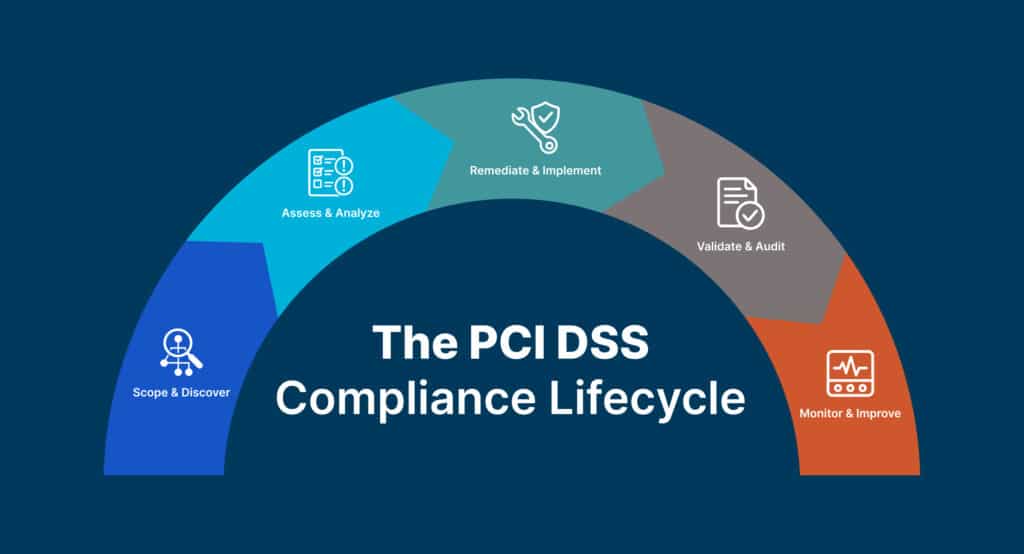
Make PCI DSS compliance a year-round strength, not a once-a-year scramble.
What is a PCI Audit, and When is it Required?
When a PCI Audit Is Required
Most organizations validate PCI compliance once a year, but not all require a full external audit. Your assessment path depends on your merchant or service-provider level, which is based on annual transaction volume and how you handle card data.
You’ll need an audit or new assessment when:
- Recertifying annually to maintain compliance with your acquiring bank or payment brand.
- Changing merchant or service-provider level, often due to growth in transaction volume or service scope.
- Responding to a data breach or security incident when a payment brand or bank requests independent verification.
- Undergoing vendor or bank reviews, where partners require updated proof of compliance.
Larger entities, or those designated as Level 1 merchants or service providers, must complete a QSA-led audit each year.
Smaller entities may qualify to complete a SAQ instead of a full audit. Your acquiring bank or payment brand confirms which option applies to you.
QSA-Led Audits vs. Self-Assessments
A QSAC, such as TrustNet, is a professional certified by the PCI Security Standards Council to evaluate and validate PCI DSS compliance.
A QSA conducts an in-depth audit and produces a RoC that documents how your organization meets every requirement.
The SAQ is a self-reporting tool for smaller or lower-risk environments. It follows the same controls but relies on internal validation rather than an external auditor.
|
Audit Type
|
Who Performs It
|
Key Deliverables
|
Typical Use
|
|---|---|---|---|
|
QSA-Led Audit (RoC)
|
External PCI-certified QSA
|
Report on Compliance (RoC), Attestation of Compliance (AoC)
|
Required for large merchants, service providers, or complex environments
|
|
Self-Assessment (SAQ)
|
Internal PCI lead or compliance team
|
Self-Assessment Questionnaire (SAQ), Attestation of Compliance (AoC)
|
Used by smaller merchants or service providers approved for self-assessment
|
Why Continuous Compliance Makes Audits/Assessments Easier
Audits run smoothly when compliance never stops. When your team tracks logs, scans systems, and reviews access controls year-round, you’re always ready for assessment.
Keeping evidence current reduces “audit fatigue” and shortens preparation time. It also proves that PCI DSS isn’t just a paper exercise — it’s part of your organization’s daily security operations.
Typical Costs and Influencing Factors
Direct and Indirect Costs
Direct costs usually include:
- QSA or audit fees. Full assessments that produce a Report on Compliance (RoC) can range from modest figures for smaller environments to six-figure projects for large, complex ones.
- Remediation labor. Engineering time to patch systems, reconfigure networks, deploy encryption, and adjust access controls.
- Technology investments. Security tools, encryption software, monitoring platforms, and logging infrastructure needed to meet requirements.
- Training and policy work. Updating procedures, awareness sessions, and staff certification.
- Third-party tools and services. Approved scanning vendors (ASVs), penetration testers, or managed compliance partners.
Indirect costs are often overlooked:
- Time spent by internal teams gathering evidence and supporting audits.
- Delayed projects or product work while resources focus on remediation.
- Unexpected expenses from scope changes or legacy systems discovered late.
- Potential penalties and revenue loss if compliance gaps lead to a data breach.
Operational Factors That Affect Cost
Several operational realities determine whether your compliance effort stays lean or becomes expensive:
- Environment size. More systems in scope mean more evidence and validation.
- Technical complexity. Cloud, hybrid, or legacy architectures add audit time and remediation work.
- Gap size. The further you are from compliance when starting, the higher the remediation cost.
- Team expertise. Experienced internal security staff can reduce consultant hours and rework.
- Scope accuracy. Over-scoping adds unnecessary effort; under-scoping risks non-compliance.
- Vendor dependencies. Each external service may require additional control verification.
- Change frequency. Frequent updates or new integrations require repeat testing and documentation.
- Regional labor rates. QSA and consulting fees vary by market.
- Evolving standards. PCI DSS v4.0 and later introduce stronger testing and continuous monitoring, which may raise baseline costs.
Typical Cost/Timeline Ranges
|
Business Type / Audit Path
|
Typical Cost Range
|
Estimated Timeline
|
Notes
|
|---|---|---|---|
|
Small Business (SAQ Path)
|
Around $5,000–$10,000
|
6–10 weeks
|
Simple environments with limited systems and light remediation.
|
|
Mid-Sized Organization (Partial RoC)
|
Tens of thousands of dollars
|
3–6 months
|
Broader scope, hybrid environments, or multiple teams involved.
|
|
Large Enterprise (Full RoC)
|
$50,000–$200,000+
|
6 months or longer
|
Complex infrastructure, vendor dependencies, and global operations.
|
Ongoing annual costs, such as scanning, training, and evidence maintenance, should also be budgeted.
Cost-Management Strategies
You can keep PCI DSS compliance affordable without cutting corners by focusing on efficiency. Smart planning and the right partners make all the difference.
- Phase remediation. Tackle high-risk fixes first and spread the rest across project sprints.
- Limit scope early. Use segmentation or tokenization to keep non-critical systems out of PCI coverage.
- Automate tasks. Evidence collection, monitoring, and reporting tools reduce manual work and improve accuracy.
- Leverage managed services. Outsource monitoring or audit coordination to a trusted compliance partner like TrustNet.
- Train internal teams. Skilled staff cut consulting time and speed remediation.
How TrustNet Simplifies PCI DSS Compliance
When the world’s most recognized brands need PCI DSS compliance, they turn to TrustNet. With our Accelerator+ AAA Approach, we combine expert strategy, automation, and audit assurance to help you achieve and maintain compliance faster and more cost-effectively.
Our Accelerator+ model blends:
- Advisory – Expert strategy and clear roadmaps that align PCI DSS requirements with your business goals.
- Automation – Intelligent workflows and real-time monitoring that replace manual spreadsheets and endless emails.
- Audit – Rigorous, insight-driven assessments that deliver complete assurance and confidence to your team and customers.
This unified approach helps you cut audit preparation time, minimize cost overruns, and strengthen security controls without overextending your team.
GhostWatch Managed Compliance
For organizations that want to stay audit-ready year-round, TrustNet’s GhostWatch Managed Compliance handles the heavy lifting.
GhostWatch provides:
- Expert Guidance at Every Step – Our dedicated compliance experts act as an extension of your team.
- Real-Time Compliance Monitoring – Continuous oversight with automated alerts and up-to-date dashboards.
- Cost-Effective Oversight – Achieve continuous compliance without building a large internal team.
- Faster Audit Readiness – Gap assessments, control mapping, and audit facilitation done for you.
Key Takeaways & Next Steps
PCI DSS compliance is an ongoing operational discipline.
Every requirement, control, and audit checkpoint exists to strengthen how your organization protects cardholder data and manages risk. The real challenge lies in turning those technical requirements into consistent, sustainable processes.
That’s where TrustNet adds real value.
Partnering with TrustNet
As a PCI Qualified Security Assessor Company (QSAC), TrustNet brings a hands-on, operational approach to compliance. We’ve helped organizations in every industry translate PCI DSS v4.0.1 into clear actions that fit real-world environments, from startups scaling fast to global enterprises managing complex networks and vendors.
Here’s how we help:
- Readiness Assessments that pinpoint your exact compliance posture and outline a direct path to full alignment with PCI DSS v4.0.1.
- PCI DSS RoC, AoC, and SAQ Validation that ensures your documentation is complete, accurate, and ready for assessor review.
- Remediation and Advisory Support that prioritizes what matters most, reducing effort and internal disruption.
- Year-Round Compliance Programs that keep your security and audit posture aligned as systems, vendors, and standards evolve.
Each engagement is led by experienced PCI experts who ensure that compliance strengthens your overall operations.
Your Next Step
If you handle payment card data, now’s the time to evaluate your readiness and close any remaining compliance gaps. TrustNet’s PCI experts can help you map requirements to real controls, streamline preparation, and simplify every step of your next audit.
Schedule a consultation with a TrustNet PCI DSS expert today to schedule a readiness consultation and start building lasting, audit-ready compliance with confidence.