



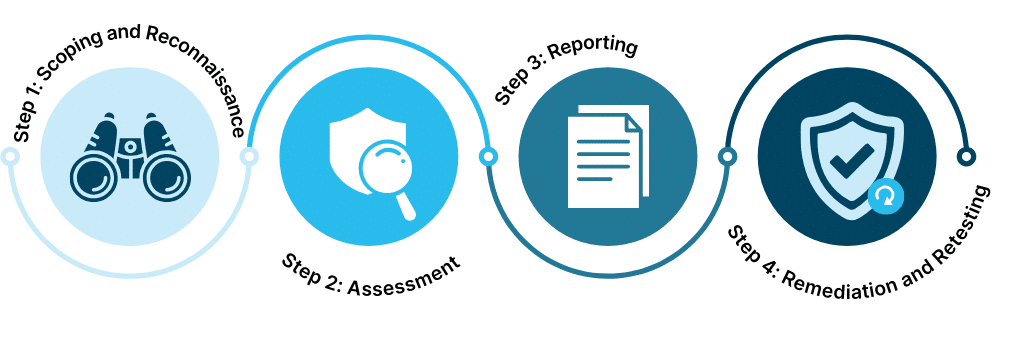
Step 1: Scoping and Reconnaissance
Define the Scope
Scoping sets clear boundaries so nothing critical is missed. It also ensures testing remains safe and compliant with industry regulations. In-scope targets often include:
- Web and mobile applications that handle protected health information (PHI), financial data, or customer credentials
- Internal and external networks tied to sensitive workflows, such as payment processing or patient portals
- Cloud platforms and SaaS environments that support regulated data storage or transactions
- APIs and third-party integrations that expand the attack surface
The scope also establishes rules of engagement, legal permissions, and compliance requirements so the test doesn’t create unnecessary risk.
Establish Clear Objectives
Every penetration test must start with business-aligned goals. CISOs and compliance officers typically define objectives such as:
- Proving readiness for SOC 2, ISO 27001, HIPAA, or PCI DSS assessments/audits
- Validating that security controls protect sensitive data from exposure or misuse
- Identifying and prioritizing risks that could disrupt operations or regulatory compliance
- Demonstrating due diligence to regulators, auditors, and business partners
Reconnaissance Activities
With scope and objectives locked, testers begin reconnaissance. This step builds a detailed map of the attack surface and highlights weak points that could threaten compliance. Typical activities include:
- Gathering open-source intelligence (OSINT) on domains, employees, and technologies
- Identifying exposed assets such as forgotten subdomains, shadow IT, or misconfigured cloud storage
- Mapping networks, ports, and services to reveal potential entry points
- Cataloging infrastructure details to support targeted assessments
Passive methods like OSINT often come first to minimize risk. Active methods, including controlled scans, may follow if approved in the rules of engagement.
The Business Impact of Effective Scoping
Step 2: The Assessment Phase
How Testing Happens
Effective penetration testing blends automation with manual expertise.
- Automated scans quickly detect common and known vulnerabilities across large environments.
- Manual testing validates results, eliminates false positives, and uncovers issues automation can’t detect, such as chained exploits or business logic flaws.
TrustNet aligns the balance of automated and manual testing with the organization’s risk profile and compliance needs. Using the iTrust platform, teams gain real-time visibility into internal and external attack surfaces, while expert-led testers validate findings and prioritize them based on actual risk and compliance impact.
Techniques Used
During this phase, testers focus on both technical weaknesses and real-world attack paths. Activities may include:
- Running vulnerability scans across networks, applications, and cloud platforms
- Manually confirming and safely exploiting vulnerabilities to show actual impact
- Reviewing firewall, identity, and cloud configurations for missteps that expose sensitive data
- Testing authentication, authorization, and session handling in applications and APIs
- Probing business logic to identify flaws attackers could exploit, such as bypassing approval or payment steps
Areas Commonly Tested
The assessment typically covers:
- Networks: internal, external, and segmentation controls
- Web applications: input validation, authentication, session management
- Cloud environments: identity and access management (IAM), storage, and workload security
- APIs: data exposure, broken authentication, improper authorization
- Human factors: phishing or social engineering, but only if explicitly approved in the scope
Exposing Real-World Risks That Compliance Demands
This phase translates plans into actionable findings. Automated tools provide breadth, while manual techniques provide depth. For CISOs and compliance officers, the assessment phase delivers evidence that controls are tested, vulnerabilities are validated, and compliance requirements are actively addressed.
However, those findings only have value if they’re communicated clearly. That’s where the reporting phase comes in.
Step 3: The Reporting Phase
Data only matters if people can act on it. The reporting step translates raw findings into executive insights, compliance evidence, and prioritized guidance so leaders, auditors, and IT teams know exactly what to do next.
What the Report Includes
An effective penetration testing report is structured so every stakeholder receives information in the right format:
- Executive summary: A concise overview of organizational risk, regulatory impact, and overall security posture in plain business language. CISOs can brief boards confidently and demonstrate due diligence to regulators.
- Technical details: Step-by-step exploit paths, proof-of-concept evidence, and configuration issues documented so IT and security teams can reproduce, verify, and remediate.
- Prioritized findings: Vulnerabilities ranked by severity and mapped to business impact, using a consistent rating system such as CVSS. This helps organizations decide which risks to address first.
- Remediation guidance: Specific and actionable recommendations tailored to the environment, enabling faster fixes and reduced downtime.
- Limitations and scope notes: A record of what was tested, what was excluded, and any constraints. This transparency prevents confusion during audits and compliance reviews.
Compliance Alignment
For regulated sectors, the report also serves as compliance evidence. Findings and remediation steps are mapped to:
- HIPAA safeguards for protecting PHI in healthcare
- PCI DSS requirements for cardholder data environments in finance and payment systems
- SOC 2 Trust Services Criteria for SaaS providers demonstrating security and availability controls
- ISO 27001 Annex A controls for broader information security management
This mapping saves time during audits, provides auditors with direct traceability to control requirements, and reduces the burden on compliance officers.
Turning Technical Findings into Executive Clarity
Healthcare providers can show HIPAA readiness, financial institutions can prove PCI DSS compliance, and SaaS companies can demonstrate SOC 2 and ISO 27001 maturity. Effective reporting ensures executives gain confidence, compliance officers gain audit efficiency, and IT teams gain actionable guidance that keeps operations secure.
But reports alone don’t close gaps. The next step is turning those insights into action through remediation and retesting.
Step 4: Remediation and Retesting
Remediation in Practice
Security and IT teams use the report’s guidance to close gaps and strengthen defenses. In regulated industries, remediation often includes:
- Healthcare: Patching electronic health record (EHR) systems, tightening database access, and correcting misconfigured cloud storage that may expose PHI.
- Finance: Updating payment applications, hardening encryption protocols, and correcting firewall rules that protect cardholder data environments.
- SaaS: Fixing identity and access management misconfigurations, securing APIs that exchange customer data, and reinforcing authentication flows.
Across sectors, effective remediation also means:
- Applying verified patches to systems and applications
- Correcting misconfigurations in firewalls, identity systems, and cloud services
- Updating access controls to enforce least-privilege principles
- Enhancing monitoring and detection where gaps were uncovered
- Assigning ownership, resources, and timelines so fixes happen quickly
Prioritization is key. Critical issues tied to compliance obligations should be resolved first to minimize risk and avoid audit setbacks.
Retesting for Validation
Fixing a vulnerability is only half the job. Retesting confirms that remediation efforts work and that no new issues were introduced. The best practice is to retest high-severity findings quickly, since delays reduce assurance. Retesting can take two forms:
- Targeted retests: Focus only on the issues originally found, providing fast confirmation for auditors and regulators.
- Full retests: Reassess the entire environment to uncover regressions or new risks introduced since the initial test.
Both approaches are valuable depending on compliance requirements, risk appetite, and available resources.
Continuous Improvement and Compliance Evidence
Environments evolve, and configuration drift or new deployments can reintroduce vulnerabilities. Regular retesting ensures these changes are caught early.
For compliance officers, validated retesting provides audit-ready evidence that issues were resolved and can be shared directly with auditors under SOC 2, ISO 27001, HIPAA, or PCI DSS reviews. This reduces preparation time and eliminates back-and-forth during assessments/audits.
Proving Progress and Closing the Loop on Risk
Without remediation and retesting, penetration testing results remain theoretical. By closing the loop, organizations strengthen their defenses, reduce regulatory risk, and prove to stakeholders that vulnerabilities are not only discovered but also resolved.
Together, these four steps form a repeatable process that transforms penetration testing into a driver of risk reduction and compliance readiness.
Key Takeaways & Next Steps
TrustNet delivers customized penetration testing services backed by iTrust, our cutting-edge platform for cyber risk visibility and continuous security validation. Don’t leave vulnerabilities unchecked; secure your environment and prove compliance.
Schedule a consultation or get an iTrust demo today.