



Scoping for SOC 2 in complex IT environments isn’t just important; it’s essential.
When you’re working across AWS, Azure, on-prem systems, and legacy databases, you’re already navigating a sophisticated landscape. Add in SaaS platforms, unmanaged APIs, and globally distributed teams, and defining your SOC 2 scope becomes a strategic challenge that requires careful attention.
Get it wrong, and here’s what you’re dealing with:
Most scoping frameworks weren’t built for this reality. They break when infrastructure evolves weekly, or when shared responsibilities with vendors blur the lines of control.
This guide changes that.
You’ll get a proven roadmap to:
What Defines a “Complex” IT Environment?
A complex IT environment is fragmented, fast-changing, and full of interdependencies. These aren’t edge cases anymore; they’re the norm for companies scaling across platforms, geographies, and architectures. Scoping for SOC 2 in these environments demands precision, because the moving parts never stop.
Here’s what complexity looks like in practice:
Multi-Cloud and Hybrid Deployments
Your infrastructure isn’t limited to just AWS anymore.You might be using Azure for analytics, GCP for machine learning, and still running critical workloads on-prem. Each of these platforms has its own security model, logging format, and identity system.
That diversity makes it harder to maintain consistent visibility and control; two things that are essential when mapping your environment to SOC 2’s Trust Services Criteria (TSCs).
Legacy Meets Modern
Distributed Teams and External Vendors
Data Flowing Across Borders
Why This Matters for SOC 2
Not Sure What Your SOC 2 Scope Looks Like?
TrustNet’s AICPA-accredited auditors help teams map SOC 2 scope across hybrid, cloud, and legacy systems. Contact Us today.
Challenges in Advanced SOC 2 Scoping
1. Over-Scoping Wastes Resources
2. Under-Scoping Creates Blind Spots
3. Dynamic Environments Shift Mid-Audit
4. Third-Party Dependencies Obscure Accountability
5. Legacy Systems Resist Control Mapping
Older technology often lacks access logs, encryption, or integration with modern SIEM tools. Mapping these systems to the Trust Services Criteria requires compensating controls or documented limitations, both of which raise scrutiny during an audit.
To overcome these challenges, scoping must be iterative, risk-driven, and tied directly to how systems influence customer trust. Static spreadsheets and guesswork won’t cut it.
Step-by-Step Scoping Framework for Complex Environments
A sound SOC 2 scope doesn’t start with systems; it starts with risk. In hybrid, cloud-native, or legacy-integrated environments, you need a repeatable, defensible approach that reflects both your architectural realities and business priorities.
Here’s how to build it:
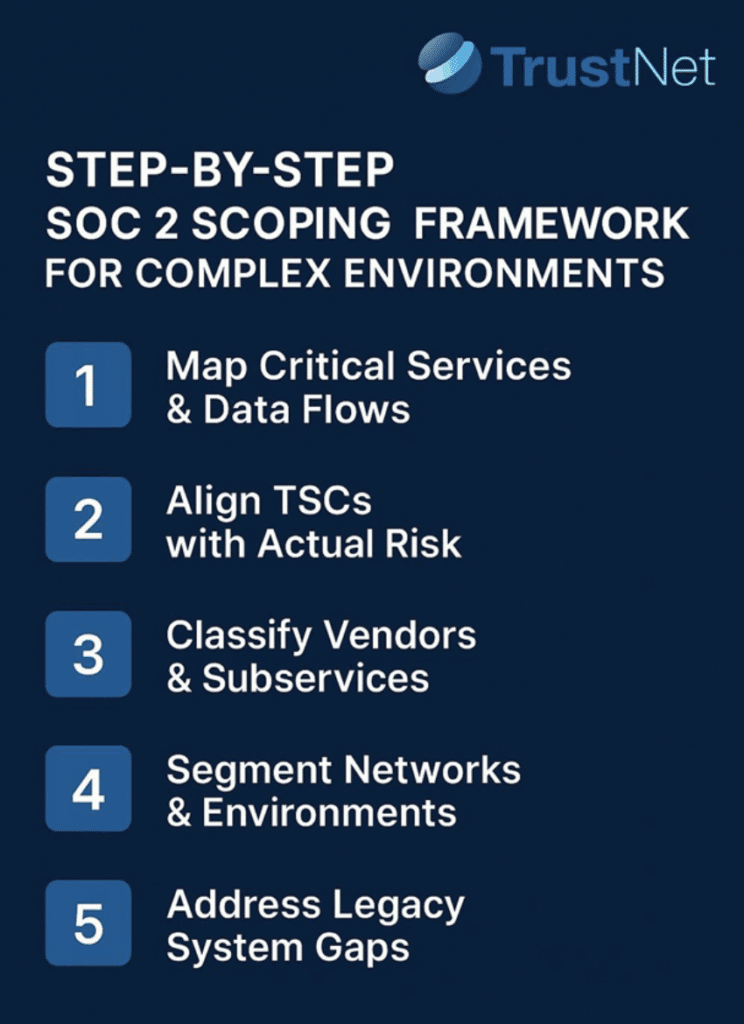
1. Map Critical Services & Data Flows
2. Align TSCs with Actual Risk
3. Classify Vendors & Subservices
4. Segment Networks & Environments
Automation & Tooling for Dynamic Scoping
To keep your SOC 2 scope accurate, you need tools that adapt in real time, surface blind spots, and reduce manual effort. That’s where GhostWatch by TrustNet comes in.
GhostWatch: Centralized Compliance Automation
Built for hybrid, cloud-native, and legacy environments, GhostWatch provides:
Avoiding Common Pitfalls
Scoping Too Much:
Don’t include systems like HR platforms, sandbox environments, or internal dev tools unless they store, process, or transmit customer data. They increase audit work with zero compliance impact.
Scoping Too Little:
Missed APIs, CI/CD pipelines, or SaaS tools create gaps that auditors flag fast. If they touch regulated data or critical workflows, they belong in scope.
Assuming the Cloud Handles It:
AWS, Azure, and GCP operate on shared responsibility. You still own data encryption, logging, monitoring, and access controls for your workloads.
Freezing Scope Mid-Change:
Product launches, cloud migrations, or vendor onboarding can instantly shift scope. If you don’t reassess, your scope drifts from reality and auditors will flag it.
Freezing Scope Mid-Change:
Product launches, cloud migrations, or vendor onboarding can instantly shift scope. If you don’t reassess, your scope drifts from reality and auditors will flag it.
What to Do Next: Turn SOC 2 Scoping into a Repeatable, Cloud-Ready Discipline
- Map systems that impact customer trust.
- Reassess your scope every time your architecture shifts.
- Eliminate noise.
- Close blind spots fast.
- Use a risk-based approach to focus your effort where it counts.
- Let automation handle the rest.
Book your SOC 2 scoping consultation with our AICPA-accredited auditors or request a GhostWatch demo. Connect with us today.