


Organizations that begin preparing for SOC 2 often ask the same question early in the process.
How long does a SOC 2 audit actually take?
The answer depends on several operational factors. Control maturity, system boundaries/ scoping, availability and completeness of evidence, readiness of documentation, and whether the report is Type 1 or Type 2, all influence the timeline. The audit itself represents only one phase of the SOC 2 process.
Most organizations must complete preparation work before the audit begins. Teams must implement controls, document policies, and establish reliable evidence sources. If the organization pursues a SOC 2 Type 2 report, it must also operate those controls during a defined observation period before auditors begin formal testing.
Thanks to these requirements, SOC 2 timelines vary widely across organizations. A Type 1 report may be completed within a few months once preparation finishes, while a Type 2 report often requires several additional months due to the observation period required to verify operating effectiveness.
Understanding these phases helps security and compliance leaders plan realistic timelines and allocate resources effectively. This article explains the stages that shape a SOC 2 timeline and the operational factors that influence audit duration.
SOC 2 Audit Timeline Snapshot
Most organizations complete a SOC 2 audit process in six to twelve months, although timelines vary based on preparation, scope, and whether the organization pursues a Type 1 or Type 2 report.
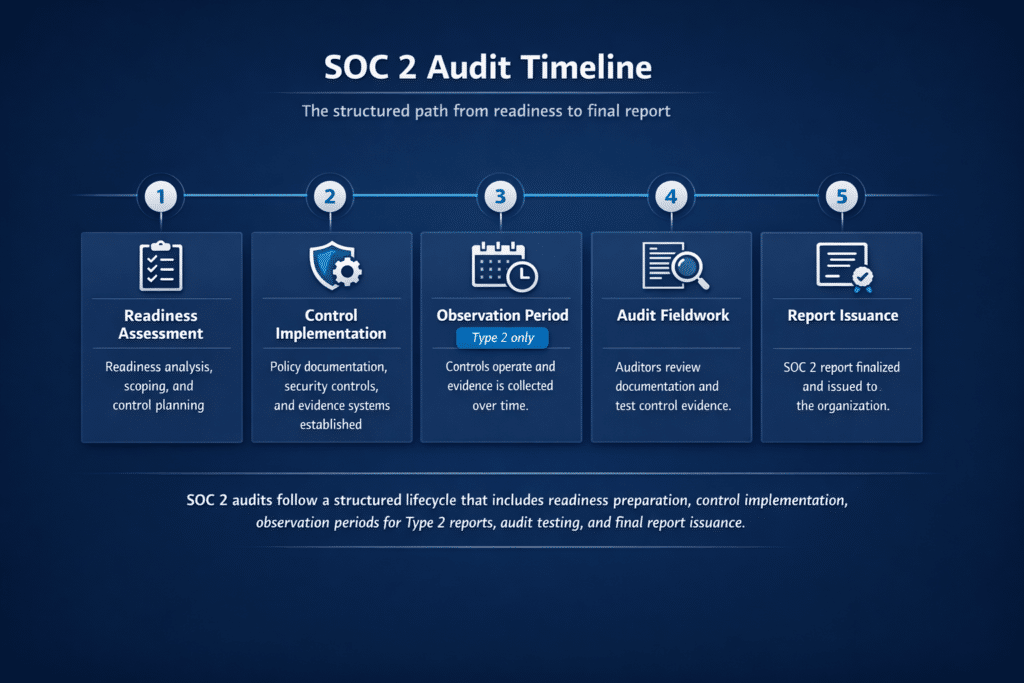
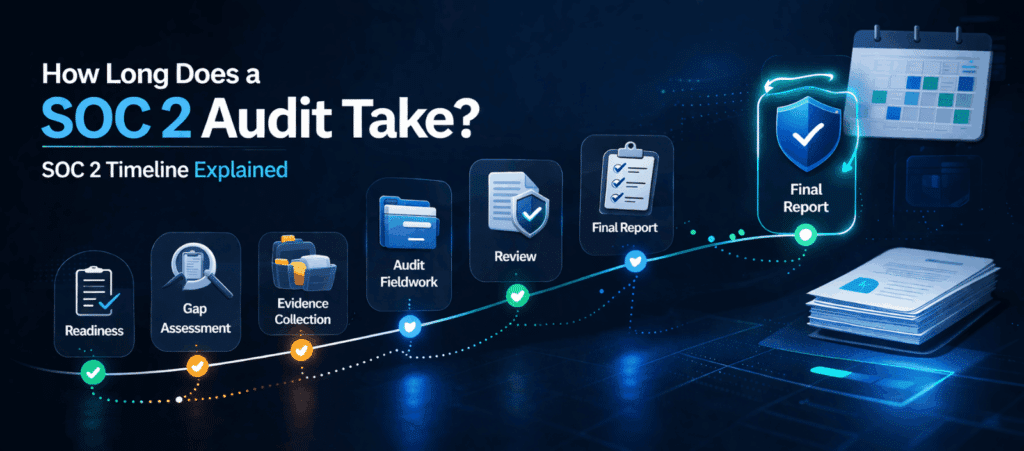
SOC 2 compliance follows a structured process that extends beyond the audit itself. Organizations typically progress through several stages before receiving their final SOC 2 report.
Typical phases include:
- readiness assessment and scoping
- control implementation and policy development
- SOC 2 Type 1 audit or observation period for Type 2
- audit testing and fieldwork
- report preparation and issuance
The exact duration depends on organizational readiness, audit scope, and the type of SOC 2 report pursued.
A Type 1 report evaluates control design at a specific point in time and can often complete within a few months once controls are ready. A Type 2 report requires auditors to evaluate control performance over an extended observation window, which commonly ranges from three months to twelve months.
Preparation often represents the most variable phase. Organizations with established security programs and centralized evidence collection can move through readiness activities more quickly than teams building controls for the first time.
Understanding the SOC 2 Audit Timeline
What SOC 2 audits evaluate
SOC 2 reports evaluate how an organization manages customer data through defined security and operational controls. The framework uses the Trust Services Criteria, which establish control expectations across several domains.
These criteria include:
- Security (mandatory)
- Availability
- Processing Integrity
- Confidentiality
- Privacy
Security remains mandatory for all SOC 2 reports. Organizations may include additional criteria depending on the services they provide and the expectations of customers or regulators.
Each selected criterion expands the number of controls auditors must review. This expansion increases both preparation work and the amount of evidence required during the audit.
Why SOC 2 timelines vary between organizations
SOC 2 timelines differ because organizations begin the process at different levels of operational maturity.
Several factors influence the duration of an audit engagement.
Control maturity plays a major role. Organizations with established security programs often maintain documented policies, centralized logging, and structured change management processes. These organizations can begin audits more quickly because many required controls already operate in practice.
Infrastructure complexity also affects timelines. Multi-cloud environments, distributed engineering teams, and extensive vendor ecosystems increase the scope of systems auditors must review.
Evidence management practices further influence audit efficiency. When logs, tickets, and monitoring data remain centralized and organized, auditors can review evidence more quickly. Fragmented documentation often slows the audit process because teams must reconstruct evidence during fieldwork.
These operational realities explain why SOC 2 timelines differ significantly between organizations even when they pursue the same report type.
Major phases of SOC 2 compliance
Despite these variations, most SOC 2 engagements follow a similar lifecycle.
Organizations typically move through several phases before receiving a final SOC 2 report.
These phases include:
- readiness preparation and gap assessment
- control implementation and documentation
- audit fieldwork for a Type 1 report or observation period for Type 2
- evidence testing and validation
- report drafting and issuance
Audit fieldwork itself may take only a few weeks in many cases. However, the preparation and operational evidence requirements surrounding that fieldwork often extend the total timeline to several months or longer.
SOC 2 Type 1 and Type 2 Timeline Differences
What a SOC 2 Type 1 audit evaluates
A SOC 2 Type 1 report evaluates the design of an organization’s control environment at a specific point in time.
Auditors review documentation, system descriptions, and policy artifacts to determine whether the organization has implemented controls that address the Trust Services Criteria. The examination focuses on whether controls exist and whether they align with SOC 2 requirements.
Because Type 1 audits evaluate control design rather than operational performance over time, organizations can often complete them more quickly once their control framework is ready.
What a SOC 2 Type 2 audit evaluates
A SOC 2 Type 2 report evaluates both control design and operating effectiveness.
Auditors must verify that controls function consistently throughout a defined observation period. During this time, the organization operates its security and compliance processes while collecting evidence that demonstrates control execution.
Auditors later review this evidence to confirm that controls function as intended across the entire review period.
This process often includes reviewing samples of:
- access review records
- system monitoring logs
- change management documentation
- vulnerability management reports
- incident response records
The sampling process allows auditors to verify that controls operate reliably rather than only appearing compliant at a single point in time.
Why Type 2 audits require longer timelines
Type 2 reports require additional time because organizations must demonstrate sustained control performance.
Observation periods typically range from three months to twelve months, depending on organizational maturity and customer expectations.
During this period, organizations must execute controls consistently and maintain evidence that demonstrates operational compliance. Only after the observation window ends can auditors perform detailed testing and issue the SOC 2 Type 2 report.
This requirement explains why Type 2 audits typically take significantly longer than Type 1 engagements.
Preparation Before the SOC 2 Audit Begins
Preparation often determines the overall SOC 2 timeline. Organizations that begin the audit without a mature control environment often experience delays during evidence review and remediation.
Most organizations perform a readiness assessment before starting the audit. This assessment evaluates existing operational practices against the Trust Services Criteria and identifies gaps that require remediation.
Security and compliance teams typically focus on several areas during readiness preparation.
Readiness assessments
A readiness assessment evaluates whether the organization’s current policies, procedures, and technical controls align with SOC 2 requirements.
Teams often review the following elements:
- documented security policies
- access management processes
- change management procedures
- incident response practices
- monitoring and logging controls
This assessment helps teams identify control gaps before the audit begins. Early remediation reduces the risk of audit delays and helps organizations establish consistent operational practices.
Scoping the system environment
Organizations must also define the scope of the SOC 2 audit.
Scope determines which systems, infrastructure components, and vendors fall within the audit boundary. Security teams typically document:
- production systems and supporting infrastructure
- cloud service providers
- internal applications
- third-party service providers
- data flows that involve customer information
Clear scope documentation allows auditors to understand the operational environment and determine which controls require evaluation.
Establishing the control framework
After defining the scope, organizations must implement controls that address the Trust Services Criteria.
Common operational controls include:
- access provisioning and deprovisioning procedures
- periodic access reviews
- change management approvals for production systems
- vulnerability management processes
- incident response workflows
- monitoring and alerting processes
These controls must operate consistently before the audit begins. Teams must also document how each control functions and who owns the process.
Control Implementation and Evidence Collection
Once organizations establish the control framework, they must operate these controls consistently and collect supporting evidence.
Auditors rely on operational evidence to verify that controls function as designed. Security and compliance teams must therefore maintain reliable records of control execution.
Implementing operational security controls
Operational security controls often involve recurring activities performed by engineering or security teams.
Examples include:
- approving and documenting production changes
- reviewing user access privileges
- scanning infrastructure for vulnerabilities
- monitoring security alerts
- responding to incidents
Teams must execute these activities according to defined procedures. Inconsistent execution creates gaps that auditors may identify during testing.
Establishing evidence sources
Organizations must also determine how they will collect and retain evidence for each control.
Common evidence sources include:
- identity and access management logs
- change management tickets from issue tracking systems
- monitoring alerts and system logs
- vulnerability scanning reports
- incident response documentation
Centralized evidence collection simplifies the audit process. When logs and records remain distributed across multiple systems, teams often spend additional time gathering documentation during the audit.
Why evidence maturity affects timelines
Evidence maturity often determines how smoothly the audit progresses.
Organizations with automated logging, structured ticketing workflows, and centralized documentation can provide evidence quickly during audit fieldwork. Teams that rely on manual documentation or fragmented systems often need additional time to assemble required artifacts.
Because of this difference, evidence management practices can significantly influence SOC 2 audit timelines.
Looking for more SOC 2 resources? Learn more in our Knowledge Hub.
The SOC 2 Observation Period
Organizations pursuing a SOC 2 Type 2 report must operate their controls during a defined observation period before auditors perform testing.
This period allows auditors to verify that controls operate consistently rather than only appearing compliant at a single moment.
Purpose of the observation window
The observation period provides operational evidence that demonstrates control performance over time.
During this window, organizations must continue executing security and compliance processes such as access reviews, monitoring activities, and change management approvals. Each activity produces records that auditors later review.
The goal of this period is to confirm that the organization maintains consistent operational discipline across its control environment.
Typical observation period lengths
Observation periods typically range from three months to twelve months.
Organizations choose the observation window based on several factors, including operational maturity and customer expectations. Some companies begin with a shorter observation period to obtain an initial SOC 2 Type 2 report. Others select longer windows to demonstrate sustained operational consistency.
Regardless of the duration, the organization must collect evidence throughout the entire period.
Evidence auditors review during the observation period
Auditors review a variety of records during the observation period.
Examples include:
- user access review documentation
- system monitoring logs
- change management records
- vulnerability management reports
- incident response documentation
Auditors often select samples from these records to verify that controls operated consistently during the observation window.
Audit Testing and SOC 2 Report Issuance
After the observation period ends, auditors begin formal testing to determine whether the control environment operated effectively during the review period.
This core audit stage involves reviewing evidence to verify that each control was performed as documented.
Auditor testing procedures
Audit testing typically includes several steps.
Auditors review evidence samples to confirm that control activities occurred according to documented procedures. They also verify that the organization maintained sufficient records to support each control.
Testing often focuses on recurring controls such as access reviews, change approvals, and monitoring activities. Auditors evaluate whether these activities occurred according to the required schedule.
When auditors identify exceptions, they analyze the issue to determine whether it represents a control failure or an isolated deviation.
Preparing the SOC 2 report
After completing testing, auditors prepare the SOC 2 report.
The report describes the organization’s system environment, the controls implemented to meet the Trust Services Criteria, and the auditor’s evaluation of those controls.
If the auditors conclude that the controls were suitably designed and — for a Type II examination — operated effectively throughout the review period, they issue an unmodified opinion indicating that the controls met the applicable Trust Services Criteria.
Organizations can then share the report with customers and partners that require assurance regarding their security practices.
Factors That Influence SOC 2 Audit Duration
SOC 2 timelines vary because organizations operate different technology environments and security programs. Several operational factors influence how quickly teams can complete preparation activities and move through the audit process.
Control maturity
Organizations with established security programs often complete SOC 2 audits more efficiently. Mature programs already include documented policies, structured access management processes, and defined change management workflows.
Teams that already operate these controls only need to formalize documentation and evidence collection. Organizations that lack structured processes must design and implement controls before the audit begins.
Scope complexity
Infrastructure complexity also affects SOC 2 timelines.
Organizations that operate multiple cloud environments, large engineering teams, or numerous third-party vendors must evaluate a broader set of systems and controls. This expanded scope increases preparation work and the amount of evidence auditors must review.
Clear scope definition early in the project helps teams manage this complexity.
Trust Services Criteria selection
All SOC 2 reports include the Security criterion. Organizations may also include Availability, Confidentiality, Processing Integrity, or Privacy, depending on their services and customer requirements.
Each additional criterion introduces new control requirements and additional evidence collection activities. Expanded criteria, therefore, increase both preparation time and audit effort.
Evidence management practices
Evidence collection processes strongly influence audit efficiency.
Organizations that maintain centralized logging, structured ticketing workflows, and automated monitoring systems can provide audit evidence quickly. Teams that rely on manual documentation or scattered records often spend additional time assembling artifacts during the audit.
Consistent evidence management reduces delays during audit testing.
Typical SOC 2 Timelines for Different Organizations
SOC 2 timelines vary depending on the maturity of the organization’s security program and operational processes.
Early-stage SaaS organizations
Early-stage companies often build foundational security processes during SOC 2 preparation.
Teams may need to implement formal access management procedures, incident response processes, and monitoring controls for the first time. These organizations often spend several months preparing their control environment before the audit begins.
Growth-stage SaaS organizations
Growth-stage companies often already have many required controls in place, especially when engineering teams maintain structured development and infrastructure management processes.
These organizations typically focus on formalizing policies, documenting control procedures, and organizing audit evidence.
Preparation timelines for these organizations often shorten because many operational processes already exist.
Mature technology platforms
Organizations with mature security programs often maintain extensive monitoring infrastructure, automated identity management, and structured operational processes.
These organizations can often move quickly into SOC 2 audit phases because they already collect operational evidence through existing systems.
In some cases, organizations with mature controls proceed directly to a Type 2 audit if they can demonstrate consistent operational performance.
Common Causes of SOC 2 Audit Delays
Several operational issues commonly slow SOC 2 audits.
Incomplete documentation
Organizations sometimes maintain strong operational security practices but lack formal documentation for those controls. Auditors require written policies and control descriptions to evaluate the control environment.
Teams must document procedures clearly before auditors begin testing.
Inconsistent control execution
Recurring controls, such as access reviews or vulnerability scans, must occur according to defined schedules. If teams perform these activities inconsistently, auditors may identify gaps in the evidence.
Organizations must demonstrate that controls operate reliably throughout the review period.
Missing evidence
Security teams often perform required activities but fail to retain the records that demonstrate those activities occurred.
Missing logs, incomplete tickets, or undocumented reviews can create evidence gaps during audit testing.
Unclear control ownership
Each control requires a defined owner who performs or reviews the activity.
When ownership remains unclear, teams may skip recurring tasks or fail to document results. Defined ownership ensures consistent execution.
Coordination gaps between teams
SOC 2 controls often involve multiple teams, including engineering, security, and operations.
Without coordination, teams may interpret procedures differently or follow inconsistent processes. Clear communication and defined responsibilities help maintain consistent control execution.
TrustNet’s Accelerator+: An End-to-End Approach to SOC 2 Compliance
TrustNet’s Accelerator+ provides an integrated approach that helps organizations build sustainable compliance programs and complete audits efficiently.
Accelerator+ combines advisory expertise, automation capabilities, and independent assurance services into a single compliance strategy.


Advisory
TrustNet’s Advisory services evaluate existing operational standards against relevant compliance benchmarks.
Advisors review policies, procedures, and technical controls to identify security or operational gaps. This process highlights areas that require remediation and helps organizations align their environments with applicable compliance requirements.
Automation
TrustNet’s automation platform streamlines governance, risk, and compliance processes.
Organizations use the platform to manage evidence collection, maintain control documentation, and monitor compliance activities across frameworks such as SOC, PCI, and ISO 27001. Continuous evidence collection supports more efficient audits and reduces manual documentation work.
Audit
TrustNet’s experienced auditors conduct structured audits that emphasize efficient planning and thorough evaluation.
Auditors guide organizations through the assessment process, collect and review evidence, and deliver independent reports that confirm the effectiveness of implemented controls.
By integrating advisory, automation, and assurance services, Accelerator+ provides a cohesive compliance strategy that helps organizations maintain strong security practices while meeting regulatory and customer expectations.
Organizations that plan SOC 2 initiatives early often achieve more predictable audit timelines.
Frequently Asked Questions
The SOC 2 timeline depends on preparation activities, audit scope, and report type. Organizations that pursue a Type 1 report may complete the audit within a few months once they establish the control environment.
Type 2 reports require a longer timeline because auditors must review control performance during an observation period. Many organizations complete the full SOC 2 process within several months to over a year, depending on preparation and observation period length.
SOC 2 Type 2 reports require auditors to evaluate control execution during a defined observation window. Organizations commonly select observation periods that range from three months to twelve months.
During this period, organizations must operate controls consistently and collect evidence that demonstrates those activities occurred.
Organizations may proceed directly to a Type 2 audit if they already operate mature security controls and maintain sufficient operational evidence.
Many companies begin with a Type 1 report because it confirms that control design aligns with SOC 2 requirements. Organizations with mature programs sometimes choose Type 2 immediately to meet enterprise customer expectations.
Preparation timelines vary widely depending on the organization’s existing security program.
Teams often spend several weeks or months preparing their control environment. Preparation activities include performing readiness assessments, documenting policies, implementing controls, and establishing evidence collection processes.
Organizations with mature security practices often complete preparation more quickly.
The fastest SOC 2 timeline typically involves a Type 1 audit because auditors evaluate controls at a single point in time.
Organizations with mature security programs and structured evidence collection processes can often complete Type 1 audits relatively quickly after preparation. Type 2 reports require additional time due to the observation period needed to evaluate control performance.
Several operational issues frequently extend SOC 2 timelines.
Common causes include incomplete documentation, inconsistent control execution, missing evidence, unclear control ownership, and fragmented logging or monitoring systems.
Organizations that maintain structured processes and centralized evidence collection typically experience smoother audits.