


Executive Summary
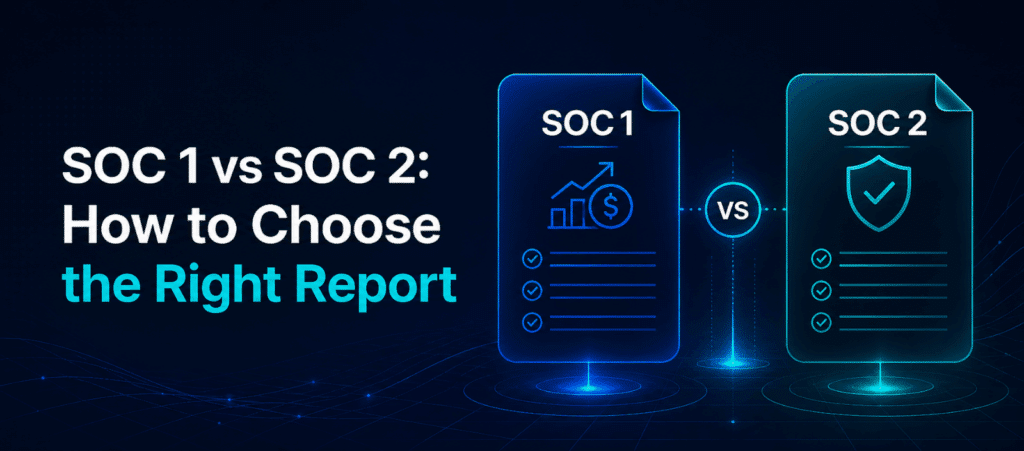
SOC 2 Type 1 and Type 2 reports answer different questions about your control environment. A Type 1 report tells customers whether your controls are suitably designed and implemented at a specific point in time. A Type 2 report assesses whether those controls are suitably designed and operated effectively over a defined period of time.
Most enterprise customers generally require Type 2. The path you choose affects your audit timeline, evidence requirements, internal workload, and total cost. Starting with the wrong report can delay the assurance your customers actually need and create gaps that complicate future audits.
Key takeaways:
- Type 1 evaluates the design of controls and whether they are implemented at a point in time
- Type 2 evaluates the design of controls and their operating effectiveness over a defined period of time
- Enterprise buyers generally require Type 2 as a baseline
- Type 1 can serve as an interim milestone for organizations that are early in their SOC 2 journey or preparing for Type 2
- The gap between Type 1 and Type 2 is primarily evidence consistency and operating effectiveness, not control scope
- Audit timelines, preparation effort, and evidence demands differ significantly between the two paths
What is SOC 2?
SOC 2 evaluates controls relevant to the AICPA Trust Services Criteria: security, availability, processing integrity, confidentiality, and privacy. Security, also known as the Common Criteria, is required for every SOC 2 report. Organizations do not need to include all five categories. Availability, processing integrity, confidentiality, and privacy are optional criteria that organizations include when customer commitments, service commitments, system scope, or data-handling practices make them relevant.
SOC 2 applies when an organization provides services that store, process, transmit, or otherwise impact customer data or systems, and when customers need assurance that the organization has effective controls related to security, availability, confidentiality, processing integrity, or privacy. SaaS companies, cloud service providers, managed service providers, and other technology vendors commonly obtain SOC 2 reports.
SOC 2 does not address internal controls over financial reporting. Its scope covers how an organization designs, implements, and operates controls to protect systems and data from unauthorized access, disruption, and misuse. Organizations whose services affect customer financial reporting may also need to evaluate whether SOC 1 applies.
Independent CPA firms issue SOC 2 reports under AICPA attestation standards. These reports are not certifications. They provide an auditor’s opinion on whether the organization’s system description is fairly presented and whether controls are suitably designed, and for Type 2 reports, whether those controls operated effectively over a specified review period.
What is a SOC 2 Type 1 Report?
A SOC 2 Type 1 report evaluates the design of controls and whether those controls have been implemented at a specific point in time. The auditor reviews your system description and documented controls, evaluates whether the controls have been implemented as described, and determines whether they are suitably designed to meet the relevant Trust Services Criteria as of a specific date.
A SOC 2 Type 1 report does not evaluate whether those controls operated effectively over a period of time. It is a point‑in‑time report: as of a specific date, the auditor assesses whether the controls were suitably designed and implemented, but not their operating effectiveness.
What Type 1 evaluates
Type 1 focuses on the design of controls and whether they have been implemented. The auditor evaluates whether each control has been implemented as described and whether its design would reasonably address the risk it is intended to mitigate under the relevant Trust Services Criteria as of a specific point in time.
Testing focuses on the system description, control descriptions, policies, procedures, configuration, and other point‑in‑time evidence, and supporting documentation that demonstrates whether controls are in place and suitably designed as of the report date. Type 1 does not require evidence that controls operated effectively over a sustained review period.
When Type 1 makes sense
Type 1 can serve as an interim milestone for organizations that are early in their SOC 2 journey or preparing for Type 2. It is useful when an organization needs to demonstrate initial SOC 2 control readiness, has not yet built sufficient operating evidence across a full audit period, or faces a customer requirement that cannot accommodate a Type 2 timeline.
Organizations that complete a Type 1 report also gain a clearer view of control design and implementation gaps before beginning a Type 2 observation period. This can be especially valuable when remediation priorities are not fully defined, and the team needs a structured way to validate scope, control design, and implementation before testing operating effectiveness over time.
Common Type 1 scenarios
- Early‑stage SaaS companies facing their first enterprise customer or procurement requirement
- Organizations entering a regulated or risk‑sensitive market that requires documented security or compliance assurance
- Companies using Type 1 as an interim milestone before beginning a Type 2 observation period
- Vendors responding to a specific customer request that needs third-party validation on a compressed timeline
What is a SOC 2 Type 2 Report?
A SOC 2 Type 2 report evaluates both the design and operating effectiveness of controls relevant to the applicable Trust Services Criteria over a defined period. The auditor tests whether controls were suitably designed and whether they operated effectively and consistently throughout the review period, which is typically six to twelve months.
Type 2 reports require evidence of sustained operation. Controls in scope must demonstrate that they were operating throughout the entire audit period, rather than only at a single point in time.
What Type 2 evaluates
Type 2 auditors test the operating effectiveness of controls over a defined period of time. They sample control activity throughout the review period and evaluate whether controls were performed as designed, consistently, and produced reliable results. They look for evidence such as timestamps, ownership records, approvals, review notes, exception handling, and follow‑up documentation that demonstrates each control operated as intended over the audit period.
A control that operates correctly in some instances but fails in others may result in an exception or a qualified finding, depending on the nature of the control, the severity and frequency of the deviation, remediation activity, and whether effective compensating controls exist. Auditors do not simply average performance; they evaluate whether controls achieved their stated control objective throughout the review period.
Why Type 2 requires an audit period
Controls that are suitably designed can still fail during operation. Ownership gaps, manual processes, inconsistent workflows, and incomplete evidence collection can produce controls that work during initial implementation but drift over time. Type 2 exists to validate sustained operating effectiveness of controls, not just initial design and implementation.
The observation period typically runs six to twelve months, depending on customer expectations, auditor approach, scope, and the assurance objectives the report needs to support. Most organizations also require a readiness or preparation phase before the observation period begins. That preparation involves closing control gaps, establishing evidence workflows, and confirming ownership across in-scope controls.
Organizations that enter the observation period with unresolved gaps may face control exceptions, adverse findings, remediation requirements, or report delays that could have been avoided through structured preparation.
Common Type 2 scenarios
- Enterprise SaaS vendors whose customers require ongoing assurance as a procurement requirement
- Managed service providers subject to ongoing customer security review
- Organizations in healthcare, financial services, or other regulated or risk-sensitive industries where continuous control operation is expected
- Companies scaling into enterprise markets where procurement and risk teams require SOC 2 Type 2 as a baseline vendor assurance
SOC 2 Type 1 vs Type 2: Key Differences
Point-in-time vs period-of-time review
Type 1 evaluates your control environment at a specific point in time (as of a stated date). Type 2 evaluates both the design and operating effectiveness of controls across a defined period. That difference changes the nature of audit testing, what evidence you need, and the level of assurance the report provides to customers.
A Type 1 report answers:
Were these controls suitably designed and implemented as of this date?
A Type 2 report answers:
Were these controls suitably designed and operating effectively throughout the review period?
Those are materially different assurance questions, and they produce different levels of buyer confidence.
Evidence expectations
Type 1 requires evidence that controls have been implemented as described and are suitably designed as of a specific point in time. Type 2 requires evidence that controls operated consistently and effectively across the full review period.
That means Type 2 evidence may include access review records with timestamps from each review cycle, change management tickets with approval chains and evidence of execution from throughout the period, incident response records, vendor review documentation, and log monitoring or alert review evidence that shows recurring, documented oversight across multiple months
Organizations that approach Type 2 without structured evidence workflows often discover that controls did not operate as designed for the entire period or that evidence cannot be reconstructed reliably. Manual tracking through email or spreadsheets often breaks down over extended periods. That inconsistency may result in control exceptions, audit rework, scope limitations, or reporting delays.
Customer acceptance
Most enterprise customers accept Type 1 as a starting point but require Type 2 for ongoing relationships. Procurement teams treating Type 1 as permanent assurance are becoming less common. If you operate in enterprise sales cycles, expect customers to request Type 2 and to ask about your observation period, report coverage, exceptions, and next report date.
Audit timeline
Type 1 typically completes faster because it evaluates design and implementation at a point in time. A Type 1 engagement often takes two to four months from readiness activities through report issuance, depending on scope, complexity, and control maturity.
Type 2 requires an observation period, readiness preparation, testing, and final reporting. Many organizations complete a Type 2 engagement in roughly nine to twelve months, though timelines can extend longer for organizations starting with low control maturity, broad scope, or significant remediation needs.
Which SOC 2 Report Should You Start With?
If your customers require Type 2 and you already have an established control environment, begin preparing for Type 2 directly. Adding a Type 1 phase may extend your overall timeline without providing meaningful value if your controls are already designed, implemented, and operating consistently, and evidence workflows are already in place.
If you are starting from a low maturity baseline, have significant control gaps, or face an immediate customer requirement that cannot wait for a Type 2 report, a Type 1 report gives you a defined deliverable that demonstrates control design and implementation while you build toward Type 2.
The decision depends on three factors:
- What your customers require
- How mature your current controls are
- How much time you have before the requirement becomes a deal risk
A readiness assessment helps answer those questions with evidence rather than assumptions.

Why Type 2 Usually Impacts the Cost of SOC 2 More Than Type 1
Type 2 audits require controls to operate effectively over a defined period. That results in greater evidence collection, more extensive auditor testing, and increased internal coordination. Those requirements usually translate into a higher total investment compared to Type 1.
Control maturity at the start of the engagement is one of the strongest predictors of total SOC 2 cost. Organizations with gaps in access management, logging, change management, vendor oversight, incident handling, or policy governance must invest additional time and resources to remediate deficiencies before they can successfully complete a Type 2 review period.
Evidence infrastructure also affects cost. Organizations that build evidence workflows early and maintain consistent control execution throughout the observation period face fewer surprises at audit time. Organizations that rely on manual tracking may discover gaps late, which creates rework and can extend the engagement.
For a detailed view of how audit type, scope, and readiness gaps affect SOC 2 pricing, review TrustNet’s SOC 2 pricing guide.
TrustNet’s Accelerator+
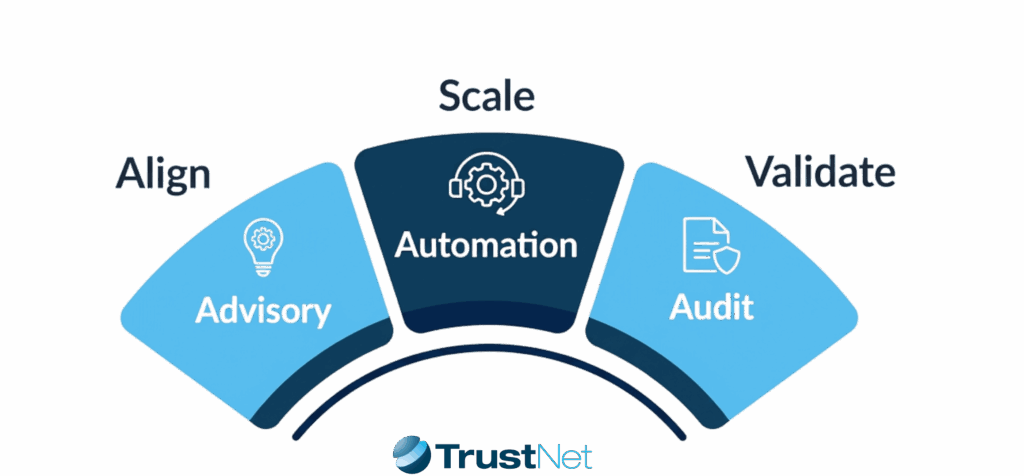
TrustNet’s Accelerator+ approach supports SOC 2 readiness through a structured model that connects control and operational effectiveness, evidence collection, and audit expectations into a single operating system.
Advisory
We evaluate your SOC 2 readiness based on the audit path that fits your organization, whether Type 1, Type 2, or a phased approach. We identify control gaps, evidence gaps, ownership issues, and remediation priorities aligned to your customer requirements and audit timeline. We challenge assumptions about scope and maturity early so the audit engagement reflects your actual control environment, not an optimistic view of it.
Automation
Our automation platform supports evidence collection, control tracking, policy management, and recurring review workflows. For SOC 2 Type 2 programs, continuous evidence collection helps teams demonstrate control operation across the audit period without relying on last-minute reconstruction. We map evidence requirements to controls before the observation period begins so gaps surface early, not during auditor testing.
Audit
Our experts perform SOC 2 readiness assessments that simulate auditor expectations. We review control design, evidence quality, operating consistency, and ownership accountability before the formal audit begins. When we identify a control that won’t hold up under sampling, we flag it with enough lead time to address it before it affects the final report.
Accelerator+ integrates advisory, automation, and audit into a single operating model that supports stronger SOC 2 readiness, improves evidence quality, and reduces friction during customer security reviews.
Need to budget for a SOC 2 audit? Explore TrustNet’s SOC 2 pricing guide to understand how audit type, scope, and readiness affect cost.
Frequently Asked Questions
Type 1 evaluates the design of controls at a specific point in time. Type 2 evaluates both control design and operating effectiveness over a defined audit period, typically six to twelve months.
Type 1 confirms controls exist and are suitably designed. Type 2 confirms they operated consistently and effectively throughout the review period. Enterprise customers and regulated buyers generally require Type 2.
It depends on control maturity and customer requirements. Startups with established control environments and enterprise customers requiring Type 2 should move directly to Type 2 preparation. Startups with material control gaps or an immediate customer requirement for third‑party assurance that needs to be met quickly may benefit from pursuing Type 1 as a short‑term milestone.
The right answer depends on the current state and consistency of your controls, not on the company stage alone.
Most enterprise customers require Type 2 for ongoing vendor relationships. Type 1 may satisfy an initial procurement requirement, but enterprise security and procurement teams typically follow up by asking for a timeline to complete Type 2. In regulated industries such as healthcare and financial services, Type 2 is generally a baseline expectation, not a premium requirement.
Audit type, length of the observation period, number of in-scope systems and services, control maturity at the start of the engagement, and the number and scope of Trust Services Criteria (TSC) selected all affect cost. Type 2 engagements cost more than Type 1 because they require sustained evidence collection over time, longer and more complex auditor testing, and ongoing internal coordination throughout the review period. Review TrustNet's SOC 2 pricing guide for a detailed breakdown of cost factors.
Most organizations take approximately nine to fourteen months from readiness assessment through final report issuance for a first‑time Type 2 engagement. That timeline typically includes three to six months of readiness preparation, a six‑to‑twelve‑month observation (review) period, and the final audit testing and report issuance phase. Organizations with significant control gaps before they start face longer timelines. Those with mature controls and established evidence workflows can move faster.