


Executive Summary
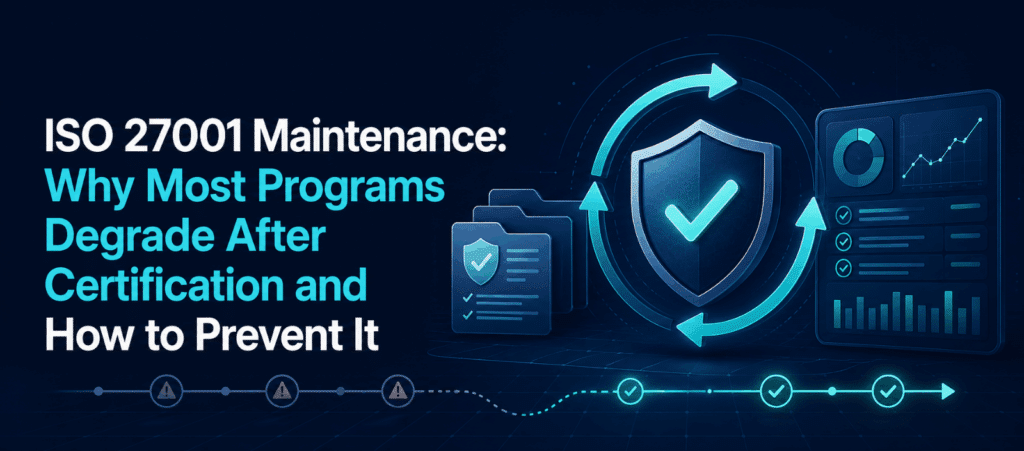
Most organizations treat ISO 27001 certification as a finish line. The audit ends, the certificate arrives, and the intensity that drove implementation drops. Teams shift attention to other priorities. The implementation team disbands or moves on. The controls that operated consistently under scrutiny begin to drift.
This is not a failure of intent. It is a failure of design. Programs built to pass an audit do not automatically operate after one.
The consequences surface during surveillance audits, which occur annually after certification. By that point, many organizations have six to twelve months of inconsistent control execution, incomplete evidence, and undocumented reviews. Auditors find it. Findings follow.
Understanding why programs degrade is the first step toward building one that does not.
Key Points
- ISO 27001 certification confirms control design at a point in time, while ongoing audits evaluate whether controls operate consistently over time
- Surveillance audits assess continued ISMS operation through sampling and evidence review, not just documented policies
- Most audit findings result from inconsistent control execution, incomplete evidence, or gaps between documented procedures and actual practice
- Common breakdowns occur in access control, logging and monitoring, change management, supplier oversight, and risk management processes
- Control ownership must transfer to operational teams after certification or execution becomes inconsistent
- Risk assessments, internal audits, and management reviews must occur at planned intervals and reflect actual operational changes
- Evidence collected during normal workflows is more reliable than evidence reconstructed before an audit
- Programs designed for continuous operation, clear ownership, and repeatable processes maintain audit readiness more effectively than audit-driven implementations
Why ISO 27001 Programs Degrade
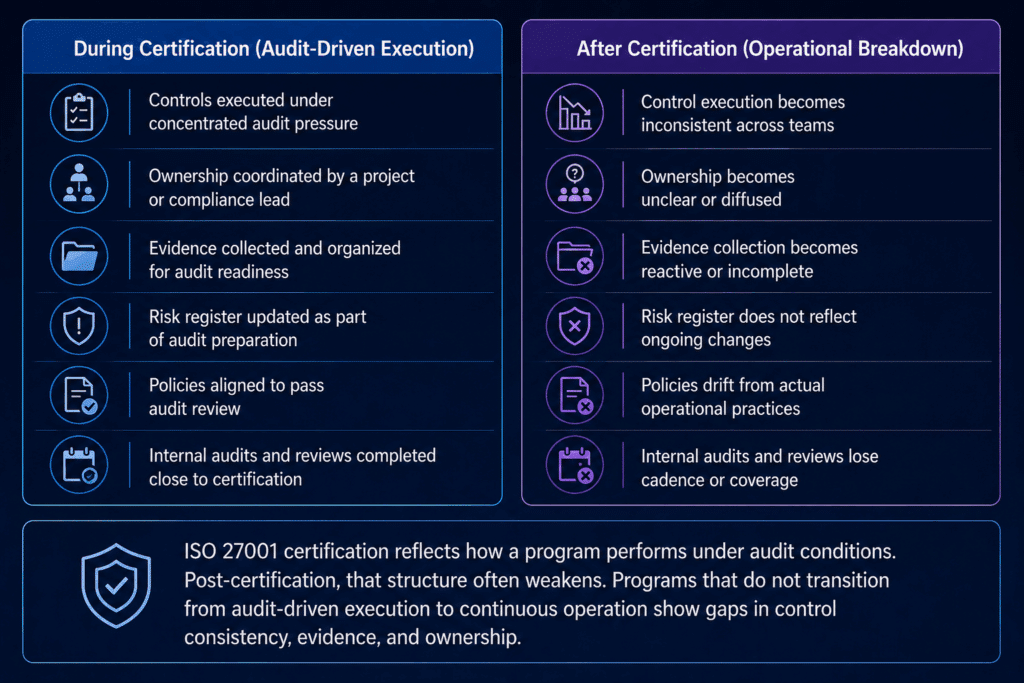
ISO 27001 implementation tends to concentrate effort. Organizations dedicate resources, define controls, assign temporary ownership, and build documentation in preparation for the certification audit. That concentrated effort produces results. It also creates a dependency on urgency.
When the certification audit ends, the urgency ends with it. What remains is a set of controls designed for a moment, not a system designed for ongoing operation.
Several patterns drive degradation consistently across organizations.
Ownership gaps
During implementation, control ownership tends to sit with the project team or a designated compliance lead. After certification, that ownership rarely transfers cleanly to operational teams. Controls still list owners, but no one enforces accountability. Reviews get missed. Evidence goes uncollected. No one escalates the gap because no one has a defined responsibility to do so.
Static risk registers
ISO 27001 requires organizations to identify risks, assess them, and map controls to treatment decisions. During implementation, organizations complete this process. After certification, risk registers frequently remain unchanged for 12 months or longer, even as the environment changes or new risks appear. New vendors get onboarded without risk assessment or proper due diligence. Infrastructure changes proceed without triggering updates. The register becomes a historical document, disconnected from the actual risk landscape.
Evidence collected during audits, not during execution
A consistent pattern in degraded programs is evidence reconstruction. Teams collect and organize evidence when an audit is imminent, not when controls actually execute. This produces incomplete records, missing timestamps, and gaps that auditors can identify during sampling. It also means the evidence does not reflect reality, which creates findings even when controls have technically operated.
Policy drift
Policies defined during implementation reflect the environment at that time. Over 12 to 18 months, procedures change, tools change, and team structures change. Policies that once matched actual practice begin to diverge from it. Auditors compare documented procedures to observed behavior. When they find mismatches, they raise findings regardless of whether the underlying practice is sound.
What Degradation Looks Like in Practice
Degradation does not announce itself. It appears in small gaps that accumulate over time. By the time a surveillance audit occurs, those gaps have compounded into findings that require formal remediation.
The most common patterns appear in the same control domains across organizations.
Access control
Quarterly access reviews get skipped or reduced to annual activity. When reviews occur, teams mark them complete without validating that actual user permissions align with defined roles. Privileged accounts receive limited review. The evidence shows a review date but no validation detail. Auditors cannot confirm that access remains appropriate based on the evidence available.
Logging and monitoring
Log review procedures define what should occur. After certification, review activity continues but documentation stops. Alerts get addressed, but no records show what was reviewed, when it was reviewed, or what action followed. Auditors cannot distinguish active monitoring from a log configuration that sits untouched.
Change management
Formal change management processes work during controlled periods. Under operational pressure, teams implement urgent changes outside ticketing systems. Approvals occur in chat without traceability. Documentation gets added after implementation. Each undocumented change is a potential audit finding because auditors cannot verify that the change followed defined procedures.
Supplier reviews
ISO 27001 requires organizations to manage supplier security based on defined criteria. Annual supplier reviews often occur once and then slip past their review date without a trigger to reschedule. Security assessments for new or changed suppliers go undocumented. When auditors request supplier review records, organizations find gaps that span months.
Internal audits and management review
ISO 27001 requires internal audits and management reviews as part of the ISMS. These activities often occur close to the certification audit and then lapse. When surveillance auditors request evidence of internal audit activity and management review, organizations that treated these as one-time activities cannot produce records showing ongoing execution.
What Surveillance Audits Actually Test
ISO 27001 operates on a three-year certification cycle. Initial certification covers the full scope of the ISMS. Surveillance audits occur annually in years one and two. Recertification occurs in year three.
Surveillance audits do not repeat the full certification scope. Auditors focus on a subset of controls, with specific attention to areas where they previously identified risk or observed weaker evidence. They also look for evidence of sustained operation: records that demonstrate controls ran consistently over the preceding 12 months, not just in the period before the audit.
This is where degraded programs fail. Organizations that collected evidence consistently have records to produce. Organizations that reconstructed evidence before the certification audit cannot replicate that reconstruction convincingly across 12 months of claimed activity.
Auditors recognize reconstructed evidence. Timestamps cluster. Activity patterns do not match normal operational rhythms. When inconsistencies appear, auditors extend sampling and raise questions about the entire control domain.
Recertification in year three carries the same risk. Organizations that deferred maintenance for two years face a compressed effort to remediate gaps across the full ISMS scope while simultaneously maintaining normal operations.
Most teams do not detect control drift until a surveillance audit surfaces it. A structured ISO 27001 readiness assessment evaluates control execution, evidence quality, and ownership before an auditor samples it.
Building an ISMS That Sustains Certification
Programs that sustain certification share a structural characteristic: they design for operation, not for audit. Controls exist within workflows. Evidence collection happens during execution. Ownership is permanent and accountable.
Building this structure requires deliberate decisions during and after initial implementation.
Make ownership permanent
Every control needs a named owner with a defined responsibility for execution and evidence. That ownership should not sit with a project team. It should transfer to the operational function responsible for the underlying activity. A security engineer owns log review. An IT manager owns access reviews. A procurement lead owns supplier assessments. When ownership is operational rather than project-based, controls remain active without requiring external coordination.
Integrate evidence collection into workflows
Evidence that requires a separate collection step gets skipped under operational pressure. Evidence that generates automatically during execution does not. Organizations should evaluate each control and identify how ticketing systems, access management platforms, log management tools, and change management systems can produce evidence as a byproduct of normal activity. When evidence collection requires no additional effort, it occurs consistently.
Define and enforce review cycles
Every control with a review requirement needs a scheduled cadence. Access reviews run quarterly. Supplier assessments run annually, timed to each supplier’s contract or onboarding date. Policy reviews run annually, with additional reviews triggered by significant operational changes. Internal audits cover the full ISMS scope over the certification cycle. These cycles should live in a system that generates reminders and tracks completion, not in a spreadsheet that someone updates manually.
Treat risk assessment as an ongoing process
Annual risk assessments satisfy the minimum requirement. They do not reflect operational reality in organizations with frequent infrastructure, personnel, or service changes. Organizations should define the events that trigger a risk assessment update: new vendor onboarding, significant architecture changes, new product lines, acquisition activity, or regulatory scope changes. A risk register that updates in response to real changes stays current without requiring a formal annual scramble.
Use internal audits functionally
ISO 27001 requires internal audits. Most organizations complete them as documentation exercises. Internal audits that sample actual control execution, compare evidence to policy requirements, and surface gaps before external auditors do are operationally valuable. They reduce surveillance audit findings and improve control consistency. Organizations should scope internal audits to cover different control domains each cycle, ensuring full ISMS coverage across the three-year certification period.
What ISO 27001 Maintenance Requires
Maintaining ISO 27001 certification is not a single activity. It is a recurring set of operations that confirm the ISMS functions as designed. The following represents the minimum operational baseline for a program that sustains audit readiness.
Access reviews
Run quarterly at minimum. Reviews should validate actual user permissions against defined roles, not simply confirm that a review occurred. Privileged account reviews require separate documentation. Evidence should include who performed the review, the date, the scope reviewed, and any actions taken in response to identified discrepancies.
Log review documentation
Log review frequency depends on the organization’s defined procedures and risk posture. Evidence must show what was reviewed, when it was reviewed, who performed the review, and what follow-up actions occurred. A log management tool with configured review workflows satisfies this requirement more reliably than manual documentation.
Risk register updates
Update the risk register in response to defined trigger events, at minimum annually. Triggers should include significant infrastructure changes, new or materially changed supplier relationships, new product or service launches, personnel changes in security-critical roles, and any identified incident that reveals a previously unrecognized risk.
Supplier security reviews
Review supplier security annually at minimum, with review frequency scaled to supplier risk tier. High-risk suppliers who access sensitive systems or handle regulated data require more frequent review. Reviews should be documented and retained, and results should feed back into the risk register where they affect the organization’s overall risk posture.
Policy reviews
Review all ISMS policies annually. Initiate out-of-cycle reviews when significant operational changes affect the scope, applicability, or accuracy of documented procedures. Every policy should carry a review date. When that date passes without a completed review, the policy is out of compliance with its own defined lifecycle.
Internal audits and management review
Conduct internal audits at least annually, scoped to ensure full ISMS coverage over the three-year certification cycle. Document management reviews separately, capturing the inputs reviewed, the decisions made, and the actions assigned. Both activities should produce records that auditors can sample independently to confirm ongoing ISMS operation.
TrustNet’s Accelerator+
TrustNet’s Accelerator+ approach supports ISO 27001 alignment through a structured model that connects risk, controls, and audit requirements into a single system.
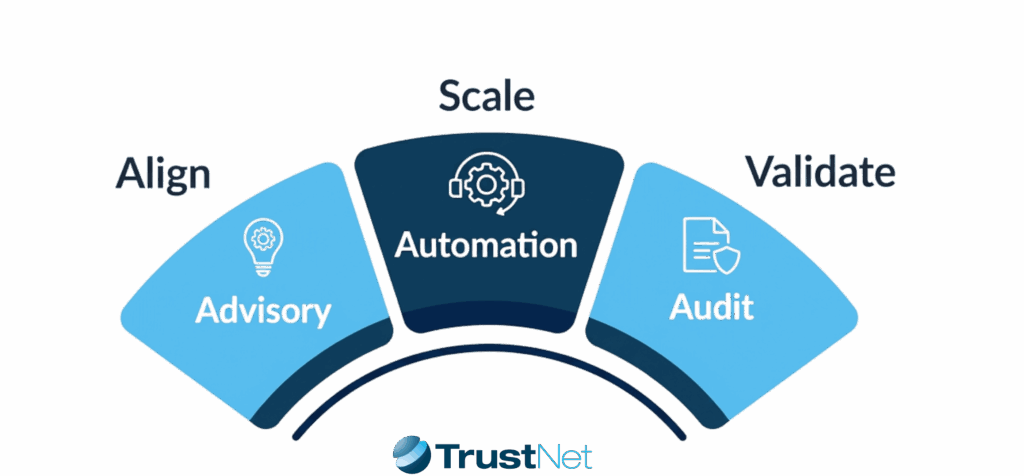

Advisory
We evaluate current ISMS practices against ISO 27001 requirements, identify where controls have drifted from their defined design, and establish remediation priorities aligned to your audit timeline. For post-certification programs, this includes a structured assessment of control execution, evidence quality, and ownership accountability across the full ISMS scope.
Automation
Our automation platform supports documentation, control tracking, and evidence management required for sustained ISO 27001 operation. Continuous evidence collection removes the need for pre-audit reconstruction. Scheduled review workflows enforce cadences without requiring manual coordination.
Audit
Our experts perform ISO 27001 readiness assessments that simulate surveillance audit conditions. We identify gaps in execution, evidence, and ownership before external auditors do. For organizations approaching recertification, we support full ISMS scope review and gap remediation aligned to recertification requirements.
Accelerator+ integrates advisory, automation, and audit into a single operating model that supports consistent execution, improves audit readiness, and reduces friction during procurement.
Need a clear view of where your ISMS stands today? Book a working session to assess control performance, evidence quality, and audit readiness.
Frequently Asked Questions
ISO 27001 maintenance requires consistent execution of controls across defined review cycles. This includes quarterly access reviews, documented log review activity, annual risk register updates triggered by operational changes, annual supplier reviews scaled to supplier risk tier, annual policy reviews with change-triggered exceptions, and annual internal audits scoped to cover the full ISMS. Each activity must produce timestamped, traceable evidence that auditors can sample during surveillance audits.
Programs degrade because they are built for certification, not for ongoing operation. Implementation effort concentrates on audit preparation. After certification, ownership gaps emerge, evidence collection stops, risk registers go static, and policies diverge from actual practice. Without systems that enforce execution and evidence collection during normal workflows, controls become inconsistent and audit findings follow. Programs degrade because they are built for certification, not for ongoing operation. Implementation effort concentrates on audit preparation. After certification, ownership gaps emerge, evidence collection stops, risk registers go static, and policies diverge from actual practice. Without systems that enforce execution and evidence collection during normal workflows, controls become inconsistent and audit findings follow.
Surveillance audits focus on a subset of the ISMS scope, with specific attention to controls that showed weakness during initial certification and areas where sustained operation is hardest to maintain. Auditors look for evidence of consistent control execution over the preceding 12 months, not just documentation of control design. They use sampling to evaluate whether execution is consistent. If sampled evidence shows inconsistency, auditors extend testing and raise findings.
Control drift typically begins within three to six months of certification. The initial post-certification period carries the highest risk because attention and urgency shift away from compliance. Organizations that do not transfer ownership to operational teams and integrate evidence collection into workflows during this period see gaps compound by the time their first surveillance audit occurs.
Recovery before a surveillance audit is possible but requires prioritization. Organizations should assess which controls have lapsed, identify evidence gaps, assign operational ownership, and implement review cycles before the audit. A structured readiness assessment identifies the highest-risk gaps and supports targeted remediation within the available timeline.
A certification audit evaluates whether the ISMS meets ISO 27001 requirements and awards initial certification. Surveillance audits occur annually in years one and two of the three-year certification cycle and focus on whether the ISMS continues to operate as certified. Surveillance audits use sampling to confirm sustained execution and evidence consistency, rather than re-evaluating the full ISMS scope.
Recertification occurs in year three of the certification cycle. It evaluates the full ISMS scope and confirms that the organization has maintained certification requirements across the three-year period. Organizations with consistent evidence and sustained control operation approach recertification in the same condition as their initial audit. Organizations that allowed programs to degrade face compressed remediation effort while managing ongoing operations.
The most common reason is inconsistent control execution during the period between the certification audit and the surveillance audit. Organizations that treated ISO 27001 as a project rather than an operational system allow controls to drift when audit pressure lifts. Auditors find the gaps through sampling, and findings result from controls that technically exist but do not operate consistently enough to produce reliable evidence.
Organizations should treat the post-certification period as the start of ongoing program management, not the end of the compliance project. This means transferring control ownership to operational teams, integrating evidence collection into existing workflows, establishing defined review cycles, maintaining the risk register in response to operational changes, and conducting internal audits on a schedule that covers the full ISMS before recertification.