


Executive Summary
Managed security services help organizations strengthen cyber defense without building a full in-house security operations center. The right provider gives your team continuous monitoring, threat detection, incident response support, vulnerability management, cloud and network security visibility, and actionable reporting.
For many growing organizations, the challenge is not whether security matters. It is whether the internal team has enough time, tooling, and expertise to monitor threats around the clock, investigate alerts, prioritize vulnerabilities, and respond before risk becomes business disruption.
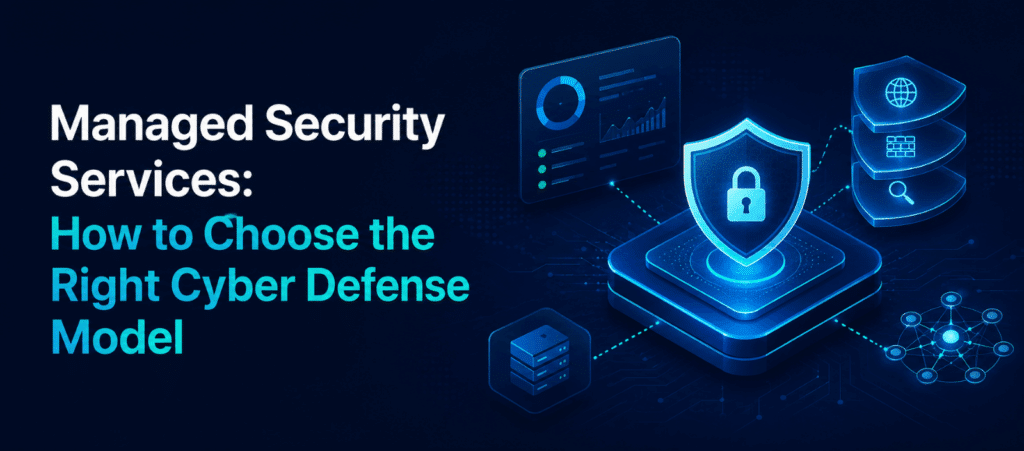
TrustNet’s GhostWatch managed security service is designed to provide always-on protection, expert insight, and scalable security coverage. It combines 24/7 monitoring, integrated SIEM capabilities, threat intelligence, incident response, vulnerability management, network and cloud security, and regular reporting into a managed operating model.
Key takeaways:
- Managed security services extend your security team with 24/7 monitoring, detection, response, and expert support
- A managed security model is especially useful when internal teams cannot staff or maintain a full security operations center
- SIEM, threat intelligence, vulnerability management, and incident response should work together rather than operate as disconnected tools
- The right provider should improve visibility across cloud, network, endpoint, and application environments
- Managed security supports stronger risk management, faster response, and better evidence for compliance and vendor assurance
TrustNet’s GhostWatch is positioned for organizations that need scalable, cost-effective protection without sacrificing depth
What Are Managed Security Services?
Managed security services are outsourced cybersecurity functions delivered by a security provider that monitors, detects, investigates, and helps respond to threats across an organization’s environment. These services often include security monitoring, SIEM management, threat detection, incident response, vulnerability management, network security, cloud security, threat intelligence, and security reporting.
The goal is not simply to add another security tool. The goal is to create an operating model where alerts, logs, vulnerabilities, threat intelligence, and response workflows are continuously reviewed by experienced security professionals.
For organizations that cannot justify the cost or complexity of a fully staffed internal SOC, managed security services provide access to enterprise-grade defense capabilities without requiring the company to build every function internally.
TrustNet’s GhostWatch service is an all-in-one managed security solution that protects IT environments through real-time monitoring, advanced threat intelligence, and rapid incident response.
Why Managed Security Matters
Cyber threats do not follow business hours. Attackers look for weak credentials, exposed systems, misconfigurations, unpatched vulnerabilities, and gaps in monitoring. Internal IT and security teams are often responsible for daily operations, compliance requests, cloud configuration, endpoint management, vendor reviews, and incident handling at the same time.
That creates a practical problem: even strong teams can miss signals when visibility is fragmented or alert review depends on manual effort.
Managed security services help close that gap by providing continuous oversight. A provider monitors security events, correlates activity, escalates suspicious behavior, supports incident response, and helps prioritize remediation. This can improve security posture while reducing the operational burden on internal teams.
For organizations preparing for SOC 2, PCI DSS, HIPAA, HITRUST, ISO 27001, or other assurance programs, managed security can also support stronger control operation. Continuous monitoring, vulnerability management, log review, alert handling, and documented response activity are often important evidence areas for security and compliance teams.
What Managed Security Services Typically Include
A strong managed security program should connect detection, investigation, remediation, and reporting into one operating model.
Security Monitoring and SIEM
Security monitoring gives organizations visibility into suspicious activity across systems, users, applications, networks, and cloud environments. SIEM capabilities help collect logs, correlate events, and generate alerts that require review.
This matters because logs have limited value if no one is reviewing them, correlating them, or escalating meaningful signals. Managed SIEM support helps organizations move from raw data to actionable security operations.
Threat Detection and Incident Response
Threat detection identifies signs of compromise, misuse, suspicious behavior, or active attack. Incident response focuses on containing and addressing threats quickly so the organization can reduce impact.
This is one of the most important differences between passive monitoring and managed security. The provider should not only generate alerts. It should help your team understand what matters, what happened, what needs containment, and what remediation steps should follow.
Vulnerability Management
Vulnerability management identifies exploitable weaknesses and helps prioritize remediation based on risk. A mature program does not treat every vulnerability equally. It considers exploitability, asset criticality, exposure, compensating controls, and business context.
This is especially important for organizations with cloud workloads, internet-facing applications, distributed teams, and rapidly changing infrastructure. Vulnerabilities must be detected, prioritized, assigned, tracked, and remediated before attackers can exploit them.
Network and Cloud Security
Modern environments are rarely limited to a single corporate network. Organizations often operate across on-premises infrastructure, cloud platforms, SaaS tools, remote endpoints, and hybrid environments.
A managed security provider should help organizations maintain visibility across those layers. Monitoring only one environment creates blind spots. Effective managed security needs to account for how users, workloads, applications, and data move across the business.
Threat Intelligence and Reporting
Threat intelligence helps security teams understand current attacker tactics, emerging vulnerabilities, malicious indicators, and changing risk patterns. Reporting converts security activity into operational insight for engineers, executives, auditors, and risk owners.
Reporting is just as important as detection. Leadership needs to understand trends, recurring issues, remediation status, and how security posture is improving over time. Engineers need actionable details. Compliance teams need evidence that controls are operating.
When Does an Organization Need Managed Security?
Managed security becomes important when security risk grows faster than internal capacity. That often happens when organizations scale cloud infrastructure, enter regulated markets, support enterprise customers, process sensitive data, or prepare for formal audits and security reviews.
Common signs include:
- Security alerts are generated but not reviewed consistently
- Vulnerability scans produce long lists without clear prioritization
- Cloud, network, and endpoint visibility are fragmented
- Incident response depends on a few key individuals
- Security reviews and compliance audits require evidence the team struggles to produce
- Customers ask how threats are monitored outside business hours
- The business cannot justify the cost of building a full in-house SOC
For VC-backed SaaS companies, healthcare organizations, retail and financial services companies, and tech-forward enterprises, TrustNet positions GhostWatch as a fit for organizations that need continuous protection and scalable security support.
Managed Security and Compliance Readiness
Managed security is not the same as compliance, but it can support compliance readiness. Many frameworks and customer assurance programs expect organizations to demonstrate that security controls are operating, monitored, reviewed, and improved over time.
Managed security can help support evidence in areas such as:
- Security event monitoring
- Log review and alert triage
- Vulnerability identification and remediation tracking
- Incident detection and response
- Cloud and network security oversight
- Security posture reporting
- Control owner accountability
For SOC 2, PCI DSS, ISO 27001, HIPAA, HITRUST, and similar programs, customers and auditors often want to see that security practices are not only documented but operating consistently. Managed security can provide the workflows, reporting, and expert oversight that make those controls easier to sustain.
This is especially valuable when a company is scaling quickly. A small team may be able to write policies or configure tools, but maintaining evidence of recurring security operations is harder without a structured operating model.
How to Choose a Managed Security Provider
Choosing a managed security provider should start with the assurance question your organization needs to answer.
- Do you need better visibility?
- Do you need faster detection and response?
- Do you need vulnerability prioritization?
- Do you need cloud and network monitoring?
- Do you need compliance-supporting evidence?
- Do your customers expect 24/7 security oversight?
A strong provider should be able to explain what it monitors, how alerts are triaged, how incidents are escalated, what reporting is provided, how vulnerability risk is prioritized, and how the service fits your business environment.
The best fit is not always the provider with the longest tool list. It is the provider that can integrate monitoring, intelligence, investigation, remediation guidance, and reporting into a security operating model your team can actually use.
How Managed Security Affects Cost
Managed security cost depends on scope, environment complexity, data volume, monitoring requirements, response expectations, and the level of expert support required.
Common cost drivers include:
- Number of systems, users, endpoints, cloud accounts, and networks in scope
- Volume and complexity of logs
- SIEM integration and tuning requirements
- Vulnerability scanning frequency and remediation support
- Incident response expectations
- Reporting cadence and stakeholder requirements
- Compliance or audit support needs
- Internal security maturity at the start of the engagement
Managed security can be more cost-effective than building a full in-house SOC because it gives organizations access to security tooling, monitoring workflows, and expert support without requiring them to hire, train, and retain a complete 24/7 security team.
GhostWatch is a scalable, cost-effective protection that allows organizations to pay for the coverage they need as the business evolves.
Need to understand what managed security would cost for your environment? Review GhostWatch’s pricing options or talk to an expert about the scope, systems, and coverage your organization needs.
TrustNet’s GhostWatch Managed Security
TrustNet’s GhostWatch supports managed security through a structured model that connects monitoring, detection, response, vulnerability management, cloud and network visibility, threat intelligence, and reporting.
24/7 Monitoring
GhostWatch provides around-the-clock monitoring with intelligent alerting and response support designed to stop threats before they disrupt business operations.
Threat Detection and Incident Response
GhostWatch helps identify, contain, and respond to threats quickly. The goal is to reduce impact, support timely remediation, and give internal teams the guidance they need when suspicious activity appears.
Vulnerability Management
GhostWatch supports vulnerability management using real-time, supported by continuously updated threat intelligence to help detect and address exploitable weaknesses.
Network and Cloud Security
GhostWatch supports active monitoring and threat prevention across on-premises, multi-cloud, and hybrid infrastructure.
Threat Intelligence and Reporting
GhostWatch provides automated alerts, threat intelligence, and regular security posture updates so technical and business stakeholders can understand what is happening and what needs attention.
TrustNet’s GhostWatch gives organizations a managed security operating model that supports stronger visibility, faster response, scalable coverage, and clearer reporting. It is designed for organizations that need expert-led cyber defense without building every security function internally.
Ready to strengthen your security posture with 24/7 managed protection? Talk to TrustNet about GhostWatch Managed Security today.
Frequently Asked Questions
Managed security services are outsourced cybersecurity services that help organizations monitor, detect, investigate, and respond to threats. They often include SIEM monitoring, threat detection, incident response, vulnerability management, cloud and network security, threat intelligence, and reporting.
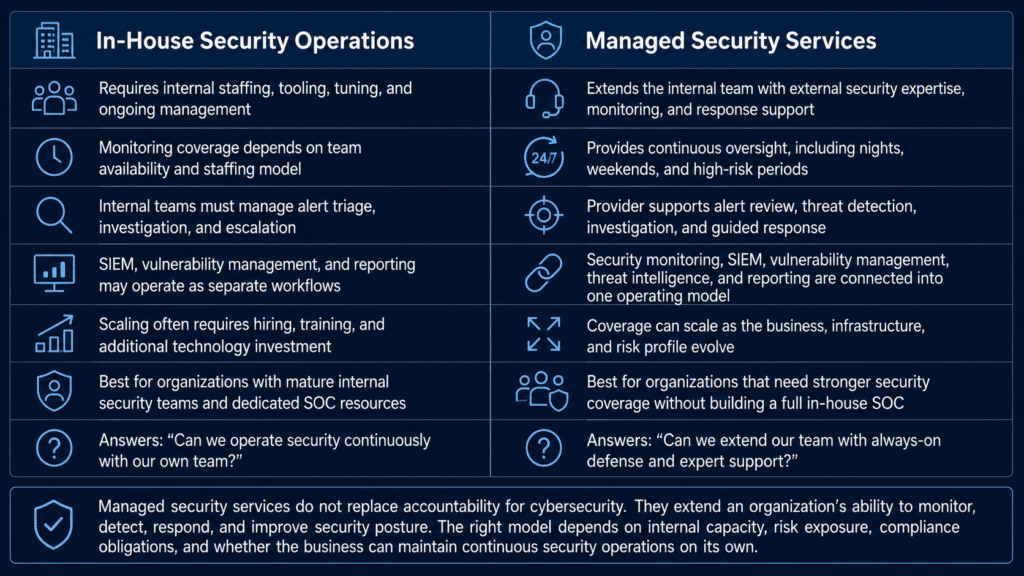
An in-house SOC is operated by the organization’s own employees, tools, and processes. Managed security extends or supplements the internal team through an external provider that delivers monitoring, detection, response support, and reporting. Managed security is often more practical for organizations that need continuous coverage but do not have the resources to build a full 24/7 SOC.
No. Managed security usually extends the internal team rather than replacing it. The provider monitors, investigates, escalates, and supports response, while the organization remains responsible for business decisions, remediation ownership, system changes, and risk acceptance.
A managed security service should include continuous monitoring, SIEM or log correlation, threat detection, alert triage, incident response support, vulnerability management, network and cloud security visibility, threat intelligence, and clear reporting. The exact scope should reflect the organization’s environment, risk profile, and compliance obligations.
Managed security can support compliance by helping operate and document security controls. Monitoring records, alert reviews, vulnerability management evidence, incident response activity, and security posture reports can support audits and customer assurance reviews for frameworks such as SOC 2, PCI DSS, ISO 27001, HIPAA, and HITRUST.
Managed security services are useful for SaaS companies, healthcare organizations, financial services firms, retailers, managed service providers, and other organizations that store, process, or transmit sensitive data. They are especially valuable when internal teams need stronger monitoring, faster response, and better security visibility without building a full in-house SOC.
Managed security cost depends on the number of systems in scope, log volume, cloud and network complexity, monitoring requirements, response expectations, vulnerability management needs, reporting cadence, and compliance support requirements. Organizations with larger or more complex environments usually require broader coverage and deeper integration.
GhostWatch is TrustNet’s managed security service. It provides 24/7 monitoring, integrated SIEM capabilities, threat detection, incident response support, vulnerability management, network and cloud security, threat intelligence, and reporting for organizations that need scalable cyber defense.
GhostWatch is TrustNet’s managed security service. It provides 24/7 monitoring, integrated SIEM capabilities, threat detection, incident response support, vulnerability management, network and cloud security, threat intelligence, and reporting for organizations that need scalable cyber defense.