


Executive Summary
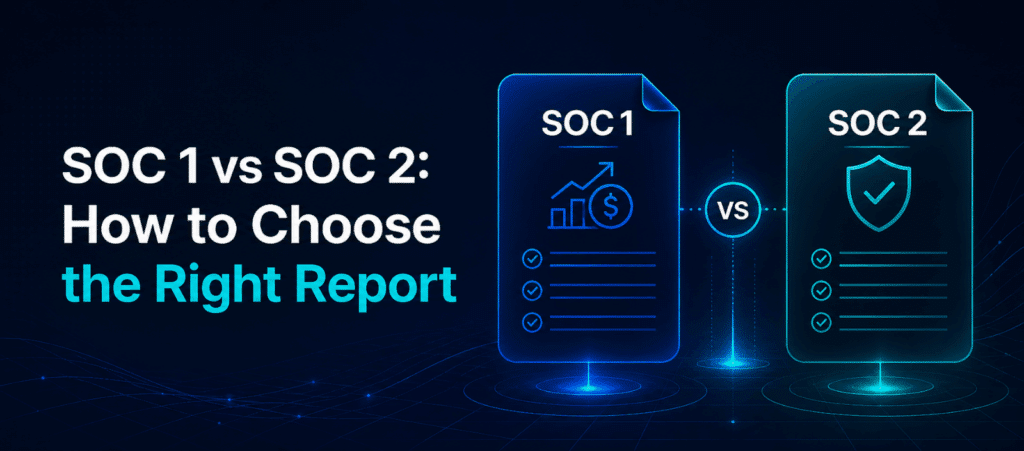
SOC reports give customers and partners verifiable evidence that your organization manages risk appropriately. Choosing between SOC 1 and SOC 2 depends on what your customers need to verify, how your services affect their financial reporting, and what security assurance your market expects.
Most organizations default to SOC 2 without evaluating whether SOC 1 applies to their business model. Some organizations require both reports because they both affect customer financial reporting and provide technology services that require security assurance. Getting that decision wrong wastes time, budget, and audit cycles on the wrong report.
Key takeaways:
- SOC 1 addresses controls that affect customers’ internal control over financial reporting
- SOC 2 addresses security as a required baseline, along with availability and other Trust Services Criteria such as confidentiality, processing integrity, and privacy, depending on what customers require
- Report type depends on service model, customer base, and assurance requirements
- Both reports come in Type 1 and Type 2 formats with different evidence requirements
- Starting with the wrong report delays the assurance your customers actually need
What is a SOC Report?
A SOC (System and Organization Controls) report is an independent audit of the design and operating effectiveness of controls at a service organization that are relevant to customer financial reporting, security, availability, processing integrity, confidentiality, or privacy. The American Institute of CPAs (AICPA) establishes the reporting framework and standards. An independent CPA firm performs the audit and issues the report.
SOC reports provide customers and prospects with independent, third-party assurance that an organization has implemented and operates its controls as described. They help reduce the need for customer-led audits, streamline vendor due diligence, and support enterprise procurement and compliance requirements.
Why customers and partners request SOC reports
Enterprise buyers rarely take a vendor’s word on security or financial control. Procurement processes increasingly require documented evidence of control effectiveness before contracts close. SOC reports provide evidence in a standard format that legal, finance, risk, and security teams can evaluate without conducting their own assessment.
A SOC report answers a simple question: has an independent auditor verified that the controls are properly designed and, for Type 2 reports, operating effectively over a defined period? That question carries more weight as contract values increase and data sensitivity grows.
How SOC reports support vendor assurance
Vendor assurance programs use SOC reports to evaluate third-party risk without performing direct audits. Your customers’ internal audit and compliance teams review your SOC report as part of their vendor management cycle. A current, clean SOC report shortens that review and reduces friction during contract renewals.
Without a SOC report, customers must rely on self-attestations, security questionnaires, or their own assessment activities. That creates more work for both sides and introduces delays into the procurement process.
What is SOC 1?
SOC 1 addresses controls at a service organization that are relevant to its customers’ internal controls over financial reporting (ICFR). The report scope focuses specifically on financial reporting risks, not general security.
If your organization processes transactions, manages payroll data, handles accounts payable or receivable, or performs activities that could materially impact how your customers prepare and report financial statements, SOC 1 applies to your service model.
When SOC 1 applies
SOC 1 applies when a service organization’s services are relevant to a customer’s internal control over financial reporting (ICFR). The key question is whether a control failure at your organization could reasonably result in a material misstatement in your customer’s financial statements.
Payroll processors, loan servicers, claims processors, and other service providers that calculate, initiate, or record transactions reflected in the general ledger commonly fall within the SOC 1 scope. Benefits administrators and transaction management platforms may also fall within the SOC 1 scope depending on whether their services directly impact amounts or disclosures in financial statements.
Your customers’ external auditors may require a SOC 1 report to complete their audit procedures related to financial reporting.
Common SOC 1 use cases
- Payroll and HR platforms that process employee compensation data
- Benefit plan administration and enrollment services that affect payroll deductions or employer benefit costs
- Accounts payable and accounts receivable outsourcing services
- Financial transaction processing, clearing, and settlement services
- Custodial or trust account management of customer funds or financial assets
SOC 1 Type 1 vs Type 2
A SOC 1 Type 1 report explains how a service organization’s system is described by management and evaluates whether the related controls are suitably designed as of a specific date.
The service auditor provides an opinion on whether the system description is fairly presented and whether the controls, if they were to operate as designed, would be capable of achieving the stated control objectives related to financial reporting.
A SOC 1 Type 2 report includes everything in a Type 1 report and also evaluates whether those controls operated effectively over a specified period of time.
In addition to assessing design, the service auditor tests the controls to determine whether they were performed consistently and functioned as intended throughout the review period, which is commonly six to twelve months.
A SOC 1 Type 2 report evaluates both control design and operating effectiveness over a defined period, typically six to twelve months. The auditor tests whether controls operated consistently during that period and produced reliable results.
Because a Type 2 report shows how controls actually performed over time, it provides a higher level of assurance to customers and their auditors.
As a result, many of their customers’ auditors, along with long‑term customers and organizations in regulated or higher‑risk industries, typically expect or require a SOC 1 Type 2 report rather than a Type 1.
What is SOC 2?
SOC 2 evaluates controls relevant to the AICPA Trust Services Criteria: security, availability, processing integrity, confidentiality, and privacy. Security, also known as the Common Criteria, is required in every SOC 2 report. Organizations do not need to include all five categories. Availability, processing integrity, confidentiality, and privacy are optional criteria that organizations include when customer commitments, service commitments, system scope, or data-handling practices make them relevant.
SOC 2 does not address internal controls over financial reporting (ICFR). Its scope covers how an organization designs and operates controls to protect systems and data from unauthorized access, disruption, and misuse.
When SOC 2 applies
SOC 2 applies when an organization provides services that store, process, transmit, or otherwise impact customer data or systems, and when customers need assurance that the organization has effective controls related to security, availability, confidentiality, processing integrity, or privacy. As a result, SaaS companies, cloud service providers, managed service providers, and other technology vendors commonly obtain SOC 2 reports.
Many enterprise customers, especially those in healthcare, financial services, and other regulated or risk‑sensitive industries expect SOC 2 as a baseline vendor assurance report to support their vendor risk management and due‑diligence processes.
The Trust Services Criteria
The AICPA defines five Trust Services Criteria categories:
- Security: Information and systems are protected against unauthorized access, unauthorized disclosure of information, and damage to systems that could compromise the availability, integrity, confidentiality, and privacy of information or systems and affect the entity’s ability to achieve its objectives. (required for all SOC 2 reports)
- Availability: Information and systems are available for operation and use to meet the entity’s objectives
- Processing Integrity: System processing is complete, valid, accurate, timely, and authorized to meet the entity’s objectives
- Confidentiality: Information designated as confidential is protected to meet the entity’s objectives
- Privacy: Personal information is collected, used, retained, disclosed, and disposed of to meet the entity’s objectives
Most organizations include Security and one or more additional criteria, based on customer commitments, contractual obligations, regulatory requirements, and the nature of the services provided.
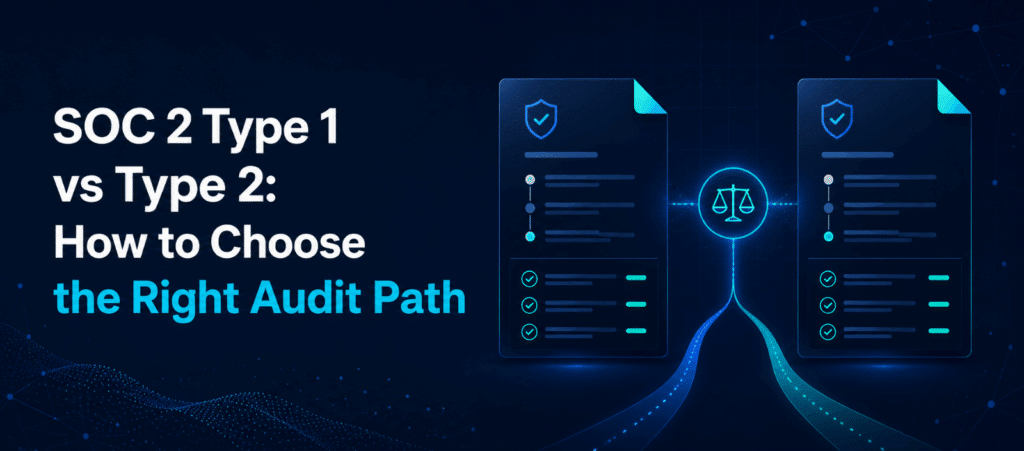
SOC 2 Type 1 vs Type 2
A SOC 2 Type 1 report evaluates the design and implementation of controls at a point in time. It confirms that controls are suitably designed and have been implemented to meet the Trust Services Criteria, but does not test operating effectiveness over time.
A SOC 2 Type 2 report evaluates both design and operating effectiveness over a defined period. Enterprise customers generally require Type 2. Type 1 can serve as an interim milestone for organizations that are early in their SOC 2 journey or preparing for Type 2.
SOC 1 vs SOC 2: Key Differences
Audit focus
SOC 1 focuses on controls relevant to Internal Control over Financial Reporting (ICFR). The audit tests whether those controls are designed and operating effectively to prevent or detect errors that could affect your customers’ financial statements.
SOC 2 focuses on controls relevant to security, availability, processing integrity, confidentiality, and privacy. The audit tests whether those controls protect systems and data in accordance with the Trust Services Criteria (TSC).
Intended users
SOC 1 reports are intended for your customers’ management teams and their financial statement auditors who rely on the service organization’s controls for financial reporting.
SOC 2 reports are intended for customers’ security, IT, risk, legal, and procurement teams, as well as other stakeholders evaluating operational and data protection controls.
The two reports serve different audiences with different assurance objectives.
Control requirements
SOC 1 controls map to risks that could impact customers’ financial statements. SOC 2 controls map to the specific Trust Services Criteria categories included in the report. Security is always included, while availability, processing integrity, confidentiality, and privacy are included based on what is relevant to the service.
Although SOC 1 and SOC 2 have different purposes, some foundational controls, such as user access controls, system changes, and incident handling may appear similar. However, these controls are evaluated against different criteria and risk perspectives.
Organizations that obtain both SOC 1 and SOC 2 reports often reuse the same controls and evidence, even though each report provides assurance for different types of risks.
Common industries
SOC 1 applies most commonly to financial services, payroll processing, benefits administration, and transaction management. SOC 2 applies most commonly to SaaS, cloud services, managed IT, data processing, and technology-enabled services.

How to Know Which SOC Report You Need
Start with your customers’ requirements. If your customers’ auditors request a SOC report and their focus is controls relevant to financial statements or Internal Control over Financial Reporting (ICFR), that points to SOC 1. If your customers’ security, risk, compliance, or procurement teams request a report and their focus is on data protection, availability, confidentiality, processing integrity, or privacy, that points to SOC 2.
Consider your service model. If your services could impact customers’ financial reporting or internal controls over financial reporting (directly or indirectly), evaluate the SOC 1 scope carefully. If your services involve hosting, storing, transmitting, or otherwise processing customer data or running systems customers rely on, SOC 2 is typically the more appropriate framework.
Some organizations need both. A payments processor, payroll provider, or core financial platform that also stores sensitive customer data may need SOC 1 for financial reporting assurance and SOC 2 for assurance related to the Trust Services Criteria (security, availability, processing integrity, confidentiality, and privacy). This is common in fintech, SaaS platforms supporting finance functions, and managed services environments.
If you’re unsure, evaluate what your customers and their auditors actually need before committing to a report type and scope. The wrong report can result in significant rework and twelve or more months of unnecessary audit preparation effort.
How Report Type Affects the Cost of SOC Compliance
Report type directly affects audit scope, evidence requirements, and total cost. SOC 1 and SOC 2 engagements vary based on the number of systems in scope, control maturity at the start of the engagement, whether you pursue Type 1 or Type 2, and the length of your audit period.
Type 2 audits require controls to operate effectively over a defined period, which results in greater evidence collection, more extensive auditor testing, and increased internal coordination. Organizations that start Type 2 without a mature control environment face higher remediation costs before the audit period even begins.
Control maturity at the start of the engagement is one of the strongest predictors of total SOC compliance cost. Organizations with gaps in access management, logging, change management, or vendor oversight must invest additional time and resources to remediate deficiencies before they can successfully complete a Type 2 audit period.
For a detailed view of how scope, readiness, and report type affect pricing, review TrustNet’s SOC audit pricing considerations.
TrustNet’s Accelerator+
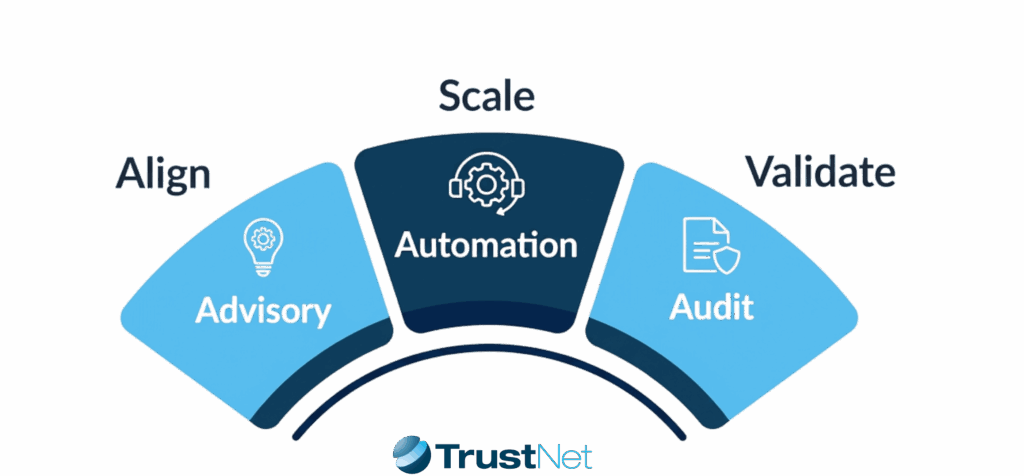
TrustNet’s Accelerator+ approach supports SOC audit readiness through a structured model that connects controls, evidence, ownership, and audit requirements into a single operating system.

Advisory
We evaluate your current control environment against SOC 1 or SOC 2 requirements based on your reporting needs. Our advisors identify control gaps, clarify ownership, and establish remediation priorities aligned to your audit timeline. We challenge scope assumptions early so the audit engagement reflects what your customers actually need, not what’s easiest to document.
Automation
Our automation platform supports control tracking, evidence collection, policy management, and audit workflow coordination. Continuous evidence collection reduces last-minute audit preparation and gives control owners a clearer view of what the auditor will test before the engagement begins. We map evidence requirements to controls so nothing collapses at audit time.
Audit
Our experts perform SOC readiness assessments that simulate audit expectations before the formal engagement. We identify gaps in control design, operating effectiveness, evidence quality, and ownership accountability so your team can address issues before they affect the final report.
Accelerator+ integrates advisory, automation, and audit into a single operating model that supports SOC readiness, reduces audit friction, and helps organizations respond more confidently to customer assurance requests.
Preparing for a SOC audit? Review TrustNet’s SOC pricing guide to understand the key factors that affect scope, readiness, and audit costs.
Frequently Asked Questions
SOC 1 addresses controls relevant to your customers’ internal control over financial reporting (ICFR). SOC 2 addresses controls relevant to the Trust Services Criteria: security, availability, processing integrity, confidentiality, and privacy. The reports serve different audiences, address different risks, and meet different customer requirements. Choosing between them should be based on what your customers need assurance over, not simply what is easiest to obtain.
Most SaaS companies need SOC 2. Unless the platform impacts customers’ internal control over financial reporting (ICFR), a SOC 1 report is typically not required. SaaS companies that process transactions, calculate amounts used directly in financial statements, or provide payroll, billing, or benefits administration services may need to assess SOC 1 in addition to SOC 2. The determining factor is how the service is used by customers, not the fact that the company is a SaaS provider.
Yes. Organizations whose services impact customers’ internal control over financial reporting (ICFR) and also store, process, or transmit sensitive customer data may need both SOC 1 and SOC 2 reports. Each report addresses different risks and serves different stakeholders. Running both programs requires careful scoping to avoid overlapping controls, but this is common in financial services, payroll providers, and managed or outsourced service environments.
Report type (SOC 1 vs. SOC 2), audit scope, number of in‑scope systems, control maturity, and whether the engagement is Type 1 or Type 2 all affect cost. Organizations that require significant control design or remediation before the audit period begins typically incur a higher total investment. Review TrustNet's SOC audit pricing considerations for a detailed breakdown.
A SOC 1 or SOC 2 Type 1 audit typically takes two to four months from initial readiness activities through report issuance, depending on scope, complexity, and control maturity.
A Type 2 audit requires an observation period of at least six months, in addition to readiness preparation and final reporting. Many organizations complete a Type 2 engagement in nine to twelve months, though timelines can extend longer for organizations starting with low control maturity or significant remediation needs.