


Executive Summary
Most organizations fail ISO 27001 audits because controls do not operate as expected, not because controls are missing.
Audit outcomes depend on consistency, evidence, and traceability. When controls are performed irregularly, lack ownership, or fail to produce sufficient evidence, auditors cannot validate effectiveness. This creates nonconformities even when the organization has defined the right controls.
ISO 27001 changes how organizations approach compliance by requiring a system that connects risk, controls, and evidence into a consistent operating model.
Key points:
- ISO 27001 audits validate control operation, not documentation
- Most audit failures result from inconsistent execution and weak evidence
- Common gaps appear in access control, logging, change management, and risk alignment
- Manual processes break down without ownership and structured workflows
- Organizations that design for repeatability and evidence consistency reduce audit findings
Why ISO 27001 Audits Fail in Practice
ISO 27001 audits assess whether an information security management system operates as intended. Auditors do not evaluate intent. They evaluate observable outcomes.
This distinction drives most audit failures.
Organizations often define controls correctly and document them in detail. Policies exist, and procedures appear complete. When auditors test those controls, they focus on execution, not documentation. They look for evidence that controls operate consistently over time.
Auditors rely on sampling. They do not review every control instance. They select specific examples and evaluate whether execution remains consistent. If one sample fails, it raises questions about the entire control.
This creates a common pattern. Controls exist in theory but do not hold up under testing.
In practice, failures come from operational gaps.
- Ownership remains unclear.
- Execution varies across teams.
- Evidence does not exist at the time of testing.
These issues prevent auditors from confirming that controls operate as intended.
Control Design vs Control Operation
ISO 27001 requires more than defining controls. It requires those controls to operate consistently, effectively, and produce verifiable evidence.
Many organizations focus on control design during implementation. They define scope, policies, map controls to requirements, and complete documentation. After that phase, responsibility shifts to operational teams.
Without integration into daily workflows, controls become secondary tasks. Teams perform them inconsistently or delay them until audit periods.
This creates a structural gap. The control exists, but its execution does not follow a repeatable process.
Over time, organizations begin to rely on manual coordination. Teams track activities through email or spreadsheets. Evidence is collected after the fact. Ownership becomes distributed without accountability.
ISO 27001 expects controls to function as a system. When execution depends on memory or informal processes, consistency breaks down, and audit findings follow.
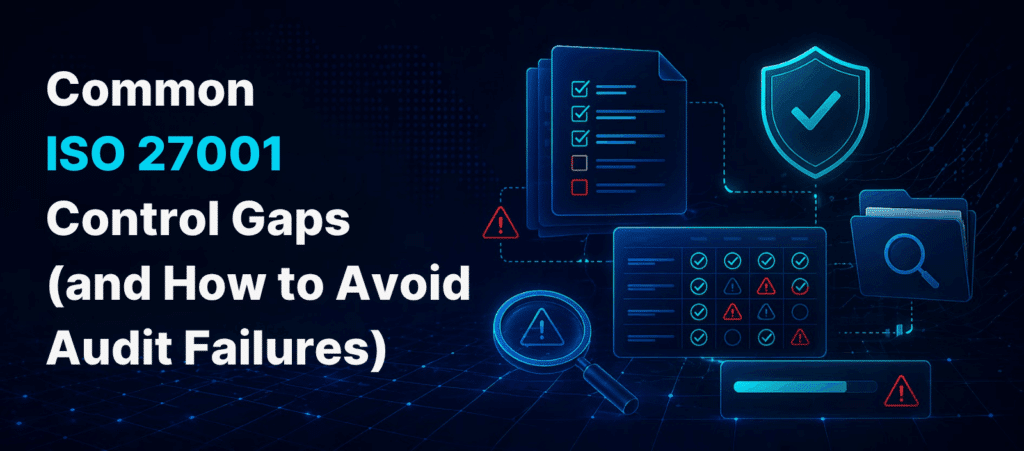
Common ISO 27001 Control Gaps (and Why They Fail in Audits)
Most audit findings come from controls that fail under testing. These failures follow consistent patterns across organizations.
Access Control
Organizations define access control policies and schedule periodic reviews. In practice, those reviews often lack consistency.
Teams delay reviews or complete them without validating actual access. Privileged accounts receive limited scrutiny. Evidence does not show who performed the review or when it occurred.
Auditors expect clear records with timestamps, ownership, and validation against defined roles. When reviews become administrative tasks instead of validation activities, auditors cannot confirm that access remains appropriate.
Logging and Monitoring
Organizations enable logging across systems and assume that it satisfies control requirements. Logging alone does not demonstrate control operation.
Teams may review alerts, but they rarely document the review process itself. No records show what was reviewed, how often reviews occur, or what actions followed.
Auditors look for evidence of active monitoring. They expect defined procedures, consistent review activity, and documented follow-up. Without that evidence, logging appears incomplete.
Change Management
Organizations define structured change management processes, but execution often bypasses those processes.
Teams implement urgent changes outside ticketing systems. Approvals occur in chat or email without traceability. Documentation happens after implementation instead of before.
Auditors expect to trace each change from request to approval to execution. When that trace does not exist, auditors treat the change as uncontrolled.
Risk Management
Organizations maintain risk registers, but many do not use them to drive control decisions.
Risk assessments may occur once per year and remain static. Controls do not map clearly to identified risks. Treatment plans exist but lack execution.
Auditors expect to see current risk assessments and a clear linkage between risks and controls. They also expect evidence that treatment actions were implemented. A static risk register does not meet those expectations.
Policy vs Practice
Policies often appear complete during implementation. Over time, execution diverges from what those policies define.
Teams follow informal processes that differ from documented procedures. Employees may not understand policy requirements. No evidence shows enforcement or review.
Auditors compare documentation to actual behavior. When they identify mismatches, they question the effectiveness of the control.
A structured ISO 27001 readiness assessment identifies where controls break down across execution, ownership, and evidence.

Why These Gaps Persist
These gaps do not come from a lack of effort. They result from how organizations implement ISO 27001.
Many teams focus on documentation. They define policies and procedures, but do not design how controls operate in daily workflows. This creates a disconnect between definition and execution. Manual processes also contribute to failure. Email approvals, spreadsheets, and informal tracking work in early stages. As organizations grow, these methods introduce inconsistency and reduce traceability.
Ownership remains another issue. Controls often span multiple teams. Without clear accountability, execution becomes uneven.
Organizations also tend to collect evidence during audits instead of during execution. This leads to incomplete or inconsistent records.
Finally, many organizations treat ISO 27001 as a project. They aim to complete certification rather than build a system that supports ongoing operation.
How to Fix Control Gaps Before Audit
Fixing control gaps requires changes to how controls operate.
Organizations should define repeatable processes with clear steps and expected outputs. Each control should have a specific owner responsible for execution and evidence.
Systems should generate evidence as part of normal workflows. This removes the need for manual documentation during audits. Tools such as ticketing systems and access management platforms should enforce consistency and maintain traceability.
Controls should also map directly to identified risks. This ensures relevance and supports audit validation.
Control Maturity and Audit Readiness
Control maturity determines audit outcomes. At a basic level, controls exist but operate inconsistently. Evidence appears incomplete or fragmented.
At a mature level, controls operate on defined schedules and produce consistent results. Evidence remains complete and timestamped. Ownership stays clear. Policies match actual practice. Risks map directly to controls.
Auditors expect to see consistency across sampled instances. Mature controls produce the same outcome each time they operate.
Pre-Audit Checklist
Before entering an audit, organizations should confirm several conditions.
- Controls should operate on a defined schedule and produce consistent results.
- Evidence should exist for each execution and include timestamps.
- Policies should reflect actual practices.
- Risks should map directly to controls.
- Reviews and approvals should remain traceable.
If any of these conditions fail, audit results are likely to be negative.
TrustNet’s Accelerator+
TrustNet’s Accelerator+ approach supports ISO 27001 alignment through a structured model that connects risk, controls, and audit requirements into a single system. In line with ISO requirements for segregation of duties, certification audits are conducted by an independent certification body, separate from advisory and readiness support activities.
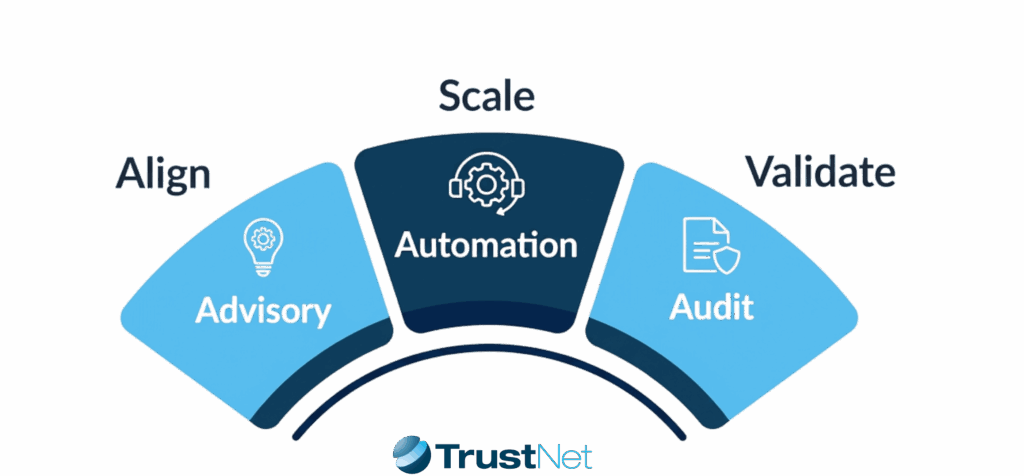

Advisory
We evaluate current practices against ISO 27001 requirements, define scope, and perform structured risk identification. This process ensures that risks map directly to controls and establishes clear remediation priorities aligned to ISMS expectations.
Automation
Our automation platform supports documentation, control tracking, and evidence management required for ISO 27001. Continuous evidence collection helps maintain consistency between defined risks, implemented controls, and audit processes.
Audit
Our seasoned experts perform ISO 27001 readiness assessments and provide certification support. Independent auditors validate that the ISMS aligns with the defined scope, controls address identified risks, and processes operate consistently over time.
Accelerator+ integrates advisory, automation, and audit into a single operating model that supports consistent execution, improves audit readiness, and reduces friction during procurement.
If controls do not produce consistent, traceable evidence, they will fail under audit testing. A readiness assessment identifies where execution, ownership, and evidence break down before certification.
Frequently Asked Questions
ISO 27001 audits fail when auditors cannot verify that controls operate consistently over time.
Auditors rely on evidence. They review selected control executions and expect consistent results with clear ownership and timestamped evidence. If execution varies or evidence is incomplete, auditors cannot confirm effectiveness. Even one failed sample can result in a finding.
The most common gaps appear in execution rather than design.
Organizations often define the right controls but fail to operate them consistently. Typical issues include incomplete access reviews, lack of documented log reviews, informal change processes, weak linkage between risks and controls, and policies that do not match actual practices.
Control effectiveness means a control achieves its intended outcome and produces evidence that confirms it operated correctly. Auditors assess whether the control runs on a defined schedule, follows a repeatable process, and generates traceable evidence. A control without consistent evidence is not considered effective.
Auditors use sampling to evaluate controls. They select specific instances of control execution and review supporting evidence. They check for consistency, traceability, timestamps, and alignment between documented procedures and actual execution. If inconsistencies appear, auditors extend testing or raise findings.
Control design defines what a control should do. Control operation reflects how that control performs in practice.
Many organizations design controls correctly but fail during operation. Audits focus on whether controls operate consistently over time, not whether they were defined properly.
Evidence allows auditors to verify that controls operated as defined. Documentation explains intent, but evidence proves execution. Without clear, time-bound, and traceable evidence, auditors cannot validate control effectiveness.
Inconsistency usually results from how controls are implemented. Common causes include unclear ownership, reliance on manual coordination, lack of structured workflows, and absence of systems that enforce execution and capture evidence.
An audit-ready program produces consistent results across all sampled controls. Controls operate on defined schedules, evidence remains complete and timestamped, ownership stays clear, and policies match actual practice. Risks map directly to controls, and execution does not depend on informal processes.
Preparation should focus on validating execution, not just reviewing documentation.
Organizations should confirm that controls operate consistently, evidence exists for each activity, ownership is clear, and policies reflect actual practices. Internal sampling helps identify gaps before the audit.
No. Most buyers still require security questionnaires. ISO 27001 provides a structured foundation that allows organizations to respond more consistently and with stronger evidence. It reduces effort but does not replace due diligence.
The most common mistake is treating ISO 27001 as a documentation exercise. Organizations focus on policies and control definitions but do not build systems that support consistent execution. This creates gaps between design and operation, which leads to audit findings.