


Executive Summary
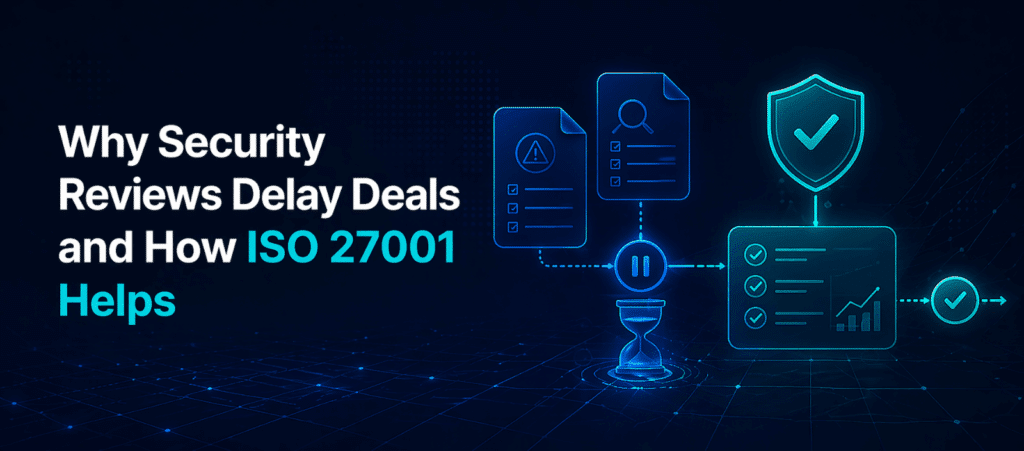
Many companies lose deals during security reviews, not during product evaluation.
Security now sits inside procurement. Buyers expect clear, structured evidence of controls, risk management, and governance. When that evidence does not exist or cannot be produced quickly, deals slow down or stop.
ISO 27001 changes how buyers evaluate vendors because it standardizes how organizations manage and prove security.
Key Takeaways
- Security reviews now act as a gating function in enterprise sales
- Most deal friction comes from a lack of proof, not a lack of controls
- Buyers rely on certifications like ISO 27001 to reduce evaluation effort
- Companies that prepare early move through procurement faster
- Security maturity directly affects deal velocity and win rates
The Deals You Never Knew You Lost
Most leadership teams assume they lose deals for obvious reasons. Price does not align. Features fall short. Timing does not work.
Those factors matter. But they do not explain a growing pattern in B2B sales. Deals stall late. Procurement slows down. Legal asks new questions. Then the deal goes quiet or disappears without clear feedback.
In many cases, security drives that outcome.
Buyers now evaluate vendors through structured security reviews. These reviews do not just assess whether a product works. They assess whether the company behind it can manage risk in a consistent and verifiable way.
When organizations cannot meet that expectation, buyers do not always explain why. They move to a vendor that can. This creates a blind spot. Companies assume they need to improve product or pricing. In reality, they lack a way to prove security in a format buyers trust.
ISO 27001 sits at the center of that shift. It does not just define controls. It defines how organizations manage risk, maintain evidence, and demonstrate consistency over time.
At the center of ISO 27001 is an Information Security Management System, or ISMS. An ISMS defines how an organization identifies risk, implements controls, maintains documentation, and ensures those controls operate consistently over time.
This system connects security practices to verifiable evidence, which allows organizations to respond to buyer requirements in a structured and repeatable way.
The Shift: Security is Now Part of the Buying Process
Enterprise procurement has changed in a measurable way.
Security now plays a formal role in vendor evaluation. Legal, compliance, and security teams review vendors as part of approval workflows. In many cases, this review begins before final contract discussions.
Buyers require structured responses to security questionnaires. They expect documented policies, defined controls, and clear ownership of risk.
This introduces a new requirement. Vendors must demonstrate that they operate a consistent and repeatable security program.
Many organizations do not prepare for this early. They respond when a deal triggers a security review. At that point, teams assemble documentation, answer questionnaires manually, and explain practices that are not formally defined.
This approach creates delays.
Procurement teams operate within defined timelines. If a vendor cannot provide clear and complete responses, the buyer must assess additional risk. That often leads to escalation, extended review cycles, or selection of another vendor.
In enterprise and regulated environments, security often acts as a gating factor.
Organizations that prepare treat security as part of the sales process. They maintain standardized evidence, align controls to recognized frameworks such as ISO 27001, and ensure consistency across responses. Organizations that do not prepare operate reactively. That gap becomes visible during procurement.
Where Deals Break Down
Deals rarely fail during early evaluation. They break down during validation.
Security reviews introduce friction at a stage where expectations are high, and timelines are constrained. Buyers expect vendors to provide clear, structured answers. When those answers are incomplete or inconsistent, the process slows.
Common failure points include:
- Incomplete or inconsistent responses to security questionnaires
- Lack of documented policies or formal control definitions
- Gaps between stated practices and available evidence
- Delays in producing the requested documentation
- Unclear ownership of security responsibilities
These issues do not always reflect weak security practices. Many teams follow reasonable controls but cannot present them in a structured way.
Buyers evaluate risk based on what they can verify. If a vendor cannot provide evidence that aligns with the questionnaire, the buyer treats that gap as increased risk.
This creates a predictable pattern.
Sales teams move quickly through early stages. Once procurement begins, progress slows. Security teams respond under pressure. Multiple stakeholders provide input. Responses require revision. Timelines extend.
Some buyers continue. Others delay decisions or select vendors that can respond more efficiently.
The breakdown does not come from a single missing control. It comes from the absence of a system that connects controls, documentation, and evidence.
The Real Problem: Proof, Not Practice
Many organizations focus on what they do. Buyers focus on what they can verify.
This creates a gap between internal practice and external validation.
A company may enforce access controls, manage vulnerabilities, and restrict data access. Without structured documentation and consistent evidence, those practices remain difficult to validate.
Buyers evaluate based on verifiable information.
This creates a trust gap. The organization believes it operates securely. The buyer cannot confirm that position through evidence.
Security questionnaires require precise and consistent answers. Audit requests require documented controls. Procurement teams expect alignment across responses.
Without a defined system, teams respond manually. Answers vary. Evidence appears incomplete. Buyers request clarification.
ISO 27001 addresses this through a management system approach. It sets requirements for how organizations identify risk, implement controls, maintain documentation, and retain evidence of effectiveness evidence. This structure supports consistent responses across deals and reduces reliance on individual knowledge.

Why ISO 27001 Changes the Evaluation Process
Buyers operate under constraints when evaluating vendors. They cannot conduct deep technical assessments for every provider. They rely on standardized frameworks to assess security posture efficiently.
ISO 27001 provides an externally audited and certified approach to information security management.
It demonstrates that an organization:
- Performs formal risk assessments
- Implements controls based on identified risk
- Maintains documentation and evidence
- Follows a continuous improvement process
This changes how buyers approach evaluation.
Buyers often use ISO 27001 certification as a starting point, then focus on specific areas based on risk. This can reduce the time required to establish baseline confidence.
The impact depends on the buyer and industry, but common outcomes include:
- More efficient security reviews
- Fewer clarification cycles
- Greater consistency in responses
- Improved alignment with procurement expectations
ISO 27001 does not replace due diligence. It provides structure that makes due diligence more efficient. Organizations without that structure must provide equivalent proof manually.
A structured ISO 27001 approach helps align risk, controls, and evidence before deals depend on them. This improves consistency and reduces delays during security reviews.
When This Becomes a Growth Constraint
Security challenges do not affect all companies equally. The impact increases as organizations scale.
Several conditions increase pressure:
- Expansion into enterprise accounts
- Entry into regulated industries
- Growth into international markets
- Increased deal volume across sales teams
In these environments, buyers expect structured security programs.
Early-stage organizations can manage reviews manually. That approach does not scale. As demand increases, response time slows and inconsistency increases.
This creates operational strain.
Sales teams depend on timely security responses. Security teams face growing demand without structured processes. Leadership sees longer sales cycles without clear cause.
At this stage, security becomes a constraint on growth. Organizations that address this early build systems that support scale. Organizations that delay often rebuild under pressure.
Where Companies Get It Wrong
Many organizations approach security based on immediate deal requirements rather than long-term structure.
Common issues include:
- Treating security as a late-stage requirement
- Reacting only when deals trigger reviews
- Selecting frameworks without aligning to internal processes
- Underestimating the effort required to build structured programs
A common pattern involves building controls incrementally. Over time, this creates fragmentation.
Controls exist without clear ownership. Documentation does not align with practice. Evidence collection becomes inconsistent.
When organizations adopt ISO 27001, they often need to formalize governance structures that previously existed in an informal or implicit form. The challenge comes from a missing system design rather than missing individual controls.
From Cost Center to Operational Requirement
Many organizations view security as a cost center. This view focuses on implementation effort and audit cost. It does not account for the operational role security plays in sales and procurement.
Security influences how buyers assess risk and approve vendors. Structured programs improve response consistency. Documented evidence supports validation. Defined processes reduce delays.
Security does not generate revenue directly, but it affects how efficiently organizations can complete deals. Organizations that recognize this treat security as an operational requirement, not a reactive function.
What a Proactive Approach Looks Like
A proactive approach aligns security with business operations.
This includes:
- Defining a formal risk management process
- Aligning controls to ISO 27001
- Maintaining consistent documentation and evidence
- Standardizing responses to security questionnaires
- Integrating security into procurement and sales workflows
This approach reduces reliance on manual effort and improves consistency.
Over time, organizations respond faster, reduce internal friction, and present a more structured security posture to buyers.
TrustNet’s Accelerator+
TrustNet’s Accelerator+ approach supports ISO 27001 alignment through a structured model that connects risk, controls, and audit requirements into a single system. In line with ISO requirements for segregation of duties, certification audits are conducted by an independent certification body, separate from advisory and readiness support activities.
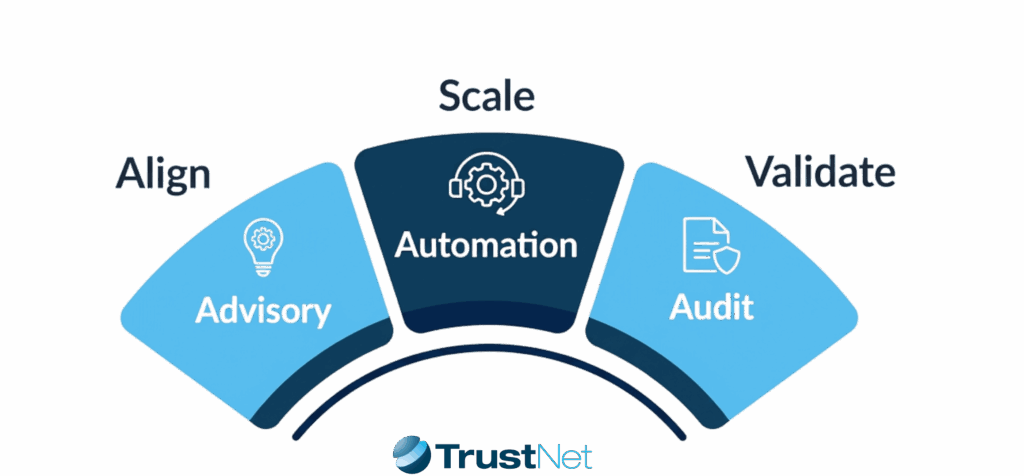

Advisory
We evaluate current practices against ISO 27001 requirements, defines scope, and perform structured risk identification. This process ensures that risks map directly to controls and establishes clear remediation priorities aligned to ISMS expectations.
Automation
Our automation platform supports documentation, control tracking, and evidence management required for ISO 27001. Continuous evidence collection helps maintain consistency between defined risks, implemented controls, and audit requirements.
Audit
Our seasoned experts perform ISO 27001 readiness assessments and provide certification support. Independent auditors validate that the ISMS aligns with the defined scope, controls address identified risks, and processes operate consistently over time.
Accelerator+ integrates advisory, automation, and audit into a single operating model that supports consistent execution, improves audit readiness, and reduces friction during procurement.
If security reviews slow down your deals, your program likely lacks structure in how risk, controls, and evidence align. An ISO 27001 readiness assessment highlights where gaps exist and what needs to change to support faster and more consistent responses during procurement.
Frequently Asked Questions
Companies lose deals during security reviews when they cannot provide clear and consistent evidence of their security practices. Buyers evaluate risk based on documentation, defined controls, and verifiable evidence. When responses are incomplete, inconsistent, or delayed, buyers often escalate concerns or select vendors that can demonstrate security more effectively.
ISO 27001 helps during procurement by providing a structured framework for managing and demonstrating information security. It shows that an organization performs formal risk assessments, implements controls based on risk, and maintains consistent documentation. This allows buyers to evaluate vendors more efficiently and reduces uncertainty during security reviews.
ISO 27001 is an international standard for information security management. It defines how organizations identify risk, implement controls, and maintain an Information Security Management System. It matters for business because it helps organizations demonstrate security maturity, align with buyer expectations, and support procurement requirements in enterprise environments.
ISO 27001 is not always required, but many enterprise buyers expect vendors to demonstrate structured security programs. In regulated industries and global markets, ISO 27001 often serves as a recognized standard that supports vendor approval and reduces friction during procurement.
ISO 27001 can affect deal velocity by reducing delays during security reviews. Organizations with structured documentation and consistent evidence can respond faster to buyer requirements. This improves the efficiency of procurement processes and reduces the number of follow-up questions.
Security questionnaires delay deals when organizations lack standardized responses or supporting evidence. Teams often respond manually, which leads to inconsistencies and additional review cycles. A structured framework such as ISO 27001 helps standardize responses and reduce delays.
Being secure refers to implementing controls that protect systems and data. Proving security requires documented processes, policies, and evidence that demonstrate those controls operate consistently. Buyers rely on proof because they must validate risk before approving vendors.
Companies typically implement ISO 27001 when they begin selling to enterprise customers, enter regulated industries, or expand into international markets. Implementing it early helps reduce rework and aligns security practices with future procurement requirements.
ISO 27001 implementation timelines vary based on organization size, existing controls, and internal maturity. Many organizations complete initial implementation in several months, followed by certification audits. Ongoing maintenance includes continuous improvement and periodic audits.
Delays in security reviews usually result from missing documentation, inconsistent responses, lack of evidence, and unclear ownership of controls. These issues often reflect gaps in system design rather than isolated control failures.
Organizations improve outcomes by implementing structured frameworks such as ISO 27001, maintaining consistent documentation, aligning controls to risk, and standardizing responses to common security requirements. This improves consistency and reduces friction during procurement.