


Executive Summary
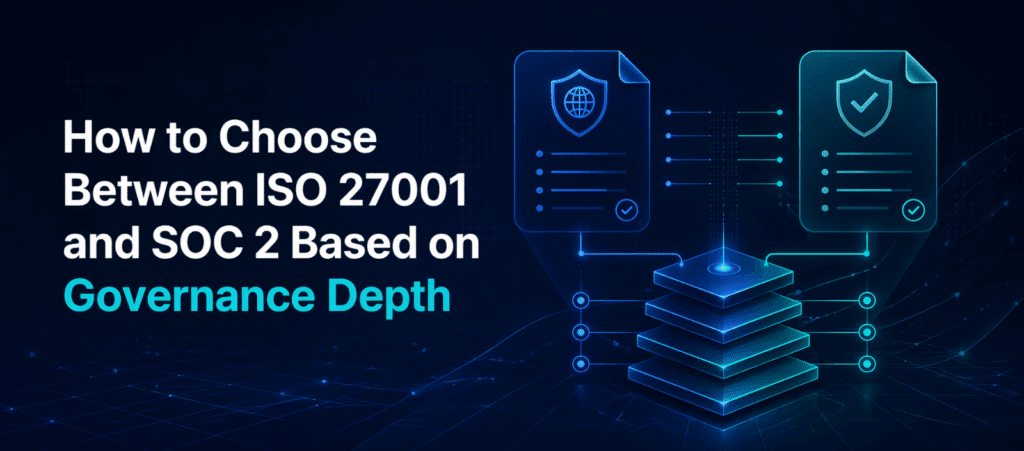
SOC 2 and ISO 27001 both evaluate information security practices, but they do so in fundamentally different ways.
SOC 2 is an attestation framework that evaluates whether an organization’s controls are suitably designed and, in the case of a Type II report, operating effectively over a defined period. ISO 27001 is a standard for establishing, implementing, maintaining, and continually improving an information security management system (ISMS).
That distinction matters because many teams approach both frameworks as equivalent audit paths. In practice, SOC 2 emphasizes validating consistent control execution, while ISO 27001 requires a structured system that governs how information security controls are selected, managed, and improved over time.
Most inefficiencies do not come from missing controls. They arise when governance structures remain undefined, risk assessments do not clearly drive control selection, or evidence does not reflect consistent operational practices.
ISO 27001 places risk management at the center of the ISMS, and reinforces the need to maintain a clear relationship between identified risks, selected controls, and the defined scope. SOC 2 does not require the same level of formal governance, offering greater flexibility but potentially introducing inconsistency as programs scale.
Key Takeaways
- SOC 2 (Type II) evaluates control design and operating effectiveness over a defined period.
- ISO 27001 requires a formal ISMS that governs how controls are managed and continually improve
- A primary difference between the frameworks is governance depth rather than the types of controls covered.
- SOC 2 allows flexible control environments, while ISO 27001 requires structured alignment between risk, controls, and scope.
- In practice, most rework tends to occur when governance gaps emerge rather than when individual controls fail.
Why Most ISO 27001 vs SOC 2 Decisions Miss the Point
Many teams start with the wrong question.
They ask whether ISO 27001 or SOC 2 is better, which leads to surface-level comparisons and decisions often influenced by speed or customer pressure rather than long-term program design.
A more useful question focuses on how the program will operate after the audit. Each framework shapes how teams define risk, manage controls, and maintain evidence. Those choices influence whether the program remains consistent as the organization grows or requires repeated adjustment.
Teams that do not account for governance early often introduce hidden complexity. That complexity may not fully surface during early audits, but it tends to appear later as inconsistent execution, audit friction, and rework across teams.
What SOC 2 Actually Evaluates in Practice
Many teams treat SOC 2 as a certification, but it functions as an attestation. Auditors evaluate whether controls are designed appropriately and operate effectively over a defined period through evidence review, interviews, and walkthroughs.
This provides a structured way to demonstrate that controls function as intended. SOC 2 does not prescribe a formal governance system for how those controls are managed or evolve over time.
That distinction leads to different outcomes depending on how organizations implement SOC 2 internally.
In stronger environments, teams integrate SOC 2 into their operating model. They define clear ownership, maintain consistent evidence, and align controls with real processes. Control execution becomes predictable because it follows defined practices.
In weaker environments, teams design controls primarily to meet audit requirements and struggle to sustain them. Ownership may shift, evidence quality may decline, and execution can depend on individual effort rather than repeatable processes.
Both types of environments can meet audit requirements. Only one tends to scale with less friction as the organization grows.
What ISO 27001 Requires Beyond Controls
ISO 27001 shifts the focus from individual controls to the system that governs them. It requires an Information Security Management System that defines how the organization identifies risk, selects controls, assigns ownership, and evaluates effectiveness over time.
This requirement is designed to enforce alignment across areas that many teams treat separately. Scope definition, risk assessment, control design, and evidence must connect in a consistent and defensible way.
In well-structured implementations, risk assessments directly influence which controls exist and how teams operate them. Ownership remains stable, and internal audits surface issues before they reach external auditors.
In weaker implementations, documentation may appear complete, but does not reflect actual operations. Risk assessments may exist, but do not meaningfully guide decisions, and internal audits may fail to identify material gaps.
ISO 27001 does more than add structure. It exposes whether that structure operates effectively in practice.
The Real Difference: Governance Depth
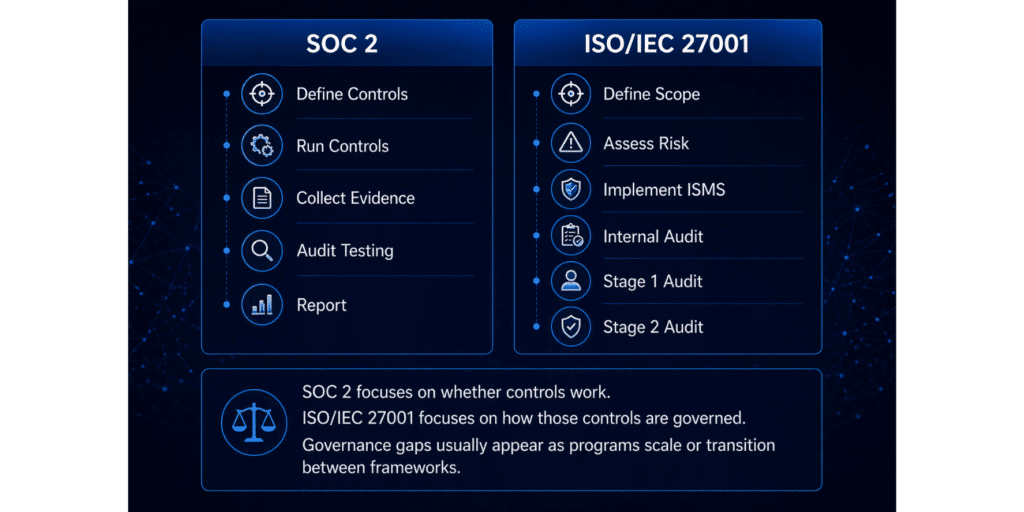
The difference between SOC 2 and ISO 27001 comes down to governance depth. SOC 2 evaluates whether controls work, while ISO 27001 evaluates whether a system exists to manage those controls over time.
This difference becomes more visible as organizations grow. Programs built around SOC 2 alone can perform well early but may begin to drift if governance is not defined explicitly. Without structured governance, consistency can depend more heavily on individuals than on established processes.
Programs built with governance in mind tend to maintain alignment because they define how decisions are made, how risks are managed, and how controls adapt as the environment changes.
The practical difference shows up in how programs respond to change:
- SOC 2 environments can meet audit requirements even when control execution varies across teams
- ISO 27001 environments are designed to enforce consistency through governance structures
Governance ultimately determines whether a program remains stable or requires repeated correction as complexity increases.
When SOC 2 is the Right Choice
SOC 2 works well when organizations need to demonstrate control execution within defined timeframes, especially in early-stage or scaling SaaS environments where customer requirements drive compliance timelines. The timeline depends on the report type, with Type 1 focusing on design and Type 2 requiring an observation period.
SOC 2 allows teams to define controls based on their environment and align them to the Trust Services Criteria. This flexibility supports faster implementation and accommodates a wide range of operating models.
SOC 2 does not require a formalized governance system such as an ISMS. Organizations must still define policies, perform risk assessments, and assign control ownership, but the framework allows variability in how those elements are structured and maintained.
That flexibility can lead to inconsistent implementation across teams if governance is not defined deliberately. As organizations grow, they often need to introduce additional structure to maintain consistency in control execution and evidence.
SOC 2 prioritizes control validation. It does not require a formal governance model that defines how controls are managed and improved over time.
When ISO 27001 Becomes Necessary
ISO 27001 becomes more relevant when control execution alone no longer supports the organization’s needs. This often occurs as teams scale, operate across regions, or engage with enterprise customers that expect more structured governance.
At that point, the organization needs a consistent way to manage risk, align controls to that risk, and maintain that alignment over time.
ISO 27001 requires an Information Security Management System that defines how risks are identified, evaluated, and treated, along with how controls are selected and maintained. It also requires internal audits and management review as part of ongoing governance.
This structure increases implementation effort but supports more consistent program operation as the organization grows.
Teams that treat ISO 27001 as an operating model, rather than only a certification requirement, tend to realize more value from the framework.
A structured approach to framework selection helps align governance, controls, and audit expectations early, reducing rework as compliance requirements evolve.
Where Organizations Get This Wrong
Most issues do not come from the frameworks themselves but from how teams apply them. Organizations often choose based on external pressure instead of internal readiness, treat SOC 2 as a permanent solution, or assume ISO 27001 simply extends existing controls.
Another common issue is building controls without a clear risk model. Without that foundation, controls exist but lack direction, and evidence does not tell a consistent story.
These decisions create predictable problems:
- Audit findings that require rework
- Inconsistent control execution across teams
- Evidence that does not reflect actual operations
- Delays when transitioning between frameworks
Governance gaps drive these outcomes because they remain hidden until the program faces scale or complexity.
What Happens When Teams Move from SOC 2 to ISO 27001
Many organizations begin with SOC 2 and later pursue ISO 27001. While controls and some evidence transfer, governance structures do not.
Teams must define scope more precisely, formalize risk management, and align controls within an ISMS. During this process, they often discover that existing controls do not map clearly to risk or that ownership lacks consistency.
This leads to rework across multiple areas:
- Documentation gets rewritten to align with ISMS requirements
- Control ownership gets reassigned or clarified
- Risk assessments get rebuilt to support control decisions
The issue is not failed controls. The issue is missing governance, which becomes visible only when a structured system is required.
What a Well-Structured Approach Looks Like
Strong programs align governance and controls from the beginning. They define a risk model that drives control selection, assign consistent ownership, and ensure that evidence reflects real operations rather than staged activity.
They also design governance structures that support multiple frameworks, which reduces duplication and avoids rebuilding the program as requirements evolve.
This approach requires more coordination early but prevents larger disruptions later.
How to Decide Based on Your Situation
Use this as a filter:
- Do you need speed or long-term structure
- Are customers asking for a specific framework
- Does your team have governance maturity
- Will you need ISO 27001 within the next 12 to 24 months
The answers to these questions clarify whether the priority is immediate validation or long-term stability.
Governance Decisions Determine Long-Term Outcomes
Choosing between SOC 2 and ISO 27001 is a strategic decision that shapes how a compliance program operates over time. SOC 2 validates that controls work, while ISO 27001 ensures those controls remain aligned with risk as the organization evolves.
Teams that focus only on passing audits often face rework as requirements expand. Teams that align governance early build programs that scale more consistently and require fewer corrections.
TrustNet’s Accelerator+ Approach
TrustNet’s Accelerator+ approach supports both SOC 2 and ISO 27001 through a structured model that aligns governance, control execution, and audit expectations across frameworks.
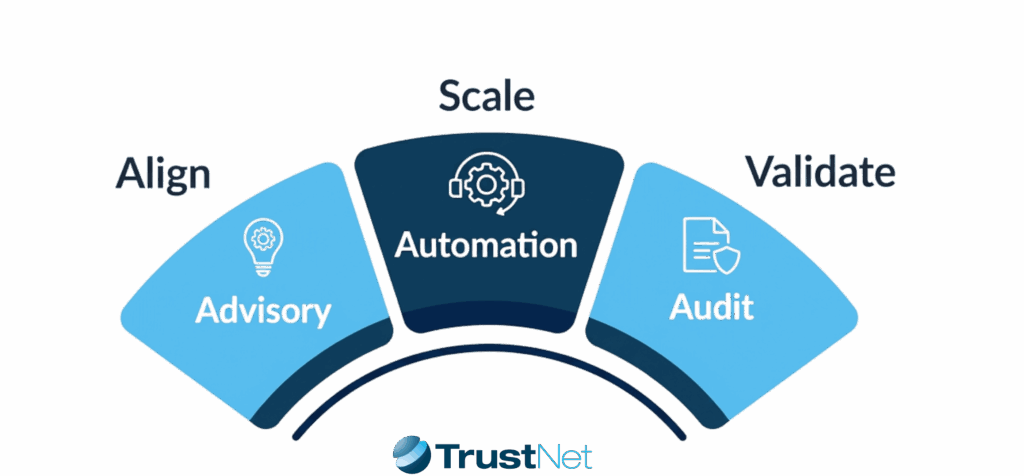

Advisory
We evaluate control environments and governance maturity to determine the right framework strategy. This includes mapping risks, identifying gaps, and aligning control design with long-term objectives.
Automation
Our automation platform supports governance, risk, and compliance activities by centralizing evidence, maintaining documentation, and managing compliance across frameworks.
Audit
Our seasoned experts deliver structured audit engagements that validate control effectiveness, confirm alignment with risk and scope, and provide independent reporting.
Accelerator+ brings these elements into a single operating model that reduces duplication, strengthens governance depth, and improves consistency as organizations scale.
Before committing to SOC 2 or ISO 27001, ensure your governance model, controls, and audit approach align with how your program will scale, not just how it will pass current requirements.
Frequently Asked Questions
SOC 2 evaluates whether controls are designed and operating effectively over a defined period. ISO 27001 requires an Information Security Management System that governs how controls are selected, implemented, and improved over time.
SOC 2 often requires less upfront structure and can be completed faster, especially for a Type I report. ISO 27001 requires formal governance processes, including risk management, internal audits, and continuous improvement, which typically increases implementation effort.
Many SaaS companies pursue SOC 2 first to meet customer requirements quickly. Organizations that expect to scale, enter enterprise markets, or operate internationally should evaluate whether ISO 27001 governance requirements will become necessary.
Yes. Organizations can align controls and evidence across both frameworks. ISO 27001 requires additional governance elements such as a formal ISMS, which can support multiple frameworks when designed correctly.
Organizations often transition when they need more structured governance, stronger risk management processes, or broader recognition across international markets. SOC 2 validates control execution, while ISO 27001 provides a system to manage those controls consistently.
Rework typically occurs when governance structures are not defined early. Organizations may need to formalize risk management, redefine scope, and align controls within an ISMS, even if controls already exist.
SOC 2 does not require a formal ISMS. However, organizations often implement governance structures internally to improve consistency and prepare for future frameworks.
Some enterprise customers, especially in global or regulated markets, expect ISO 27001 or equivalent governance frameworks. Requirements vary by industry and customer.
Some SOC 2 evidence can be reused, particularly for control operations. Organizations still need to align that evidence within an ISMS and connect it to risk management processes.
Organizations should align governance, controls, and audit expectations early. A structured approach reduces duplication, supports scaling, and minimizes rework as requirements expand.