


Executive Summary
ISO 27001 sets out requirements for an information security management system (ISMS). ISO defines the standard as a framework for establishing, implementing, maintaining, and continually improving that system, with a clear focus on managing information security risk. ISO also clarifies that external certification bodies, not ISO itself, issue certificates.
That distinction matters because many organizations picture certification as a single audit event. In practice, certification works like a staged engagement. Organizations define the ISMS scope, implement and operate the system, and perform internal audits and management review. The certification body then conducts a Stage 1 audit to review documented information, confirm scope and readiness, and plan the audit, followed by a Stage 2 audit that evaluates the effectiveness of the ISMS in operation. ISO and IAF guidance describe Stage 1 as preparation for Stage 2 rather than a full assessment of system effectiveness.
Most delays do not start with the auditor’s calendar. Teams create them earlier when the scope stays fuzzy, risk treatment does not connect clearly to controls, or evidence collection starts too late.
ISO 27001 centers the ISMS on risk management, and ISO reinforces that organizations need a defensible link between identified risk and selected controls. It also requires organizations to define an ISMS scope that is appropriate to their context and boundaries, and consistent with their risk treatment approach.
Key Takeaways
- ISO 27001 certification involves a staged management system audit process, not a single audit event
- Stage 1 focuses on readiness, scope, and planning for Stage 2. Stage 2 tests the management system more fully
- ISO 27001 requires a risk assessment process, internal audits, and management review as part of the ISMS
- Certification bodies issue certificates. ISO does not certify organizations
- The strongest engagements keep scope, risk treatment, controls, and evidence aligned from the start
Why the Process Feels Less Clear Than Teams Expect
Most security and compliance teams understand the headline requirement. They need an ISMS that fits ISO 27001. The standard frames this as a management system for identifying and managing risks to the security of information the organization owns or handles.
The confusion starts when teams move from understanding the standard to running a certification engagement. ISO explains that certification comes from an independent certification body, while ISO and IAF guidance on two-stage audits show that the audit itself follows a readiness-first structure. That means organizations need more than documents. They need a management system that auditors can scope, review, and test in stages.
That gap explains why some teams feel prepared and still lose time. They may have policies, a control list, and a target date, but they have not yet connected scope, risks, control selection, and operating evidence tightly enough to move cleanly from one phase to the next.
What the Engagement Usually Includes
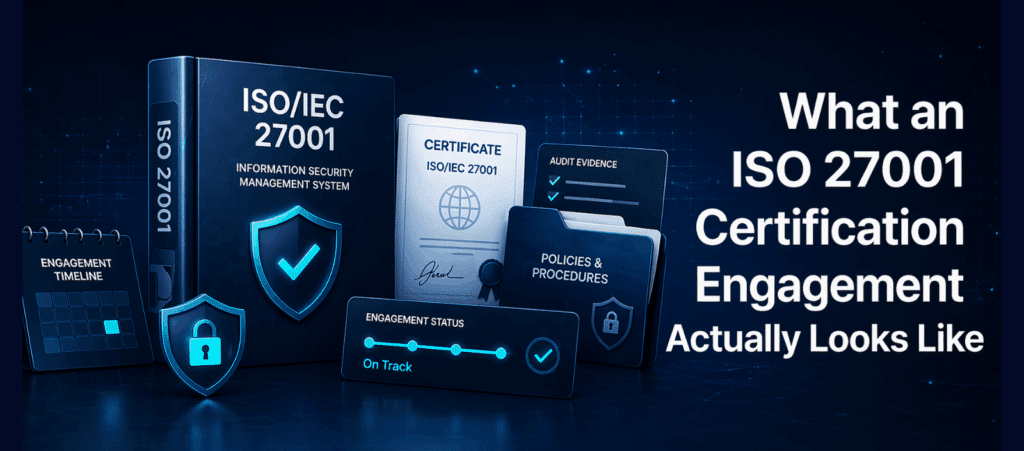
A typical ISO 27001 certification engagement moves through a series of linked activities. Organizations usually define scope, perform or refine their risk assessment and treatment approach, implement and operate the ISMS, conduct internal audits and management review, complete a Stage 1 audit that checks readiness, address any identified gaps or findings, and then proceed to a Stage 2 audit that tests the system in operation with an external certification body.
ISO 27001 define requirements for establishing, implementing, maintaining, and continually improving an ISMS, and the two-stage audit guidance explains how certification bodies structure the external audit side of that process.
The exact project plan varies by company size, technical environment, and existing maturity. The structure does not change much. A team still needs to define the ISMS, prove that leadership and governance mechanisms function, and show that the organization actually operates the controls and processes it documents.
Phase 1: Readiness and Gap Assessment
Teams often treat readiness as a pre-audit checklist. That view misses the real job. Readiness work should pressure test scope, risk methodology, documentation, and operating reality before the certification body arrives.
ISO 27001 places risk management at the center of the ISMS. Conformity means the organization has put in place a system to manage risks related to the security of data it owns or handles.
That means a useful readiness review should answer practical questions.
- What sits inside the ISMS scope
- Which information risks matter inside that scope
- Which controls the organization selected and why
- How the organization documents that logic in its Statement of Applicability and related ISMS records
When teams skip this depth, the weaknesses tend to show up later as scope changes, weak control rationale, or a scramble to explain how risk treatment decisions connect to the implemented control set.
Phase 2: ISMS Implementation and Control Alignment
Implementation does not stop at producing documents. ISO 27001 is a management system standard, and management system standards expect organizations to operate the system, maintain it, and improve it over time.
In practice, this phase forces a company to turn decisions into repeatable operating behavior. The organization needs a defined and functioning risk assessment process, a risk treatment approach, documented decisions on applicable controls, and evidence that teams follow the processes the ISMS describes. ISO’s SoA and Annex A reinforce that the organization needs a coherent rationale for selected controls and a clear relationship between risks, control choices, and the information security objectives of the ISMS.
This phase also exposes the gap between “we have a policy” and “we run the process.” A team can write an access review procedure in a day. It takes longer to prove that the organization performs that review consistently, records the output, and corrects exceptions. The same principle applies across incident management, supplier controls, change practices, and other areas that sit inside the ISMS.

If your team is preparing for ISO 27001 certification, a structured readiness review can surface scope, risk treatment, and evidence issues before the certification body tests them.
Phase 3: Internal Audit and Management Review
ISO and IAF guidance on two-stage certification audits states that Stage 1 includes evaluating whether internal audits and management reviews are being planned and performed, and whether the implementation level of the management system supports readiness for Stage 2. That point matters because it confirms that internal audit and management review are not side activities. They help demonstrate readiness for certification.
A strong internal audit does not just confirm that documents exist. It tests whether the ISMS works as designed. It should challenge scope assumptions, sample evidence, and verify that the organization can explain how it assesses and treats risk in practice.
Management review serves a different purpose. Leadership uses it to evaluate the management system and direct action. If that review lacks real substance, teams often discover the weakness during certification when auditors ask how top management oversees the ISMS.
Phase 4: Stage 1 Audit
ISO and IAF guidance on two-stage certification audits describes Stage 1 as part of the certification audit that reviews and evaluates the organization-defined scope, supports planning for Stage 2, and helps the auditor understand the organization and evaluate readiness for certification.
The same guidance lists activities such as reviewing management system documentation, evaluating site-specific conditions, collecting information about scope and processes, and checking whether internal audits and management reviews are planned and performed.
For an ISO 27001 engagement, that usually means the certification body wants a clean view of the ISMS scope, the risk assessment and treatment approach, the key documentation, and the organization’s state of readiness.
Teams that enter Stage 1 with a fuzzy scope or a weak Statement of Applicability often create problems for themselves because the auditor uses Stage 1 to frame Stage 2.
Stage 1 should reduce uncertainty. It should not introduce basic ambiguity. When it does, the engagement usually slows down.
Phase 5: Stage 2 Audit
Stage 2 is the fuller certification audit. ISO and IAF guidance on two-stage certification audits positions Stage 1 as the preparation and readiness check for this second stage. ISO 17021-1 sets the generic requirements for bodies that audit and certify management systems, while ISO 27006-1 adds information security-specific requirements for bodies that certify ISO 27001 ISMSs.
At this point, the certification body evaluates whether the ISMS conforms to ISO 27001 requirements and whether it is effectively implemented and operating in practice. Auditors will look for evidence that the organization runs the defined processes, manages information security risks through the ISMS, and maintains control decisions that make sense for the scoped environment.
This phase usually exposes problems that the team already carried into the audit. Weak scope definition, insufficient evidence, and control selections that do not match the actual environment become harder to defend once the certification body starts testing the system as operated.
Where Engagements Usually Break Down
Most certification engagements do not break because the team misunderstands the phrase “ISO 27001.” They break because the team fails to keep the core pieces aligned.
The first failure point sits in scope. If the organization cannot define what sits inside the ISMS and what risks matter inside that scope, control selection gets weaker from the start.
The second failure point sits in the control rationale. Some teams select controls because a template says they should. ISO 27001 does not frame the ISMS as a blind checklist. ISO emphasizes risk management, and the SoA guidance exists precisely because organizations need to explain applicability decisions, not just inherit them.
The third failure point sits in evidence discipline. A company can operate useful security practices and still struggle in certification if it cannot show how those practices connect to the ISMS and the selected controls over time. That issue usually surfaces late because teams do not test their own evidence rigorously enough before Stage 1 and Stage 2.
What a Well-Run Engagement Looks Like
A well-run engagement starts with a clear scope and a risk assessment process that the organization can actually explain. It continues with an ISMS that management oversees, internal audits that challenge the system honestly, and implementation that produces consistent records of how teams operate the selected controls.
The best teams do not treat Stage 1 as a formality or Stage 2 as a surprise. They use the earlier phases to reduce uncertainty. They know why each major control applies, how it connects to a risk treatment decision, and what evidence demonstrates its operation inside the scoped environment.
TrustNet’s Accelerator+ Approach
TrustNet’s Accelerator+ approach supports ISO 27001 certification through a structured model that aligns risk, control design, and audit expectations across the full engagement lifecycle.
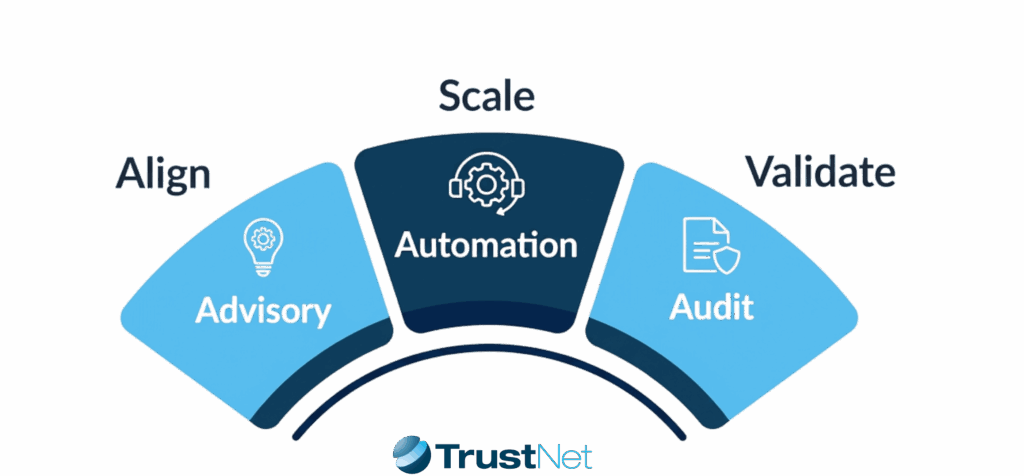

Advisory
TrustNet evaluates operational practices against ISO 27001 requirements and performs structured risk identification and validation. This includes confirming that all in-scope systems, processes, and third parties are accounted for, and that identified risks connect clearly to control coverage.
Automation
TrustNet’s automation platform supports governance, risk, and compliance activities across the organization. Teams manage evidence collection, maintain control documentation, and track compliance across frameworks such as ISO 27001, SOC, and PCI.
Audit
TrustNet delivers structured audit engagements focused on planning, evidence evaluation, and control testing. Auditors assess whether risk assessments align with scope, validate that controls address identified risks, and issue independent reports on control design and operating effectiveness.
Accelerator+ brings advisory, automation, and audit coordination into a single operating model. That model strengthens alignment across the ISO 27001 engagement, supports consistent control execution, and improves predictability across certification activities. In line with ISO requirements for separation of duties, certification audits are performed by an independent certification body.
Before your organization enters its ISO 27001 certification cycle, validate the parts that usually create delays: scope, risk treatment logic, control applicability, and evidence readiness.
Frequently Asked Questions
ISO describes ISO 27001 as the standard that sets requirements for an ISMS and supports establishing, implementing, maintaining, and continually improving that system. ISO also links conformity to managing risks related to the security of data that the organization owns or handles.
No. ISO states that it does not perform certification or issue certificates. External certification bodies handle certification.
ISO and IAF guidance says Stage 1 primarily supports scoping and planning for Stage 2 and helps the auditor understand the organization and evaluate readiness for certification. It can include reviewing documentation, gathering scope information, and checking whether internal audits and management reviews are planned and performed.
Stage 1 checks readiness, scope, and planning inputs for the main certification audit. Stage 2 serves as the fuller certification audit after the certification body has enough information to test the management system more completely. ISO and IAF guidance on two-stage audits supports that distinction.
Yes. ISO and IAF guidance on two-stage certification audits specifically says Stage 1 includes evaluating whether internal audits and management reviews are being planned and performed, and whether the management system implementation supports readiness for Stage 2.
ISO committee guidance describes the Statement of Applicability as a key way to use and interpret ISO 27001 control applicability requirements. It helps explain which controls apply and why. That makes it central to explaining how risk treatment decisions translate into the control environment.
Documentation alone does not resolve scope ambiguity, weak control rationale, or poor evidence discipline. ISO’s public materials place IS 27001 inside a risk-based ISMS model, and ISO committee guidance reinforces the need to connect risk assessment, control applicability, and the scoped environment coherently.
Start with ISO’s public page for ISO 27001, ISO’s certification page, and relevant ISO committee resources from ISO JTC 1/SC 27. For audit structure, ISO and IAF guidance on two-stage certification audits helps explain how certification bodies usually approach Stage 1 and Stage 2.