


Organizations rarely plan for SOC 2 report delays. Most teams enter an audit with defined controls, documented policies, and a completed risk assessment. They expect the process to follow a predictable timeline.
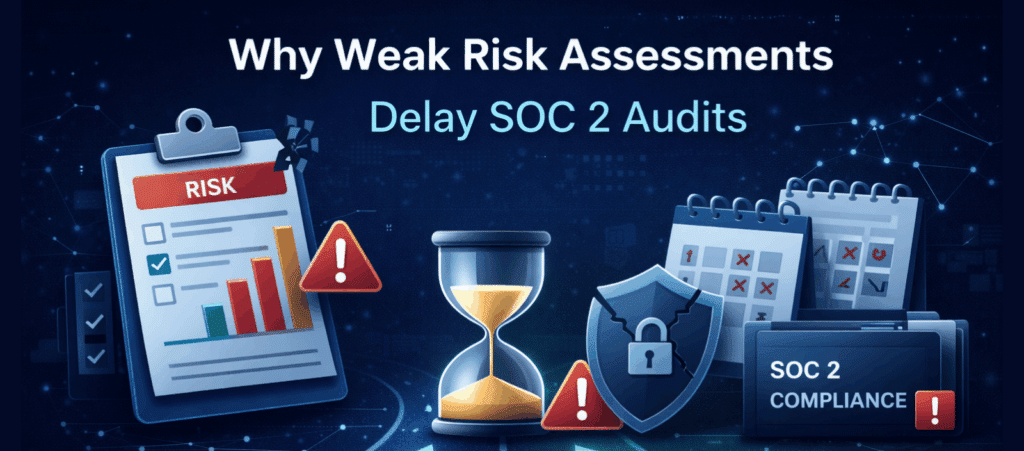
Delays occur when auditors identify issues that affect scope, control alignment, or testing strategy. These issues do not always result in immediate findings. They often trigger rework, additional validation, and extended timelines.
In many cases, the root cause sits upstream of control execution. It begins with the risk assessment.
Risk assessments outline what falls in scope, which risks require mitigation, and how controls address those risks. When a risk assessment lacks completeness, accuracy, or alignment with actual operations, auditors reduce reliance on it. As a result, they expand testing, reassess scope completeness, and request additional supporting evidence. These actions frequently extend audit timelines and delay report issuance.
What a SOC 2 Risk Assessment is Supposed to Do
A SOC 2 risk assessment establishes the foundation for the control environment. It connects business operations, system architecture, and security objectives to defined risks and corresponding controls.
A complete risk assessment identifies risks across systems, processes, vendors, and data flows. It evaluates each risk based on likelihood and impact, then maps those risks to controls that mitigate them. It also supports audit scope decisions and documents the rationale behind risk inclusion, exclusion, and prioritization.
This process does not function as a compliance formality. It drives how the organization defines its control environment and how auditors evaluate that environment.
Teams often treat risk assessments as static documentation created during readiness preparation. That approach creates misalignment because systems evolve, processes change, and risk profiles shift over time. A risk assessment must reflect the current state of the environment and demonstrate a clear relationship between identified risks and implemented controls.
How Auditors Use Risk Assessments
Auditors rely on the risk assessment during planning, scoping, and testing. They use it to validate that the audit scope includes all relevant systems and processes and to assess whether identified risks align with the organization’s environment.
Auditors evaluate whether controls are appropriately designed and implemented to address those risks and use the risk assessment to determine areas requiring deeper or expanded testing.
Auditors do not accept the risk assessment at face value. They corroborate it against system architecture, data flows, and operational practices. If the risk assessment omits key systems, understates risk levels, or lacks clear control mapping, auditors adjust their approach. This may include reassessing scope completeness, identifying gaps in control coverage, and increasing testing depth or sample sizes. Each adjustment can introduce delays to the audit timeline.
Most Common Risk Assessment Failures
1. Incomplete Risk Identification
Teams often define risks at a high level and fail to account for all relevant systems, vendors, or processes. This gap frequently appears in third-party services, internal supporting tools, and system integrations that handle or transmit data.
Teams may assume that coverage of core infrastructure satisfies audit expectations. However, auditors evaluate the full system environment, including all supporting systems and integrations. When auditors identify missing elements, they require scope updates and additional control validation, resulting in rework and audit delays.
2. Generic or Template-Based Risk Assessments
Many organizations rely on standard risk libraries or template-driven assessments that include broad risk statements and generic control mappings. These assessments often lack alignment with actual system architecture and operational workflows.
Teams assume that using a template satisfies audit expectations. Auditors expect risk assessments to reflect the organization’s specific environment. When risks do not align with actual operations, system architectures, or documented processes, auditors question control relevance and request clarification. This slows scoping and may require updates to both the risk assessment and control set.
3. Weak or Missing Risk-to-Control Mapping
Some risk assessments identify risks without clearly linking them to mitigating controls, resulting in risks without documented responses and controls without defined risk justification.
Teams may assume that documenting risks and controls separately provides sufficient coverage. However, auditors generally expect explicit risk-to-control traceability demonstrating how each control mitigates identified risks.
When this mapping does not exist, auditors must reconstruct the relationship through additional inquiries and walkthroughs, often resulting in repeated reviews and extended audit timelines.
4. Static Risk Assessments
Organizations often complete a risk assessment during readiness activities and do not routinely update it as the operating environment changes. Over time, systems evolve, infrastructure expands, and data flows shift.
As a result, organizations may continue to rely on an assessment that no longer reflects current conditions. During audits, auditors compare the documented risk assessment and defined scope to the actual environment. When discrepancies are identified, auditors may question the accuracy of the scope and the adequacy of control coverage. This often results in requests for updates and revalidation, which can delay testing and extend the overall audit timeline.
5. Misaligned Risk Ratings
Risk assessments rely on likelihood and impact scoring to prioritize mitigation efforts. When scoring lacks consistency, documented criteria, or accuracy, gaps in control coverage can occur.
High-impact risks may be undervalued, while critical systems may lack controls commensurate with their business importance or data sensitivity. This often results from subjective scoring or inconsistent risk methodologies across teams.
Auditors assess whether risk ratings align with system criticality, data classification, and actual threat exposure. When ratings do not reflect actual risk exposure, auditors increase scrutiny, request additional validation, and may expand testing, frequently extending audit timelines.
6. Lack of Ownership and Accountability
Risk assessments require continuous maintenance. Without clearly defined ownership, they become outdated and inconsistent.
Teams often complete risk assessments during readiness activities but fail to assign responsibility for ongoing review and updates. Auditors expect evidence of assigned ownership, defined review cycles, and documented updates.
When ownership is unclear, auditors request additional validation and supporting documentation, increasing audit effort, slowing progress, and introducing unnecessary delays.
7. Risk Assessments That Do Not Reflect Actual Operations
In some cases, the documented risk assessment does not reflect how systems and processes operate in practice. This misalignment appears when documentation diverges from actual workflows, system architecture, or the current in-scope environment.
Auditors evaluate alignment through inquiry, system inspection, and re-performance of key processes and controls. When discrepancies are identified, auditors typically increase the extent of testing and request additional supporting evidence. This often results in increased audit effort and may delay audit completion.

Why These Failures Cause Delays, Not Just Findings
Evidence issues affect control validation and typically result in findings. Risk assessment failures, however, change how the audit has to be carried out.
When auditors cannot rely on the risk assessment, they must re-evaluate scope, validate system inclusion and exclusion decisions, reassess control coverage, and perform additional inquiries and testing. These actions interrupt audit flow and extend timelines.
Delays increase audit costs and create scheduling challenges, especially when reports align with external commitments.
Designing Risk Assessments That Support Audit Readiness
Organizations reduce audit delays when they treat risk assessments as part of their operational environment rather than static documentation.
Each risk should map directly to one or more controls, with clear documentation that supports this relationship. Teams should update risk assessments when systems, infrastructure, or services change to maintain alignment with actual operations.
The assessment must reflect real system behavior, architecture, and workflows. Assigning clear ownership ensures consistency and accountability over time.
Before audit fieldwork begins, teams should validate that the risk assessment supports scope, aligns with current operations, and accurately reflects risk exposure.
Quick Self-Assessment Checklist
- Does the risk assessment reflect the current environment?
- Are all systems, vendors, and processes included?
- Are risks clearly mapped to controls?
- Do risk ratings align with actual impact and likelihood?
- Can the team justify scope decisions with clear rationale?
- Is ownership assigned and documented?
Risk Assessments Drive Audit Timelines
Risk assessments shape how auditors define scope, evaluate controls, and plan testing. When the risk assessment lacks completeness or alignment with actual operations, the audit slows down. Scope changes, gaps in control coverage, and additional validation steps extend timelines and often delay report issuance.
Organizations that treat risk assessments as active components of their control environment reduce this friction. They maintain alignment between risks, systems, and controls, which allows auditors to proceed without rework or expanded scrutiny.
SOC 2 readiness requires coordination across risk identification, control design, execution, and supporting evidence. Teams must ensure that risk assessments remain complete, current, and defensible under audit scrutiny.
TrustNet’s Accelerator+
TrustNet’s Accelerator+ approach supports this process through a structured and integrated model that aligns risk assessments with control design and audit expectations.


Advisory
TrustNet evaluates operational practices against relevant compliance benchmarks and performs structured risk identification and validation. This includes confirming that all in-scope systems, processes, and vendors are represented, and that risks map clearly to control coverage.
The process produces defined remediation priorities aligned to SOC 2 and related frameworks.
Automation
Our automation platform supports governance, risk, and compliance activities across the organization. Teams manage evidence collection, maintain control documentation, and monitor compliance across frameworks such as SOC, PCI, and ISO 27001. Continuous evidence collection supports consistency between documented risks, implemented controls, and audit evidence.
Audit
TrustNet conducts structured audit engagements focused on planning, evidence evaluation, and control testing. Auditors review whether risk assessments align with scope, validate control coverage relative to identified risks, and issue independent reports that confirm control design and operating effectiveness.
Accelerator+ integrates advisory, automation, and audit into a single operating model. This approach strengthens the completeness and alignment of risk assessments, supports consistent control execution, and enables more predictable audit outcomes across SOC 2 and other frameworks.
Before entering a SOC 2 audit, validate that your risk assessment supports scope, aligns with your control environment, and can withstand audit scrutiny.
Frequently Asked Questions
A SOC 2 risk assessment identifies risks that affect systems, data, and processes within the audit scope. It evaluates each risk based on likelihood and impact, then maps those risks to controls that mitigate them. It also supports scope decisions and documents why specific systems, services, and processes are included or excluded. Auditors use this assessment to understand how the organization identifies and manages risk.
Risk assessment issues affect audit scope, control alignment, and testing strategy. When auditors identify gaps or inconsistencies, they must reassess scope completeness, validate control coverage, and perform additional testing. These steps introduce rework during planning and fieldwork, which extends timelines and often delays report issuance.
Auditors expect a risk assessment that reflects the current environment and includes all relevant systems, vendors, and processes. They look for clear mapping between risks and controls, consistent risk evaluation, and documented rationale for scope decisions. They also expect the assessment to align with actual system architecture and operational practices.
A risk assessment supports and justifies audit scope by identifying which systems and processes present relevant risks. It helps determine which environments, services, and controls auditors must evaluate. If the risk assessment excludes relevant systems or understates risk exposure, auditors may reassess scope and expand testing.
Teams should update the risk assessment whenever systems, infrastructure, vendors, or business processes change. Organizations should also perform periodic reviews to confirm that the assessment remains aligned with current operations. Outdated assessments create gaps between documented scope and actual environments, which increases audit risk.
A company may still complete a SOC 2 audit with a weak risk assessment, but auditors will reduce reliance on it. They will increase testing depth, perform additional validation, and scrutinize scope decisions more closely. This often leads to delays and may affect conclusions about control effectiveness.
Misalignment occurs when organizations define risks without mapping them to controls, rely on generic templates, or fail to update assessments as systems evolve. It also occurs when documentation does not reflect actual system architecture or operational workflows. This disconnect creates gaps in control coverage relative to identified risks.
Auditors validate risk assessments through inquiry, walkthroughs, and comparison to system architecture and data flows. They assess whether risks align with actual operations and whether controls address those risks. They may also perform re-performance procedures or review supporting documentation to confirm consistency.
Common indicators include incomplete system coverage, missing risk-to-control mapping, inconsistent risk ratings, and outdated documentation. Auditors also identify issues when the assessment does not align with actual operations or when scope decisions lack clear justification.
Organizations improve their process by mapping each risk to specific controls, updating assessments regularly, and aligning documentation with actual systems and workflows. They should assign clear ownership, define consistent risk evaluation criteria, and validate scope and control coverage before audit fieldwork begins. These steps reduce audit friction and support more predictable timelines.