


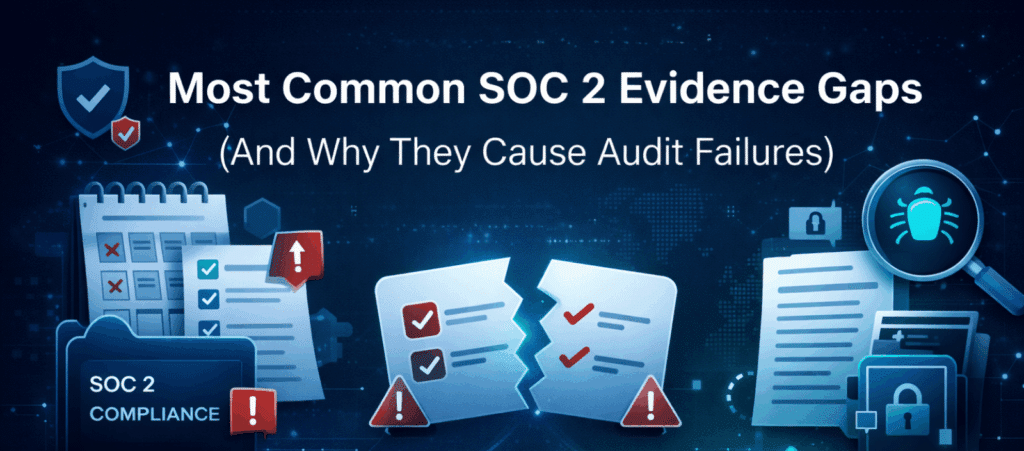
Organizations often enter a SOC 2 audit with defined controls, documented policies, and confidence in their security program. Audits rarely fail because controls do not exist. Audits encounter issues when organizations cannot produce evidence that demonstrates those controls operated as intended.
Auditors do not rely on intent alone. They evaluate documented evidence, supported by inquiry and testing procedures.
If evidence is incomplete, inconsistent, or lacks clear attribution, auditors cannot rely on it to conclude that controls operated effectively. Gaps often surface during sampling, when remediation becomes difficult and time-sensitive.
These are the most common SOC 2 evidence gaps, the issues they create during audit testing, and how teams can identify and address them before fieldwork begins.
What Audit-Ready Evidence Actually Means
Audit-ready evidence does more than show that an activity occurred. It must demonstrate that a control operated consistently, within defined parameters, and under appropriate ownership.
Strong evidence includes several characteristics:
- Completeness: The record captures the full activity, not a partial view
- Reliable timestamps: System-generated dates and times align with the control period
- Attribution: The evidence identifies who performed or approved the control
- Consistency: The same type of evidence exists across all required periods
- Traceability: The artifact maps directly to the control description
Teams often assume that evidence exists because they can locate logs, tickets, or screenshots. Auditors evaluate whether that evidence supports the control as written. If the artifact does not clearly demonstrate the control, auditors treat it as insufficient or request additional support.
How Auditors Evaluate Evidence
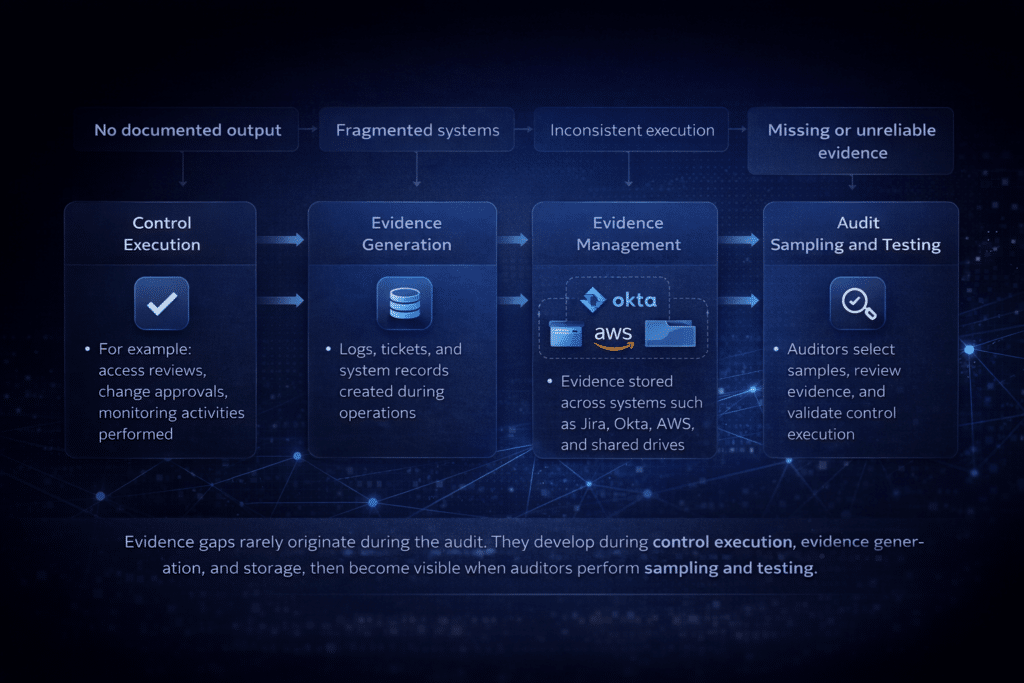
Auditors apply testing procedures to determine whether controls operated effectively over time. They do not review every record. They use sampling to evaluate consistency across the audit period.
A typical approach includes:
- Selecting samples across multiple periods within the review window
- Reviewing artifacts tied to each selected instance
- Verifying that the control executed according to its defined frequency
- Confirming that evidence aligns with the control description
For example, auditors may select multiple user access reviews within an observation period. They evaluate whether each review occurred on schedule, included appropriate approvals, and covered the correct population.
Auditors may also perform re-performance procedures or corroborate evidence through system data and inquiry. These steps often expose inconsistencies between documented evidence and actual system behavior.
Most evidence gaps become visible during this phase, when teams must demonstrate consistency across sampled periods.
Most Common SOC 2 Evidence Gaps
1. Missing Evidence for Performed Controls
Teams often perform required activities but do not retain records that demonstrate execution.
Examples include:
- Access reviews conducted without documented output
- Incident response actions discussed in Slack without formal records
- Change approvals communicated outside tracked systems
Teams assume the activity satisfies the control. Auditors require evidence that demonstrates the activity occurred during the defined period.
A common issue occurs when a control owner confirms that a review took place but cannot produce a record tied to that timeframe. Auditors typically treat this as an exception or request additional supporting evidence.
2. Incomplete or Non-Attributable Evidence
Some records exist but lack key elements required for audit validation.
Common issues include:
- Missing reviewer approval
- No indication of who performed the control
- Partial logs that omit relevant fields
For example, a ticket may show that a change occurred but not include an approval record. In this case, the evidence does not demonstrate that the approval control operated.
Auditors expect evidence to show both execution and ownership. Without attribution, they cannot confirm accountability.
3. Timestamp Gaps and Backfilled Evidence
Evidence must reflect when the control occurred, not when someone created the record.
Teams sometimes generate documentation after the fact to fill gaps. These records often lack reliable system timestamps or show creation dates that do not align with the control schedule.
Auditors review timing carefully. They compare:
- Log timestamps
- Ticket activity history
- Approval records
If timestamps do not align with the expected control cadence, auditors may question the reliability of the evidence.
A common pattern appears when multiple records show identical or clustered timestamps. This can indicate retrospective documentation rather than normal operational execution.
4. Inconsistent Control Execution
Controls must operate at defined intervals. Inconsistent execution creates gaps across the audit period.
Examples include:
- Access reviews completed in some months but not others
- Vulnerability scans performed irregularly
- Monitoring reviews conducted without a defined cadence
Teams often focus on performing controls near audit milestones. Auditors evaluate performance across the entire review period.
If sampled instances lack evidence or show inconsistent execution, auditors may identify exceptions. Repeated inconsistencies increase the risk of control deficiencies.
5. Evidence That Does Not Match the Control
Artifacts must directly support the control objective. Misalignment between evidence and control descriptions creates issues.
Examples include:
- Providing raw system logs when the control requires documented review
- Submitting reports without evidence of analysis or approval
- Using artifacts that do not reflect scoped systems
Teams often collect large volumes of data but do not demonstrate how that data supports the control.
Auditors look for a clear relationship between:
- The control requirement
- The action performed
- The evidence provided
If the artifact does not demonstrate the control, auditors may request additional evidence or identify an exception.
6. Fragmented or Manual Evidence Systems
Evidence often resides across multiple tools and formats.
Common sources include:
- Jira for change management
- Okta for identity logs
- AWS CloudTrail for infrastructure activity
- Slack for operational communication
- Shared drives for documentation
When teams rely on manual collection, they often:
- Miss records
- Provide inconsistent formats
- Struggle to trace evidence back to controls
Screenshots and spreadsheets can support evidence in some cases, but they often provide weaker assurance than system-generated records. They may lack full audit trails, context, or integrity controls.
Auditors typically expect structured, system-generated evidence that supports traceability and consistency.
A structured readiness assessment helps teams evaluate evidence quality, validate control execution, and identify gaps before audit fieldwork begins.
Why These Evidence Gaps Occur
Most evidence gaps result from system design issues rather than isolated mistakes.
Common root causes include:
- No defined mapping between controls and required evidence
- Unclear ownership of control execution and documentation
- Reliance on manual processes for evidence collection
- Reactive audit preparation instead of continuous readiness
Organizations often design controls without defining how evidence will be produced and maintained. This approach creates gaps because evidence does not emerge consistently from normal operations.
Most organizations do not fail because they lack controls. They encounter issues because they lack systems that produce reliable, repeatable evidence.
Designing Evidence That Withstands Audit
Organizations can reduce audit risk by designing evidence as part of the control environment.
Control-to-Evidence Mapping
Each control should define:
- Evidence type
- Source system
- Collection frequency
- Responsible owner
Automated Evidence Pipelines
Systems should generate evidence during normal operations.
Examples include:
- Identity systems producing access logs
- Ticketing systems capturing approvals
- Monitoring tools recording review activity
Centralized Evidence Management
Teams should store evidence in a structured and accessible system.
Pre-Audit Sampling and Validation
Teams should evaluate their evidence before auditors begin testing.
Quick Self-Assessment Checklist
- Can we produce evidence for each control on demand?
- Do records include reliable timestamps and clear ownership?
- Can we support sampled periods consistently?
- Do artifacts map directly to control requirements?
- Do we store evidence in a centralized and traceable system?
Evidence Enables Audit Conclusions
SOC 2 audits rely on evidence to support conclusions about control design and operating effectiveness. Controls may exist and operate, but auditors require reliable evidence to conclude that those controls function as described.
Weak evidence introduces audit risk even in mature environments. Missing records, inconsistent execution, and poor traceability reduce confidence in the control environment.
Teams that design evidence into their operations reduce this risk. They move from reactive documentation to consistent, defensible records that support audit requirements.
If your team is preparing for a SOC 2 audit, validate your evidence before fieldwork begins.
Frequently Asked Questions
Auditors require evidence that demonstrates control execution over time. Common examples include access review records, change management tickets, system logs, vulnerability scan reports, and incident response documentation.
Evidence must align with the control description and show when the activity occurred, who performed it, and how it met the defined requirement.
Evidence becomes insufficient when it lacks completeness, attribution, reliable timestamps, or alignment with the control.
Common issues include missing approvals, partial logs, inconsistent records across periods, or artifacts that do not demonstrate the control objective.
Auditors evaluate the nature and extent of missing evidence. Limited gaps may result in exceptions, while broader issues may affect conclusions about control effectiveness.
The impact depends on how significant and widespread the gaps are across the control environment.
Evidence issues arise when organizations cannot demonstrate consistent control execution across the audit period.
This often results from manual processes, lack of ownership, fragmented systems, or missing documentation standards.
Auditors look for consistency across sampled periods. They verify that controls operate at defined intervals, that evidence supports each instance, and that records align with system data and control descriptions.
They may also corroborate evidence through inquiry or re-performance.
Screenshots can support evidence in some cases, but they often provide weaker assurance than system-generated records.
Auditors prefer evidence that includes audit trails, system timestamps, and traceability. Screenshots without context or supporting data may not be sufficient on their own.
Organizations improve evidence quality by:
- Defining clear control-to-evidence mapping
- Automating evidence collection where possible
- Centralizing evidence storage
- Performing internal sampling before audits
These steps help ensure consistency and reduce gaps during testing.