



For startups in SaaS, fintech, and other service-driven sectors, scaling fast often means proving credibility early. Enterprise clients and investors will ask tough questions about security, and that is where SOC 1 and SOC 2 audits matter most.
These audits are not just checkboxes for compliance; they are growth enablers. A SOC 2 report can help you unlock enterprise contracts, speed up investor due diligence, and show that your startup can compete with established players even with limited resources.
SOC 2 and SOC 1: What's the Difference?
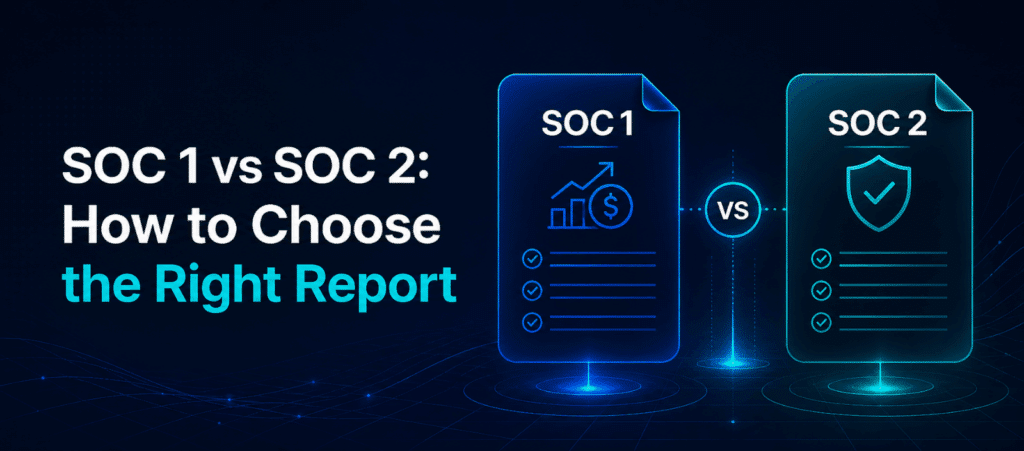
Both SOC 1 and SOC 2 audits are governed by the American Institute of Certified Public Accountants (AICPA) and help service organizations demonstrate trust and control maturity. However, they serve different purposes and audiences.
Here’s how they differ at a glance:
|
Category
|
SOC 1
|
SOC 2
|
|---|---|---|
|
Focus
|
Financial reporting controls (ICFR)
|
Controls related to data security and privacy, based on the Trust Services Criteria
|
|
Used By
|
Client financial stakeholders and auditors
|
Customers, partners, and regulators
|
|
Key Trigger
|
Impacts client financial statements
|
Handles, stores, or processes customer or business data
|
|
Common Examples
|
Payroll processors, loan servicers, financial SaaS
|
Cloud services, SaaS platforms, data centers
|
|
Report Types
|
Type I: Control design at a point in time; Type II: Control design and operating effectiveness over a period of time
|
Type I: Control design at a point in time; Type II: Control design and operating effectiveness over a period of time
|
|
Outcome
|
Confidence in financial data accuracy
|
Confidence in data security and reliability
|
The choice between SOC 1 and SOC 2 reporting depends on the nature of your services and what your clients or stakeholders need assurance over. Some organizations even pursue both to cover financial integrity and data security expectations simultaneously.
💡 Startup Pro Tip: If your startup handles customer data but not financial reporting, start with SOC 2. It’s the standard most enterprise clients expect from SaaS and cloud companies.
Download the Free 5-Minute SOC Readiness Checklist for Startups
Who Needs a SOC 1 Audit and a SOC 2 Audit?
Who Needs a SOC 1 Audit?
Service companies whose offerings have a direct impact on their clients’ financial statements must conduct SOC 1 audits. Examples are companies that supply:
- Payroll Processing: These businesses take care of computations that are directly related to financial reporting and secure employee financial data.
- Loan Servicing Companies: They manage the payment processing, interest calculations, and other financial activities for loans, impacting the financial health of the borrowing entity.
- Benefits Administrators: They manage retirement accounts, health insurance claims, and other employee benefits that have financial implications for companies.
- SaaS Providers with Financial Impact: Software as a Service (SaaS) providers whose platforms are used for financial transactions or financial reporting need SOC 1 audits to ensure the integrity of the financial data processed by their systems.
A SOC 1 report for these companies lowers the possibility of financial misstatements by assuring clients that the service provider has strong internal controls over financial reporting.
Who Needs a SOC 2 Audit?
A wider range of service organizations that receive, store, or process consumer data should consider conducting SOC 2 audits, particularly where proving a dedication to data security, privacy, and compliance is crucial. Examples are:
- Cloud Computing Services: Cloud services need to have strong controls over data security, availability, and privacy because of their role in processing and storing enormous volumes of data.
- SaaS Providers (Non-Financial Impact): SaaS platforms that may not impact financial reporting directly but handle customer data, requiring stringent controls over data security and privacy.
- Data Centers: These facilities host critical infrastructure and data for multiple clients, making the assurance of physical and environmental controls imperative for operational integrity and security.
- Managed IT Services: Companies providing IT management services must ensure the confidentiality, integrity, and availability of the systems and data they manage.
SOC 2 audits are essential for businesses in sectors where compliance, data security, and privacy are critical.
How much will it cost? See our detailed SOC 2 Pricing Breakdown.
Types of SOC 1 and SOC 2 Reports
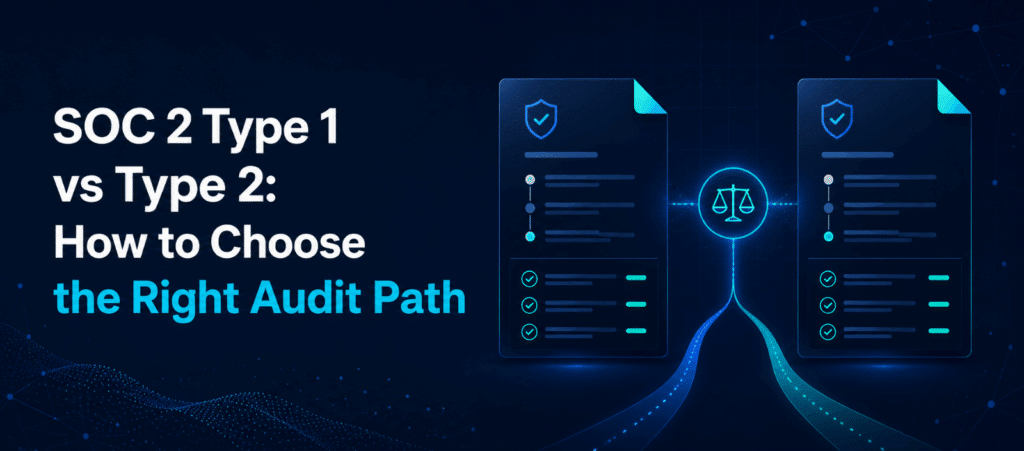
Both SOC 1 and SOC 2 audits produce Type 1 and Type 2 reports, each of which has a distinct purpose in evaluating the internal controls of a service company.
Businesses need to be aware of these differences when selecting an audit to best meet their objectives and the demands of their clients.
SOC 1 Reports
- Focuses on a point-in-time assessment
- Evaluates the design of controls relevant to internal control over financial reporting (ICFR)
- This provides assurance that the controls are properly designed to meet objectives as of a specific date
- Suitable for organizations needing to demonstrate the design effectiveness of their financial control environment
- Covers a period of time (typically 6–12 months)
- Assesses both the design and operating effectiveness of controls
- Offers a higher level of assurance to stakeholders by demonstrating the proper design and the operational effectiveness of controls over time
- It is ideal for organizations looking to provide ongoing assurance about the effectiveness of their financial control environment
SOC 2 Reports
- SOC 2 Type 1 focuses on a point-in-time assessment
- Assesses the design of controls related to the Trust Services Criteria: security, availability, processing integrity, confidentiality, and privacy
- Verifies that the service organization’s systems are designed to meet the relevant Trust Services Criteria at a specific date
- Suitable for organizations needing to prove their system controls’ design effectiveness
SOC 2 Type 2:
- Evaluates over a period of time, typically minimum of six months
- Assesses both the design and operational effectiveness of controls related to the Trust Services Criteria
- Provides a comprehensive view of how controls perform in practice
- Best for organizations that want to demonstrate ongoing compliance and effectiveness in managing data securely and reliably
The choice between Type 1 and Type 2 will depend on the organization’s specific needs, its clients’ requirements, and regulatory obligations.
💡 Startup Pro Tip: Begin with SOC 2 Type 1. It’s faster and more affordable for startups establishing initial compliance, then plan for Type 2 within the next 6–12 months for full assurance.
Preparing for a SOC 1 or SOC 2 Audit
Here’s a guide on the differences in preparation for each audit type, drawing from the AICPA’s guidelines and audit standards:
Preparing for a SOC 1 Audit
- Defining Control Objectives: Identify control objectives crucial for financial reporting and operations related to your services.
- Identifying Relevant Controls: Determine and document the specific controls that support your defined objectives, and mitigate financial reporting risks.
- Engaging a Qualified CPA Firm: Choose a CPA firm with expertise in SOC 1 audit, like TrustNet, to guide and conduct the audit process and ensure compliance with AICPA standards.
- Implementing Remediation Measures: Before the audit, address any gaps or weaknesses in your controls to meet the required standards for financial reporting integrity.
Preparing for a SOC 2 Audit
- Defining Control Objectives: Focus on the Trust Services Criteria applicable to your services—security, availability, processing integrity, confidentiality, and privacy.
- Identifying Relevant Controls: Map out controls that address the chosen Trust Services Criteria and cover how your organization safeguards and manages data.
- Engaging a Qualified CPA Firm: Select a firm with SOC 2 expertise like TrustNet to validate your controls meet the rigorous requirements of the Trust Services Criteria.
- Implementing Necessary Remediation Measures: To remediate any control deficiencies to align with the standards set by SOC 2.
Steps to SOC 1 or SOC 2 Compliance
Achieving SOC compliance follows four clear stages. Each step builds toward audit readiness and a final report you can share confidently with clients and investors.
1. Readiness Assessment
Evaluate your existing controls, policies, and documentation against SOC standards to identify gaps and define your readiness plan.
2. Remediation
Address identified gaps by strengthening controls, updating documentation, and implementing processes that align with SOC requirements.
3. Audit
A qualified CPA firm, such as TrustNet, reviews and tests your controls for design and operational effectiveness.
4. Report
Receive your official SOC 1 or SOC 2 report — a verified attestation of your compliance, which builds trust with enterprise clients and investors.

Maintaining SOC 1 or SOC 2 Compliance
- Continuous Monitoring: Implement continual monitoring practices to ensure effective controls remain in place and any changes or upgrades in processes or systems are identified and addressed quickly. This may involve automated systems or regular manual checks.
- Conduct Regular Control Tests: Conduct regular audits or third-party assessments to test controls to assess their effectiveness, either internally or by third parties. Be thorough; cover all objectives listed in your SOC Report in your testing efforts.
- Documentation: Document all monitoring and testing activities with meticulous records, such as nature of activity performed, date performed, findings and corrective actions taken.
- Annual Renewal of SOC Reports: SOC reports are valid for 12 months. Organizations should undergo a new audit annually to maintain compliance and demonstrate ongoing control effectiveness.
- Bridge Letters: Organizations can provide a bridge letter when there’s a gap between the end of the last reporting period and the date of the current report request. This letter describes any significant changes to the controls or environment and assures the effectiveness of controls during the gap period.
💡 Startup Pro Tip: Schedule quarterly control reviews. Regular mini-assessments help you stay audit-ready and avoid expensive last-minute fixes before renewal.