


Organizations that handle customer data must demonstrate strong security practices. Enterprise buyers expect vendors to prove that they manage risk, operate effective security controls, and protect sensitive information.
Two frameworks dominate this discussion: SOC 2 and ISO 27001.
Security leaders sometimes treat these frameworks as interchangeable proof of security maturity. They serve different purposes. Each framework validates security maturity in a different way.
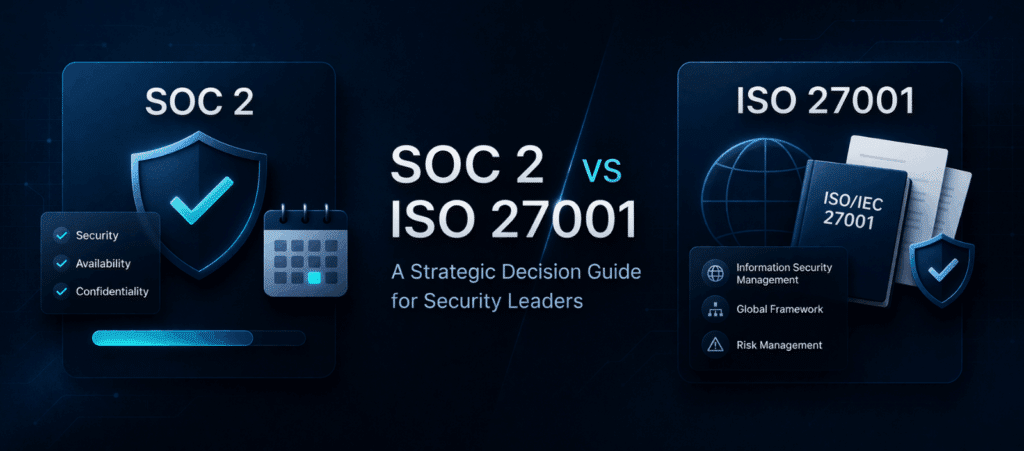
SOC 2 focuses on operational security controls and how they perform over time. ISO 27001 focuses on the management system that governs security practices.
The distinction matters.
The wrong compliance path can delay enterprise deals, increase audit effort, or force organizations to repeat work later.
This guide explains the difference between SOC 2 and ISO 27001. It also shows when each framework makes sense and how organizations should plan their compliance strategy.
Why Security Compliance Frameworks Matter
Modern organizations rely on digital infrastructure, cloud platforms, and distributed teams. These environments introduce operational risk. Customers and partners want assurance that vendors manage that risk responsibly.
Security compliance frameworks create a structured way to demonstrate trust.
Organizations use frameworks to:
- establish consistent security governance
- manage risk through documented processes
- implement technical and administrative controls
- validate security practices through independent assessment
Independent verification creates credibility. It also reduces friction during vendor security reviews.
Enterprise procurement teams often require formal security assurance before they approve vendors. Compliance frameworks allow organizations to provide that assurance.
SOC 2 and ISO 27001 serve this purpose. Each framework approaches the problem differently.
What is SOC 2?
SOC 2 is a security assurance framework developed by the American Institute of Certified Public Accountants.
The framework evaluates security controls using the Trust Services Criteria:
- Security
- Availability
- Processing integrity
- Confidentiality
- Privacy
Security forms the required foundation. Organizations may report on additional criteria depending on the specific Trust Services Criteria relevant to their services.
SOC 2 audits evaluate whether an organization designs and operates security controls that meet these criteria.
Two types of SOC 2 reports exist.
SOC 2 Type 1
A Type 1 audit evaluates control design at a specific point in time. Auditors review policies, procedures, and system configurations to confirm that the organization has designed appropriate controls.
SOC 2 Type 2
A Type 2 audit evaluates how controls operate over time. Auditors test evidence across a defined review period, often six to twelve months.
Type 2 reports provide stronger assurance because they demonstrate operational consistency.
SOC 2 gained strong adoption among SaaS companies, cloud providers, and technology platforms that serve enterprise customers in North America.
What is ISO 27001?
ISO 27001 is an international standard for Information Security Management Systems, commonly called ISMS.
An ISMS defines how an organization governs information security. It establishes policies, risk management processes, operational controls, and continuous improvement mechanisms.
Organizations implement an ISMS through several core activities:
- identifying and assessing information security risks
- selecting security controls to mitigate those risks
- documenting policies and procedures
- monitoring control effectiveness
- performing internal audits
- conducting management reviews
Certification bodies evaluate the ISMS during formal audits. Certification bodies grant ISO 27001 certification to organizations that pass the audit.
The certification confirms that the organization operates a structured management system that governs information security.
ISO 27001 holds global recognition. Many international enterprises expect vendors to maintain ISO 27001 certification as proof of security governance maturity.
Inside ISO 27001: Why Internal Audit Determines Certification Success
Many organizations assume ISO 27001 certification challenges come from implementing technical controls.
In practice, internal governance often determines whether certification proceeds smoothly.
Weak internal audit processes create common problems:
- teams treat internal audits as checklist exercises
- auditors document findings without challenging assumptions
- management assertions receive little scrutiny
- external auditors must re-test controls and validate evidence
Strong internal audits verify that the Information Security Management System actually functions as designed. They also confirm that policies, risk assessments, and controls operate consistently across the organization.
In a recent episode of The Cyber Kitchen, TrustNet’s Trevor and Jamie discuss why internal audit often determines whether ISO 27001 programs succeed or stall.
They explain how effective internal audits strengthen the management system and reduce friction during certification.

Key Differences Between SOC 2 and ISO 27001
SOC 2 and ISO 27001 both validate strong security programs. Their structures and goals differ in several important ways.
Attestation vs Certification
SOC 2 produces an attestation report.
Independent CPA auditors examine the organization’s controls and issue a report that describes the controls, testing procedures, and audit findings.
ISO 27001 produces a certification.
Accredited certification bodies evaluate the organization’s Information Security Management System. Successful audits result in formal certification.
The outputs differ. SOC 2 reports provide detailed assurance information. ISO 27001 certifications confirm that the organization operates an ISMS that meets the standard.
Control Evaluation vs Management System Governance
SOC 2 focuses on evaluating a service organization’s controls relevant to the AICPA Trust Services Criteria — security, availability, processing integrity, confidentiality, and privacy.
Auditors examine how organizations implement and operate controls such as:
- access management
- change management
- incident response
- monitoring and logging
- vulnerability remediation
ISO 27001 focuses on the governance structure that manages those controls.
The ISMS defines how organizations identify risks, assign control responsibilities, perform internal audits, and improve security practices.
SOC 2 validates operational effectiveness. ISO 27001 validates management system maturity.
Geographic Market Expectations
Market expectations often influence compliance decisions.
SOC 2 dominates North American enterprise procurement. Many U.S. companies require SOC 2 reports when they evaluate service providers.
ISO 27001 holds broader international recognition. European and global organizations often expect ISO 27001 certification as the default security benchmark.
Organizations that expand internationally often adopt ISO 27001 to simplify vendor trust discussions across multiple regions.
Audit Lifecycle
SOC 2 reports typically follow an annual audit cycle.
Organizations perform a Type 2 audit each year to verify that their controls remained effective over the review period.
ISO 27001 follows a three-year certification cycle.
Certification bodies perform surveillance audits each year to confirm that the ISMS remains operational. Organizations must complete a recertification audit at the end of the cycle.

When SOC 2 is the Better Choice
SOC 2 often provides the most practical starting point for technology companies.
SOC 2 makes sense when organizations:
- sell SaaS platforms or cloud services
- target enterprise customers in North America
- need compliance to accelerate enterprise sales cycles
- already operate mature operational security controls
SOC 2 reports allow vendors to provide detailed assurance to enterprise buyers.
Procurement teams often request SOC 2 reports during security reviews. The report allows them to evaluate how the vendor implements security controls.
For many SaaS providers, SOC 2 Type 2 becomes the first formal security assurance milestone.
When ISO 27001 is the Better Choice
ISO 27001 often suits organizations that operate in global markets or require structured governance across large environments.
ISO 27001 may fit better when organizations:
- serve international enterprise customers
- operate across multiple geographic regions
- require formal information security governance
- manage complex regulatory environments
The ISMS structure encourages consistent risk management, internal audits, and management oversight.
Organizations with distributed operations often benefit from the governance discipline that ISO 27001 introduces.
When Organizations Pursue Both
Many organizations eventually implement both SOC 2 and ISO 27001.
Several factors drive this decision.
First, global companies often face different expectations across regions. U.S. enterprise buyers request SOC 2 reports. International partners often request ISO 27001 certification.
Second, both frameworks share many security control requirements.
Common control areas include:
- access governance
- vulnerability management
- incident response
- asset management
- vendor risk management
Organizations that design security programs around these shared practices can support multiple frameworks with limited duplication.
Strategic Factors That Should Guide the Decision
Security leaders should evaluate several factors before choosing a compliance path.
Customer Expectations
Customer procurement requirements often drive compliance priorities.
If enterprise prospects consistently request SOC 2 reports, SOC 2 should become the immediate priority. If international customers request ISO 27001 certification, ISO 27001 may provide greater strategic value.
Geographic Market Strategy
Organizations that plan global expansion often adopt ISO 27001 to simplify cross-border security assurance.
Companies focused on North American markets often prioritize SOC 2 first.
Internal Security Maturity
Organizations with mature operational security controls may find SOC 2 easier to implement initially.
Organizations that want to formalize governance processes may benefit from ISO 27001’s management system approach.
Long-Term Compliance Strategy
Evaluate Your Compliance Strategy
Organizations that evaluate SOC 2 and ISO 27001 often struggle to understand how existing controls align with framework requirements.
TrustNet experts help organizations assess security program maturity, identify control gaps, and design compliance strategies that support SOC 2, ISO 27001, and other frameworks.
Designing Security Programs That Support Multiple Frameworks
Mature organizations build framework-agnostic security programs.
Instead of designing controls around a single framework, they establish operational practices that support multiple compliance standards.
Key practices include:
- centralized risk management processes
- consistent access governance policies
- structured vulnerability management programs
- documented incident response procedures
- formal vendor risk management processes
These practices support many compliance frameworks simultaneously.
Security leaders who build programs around operational discipline reduce audit complexity. They also allow compliance efforts to scale as the business grows.
Build Scalable Compliance with TrustNet’s Accelerator+
Security frameworks rarely exist in isolation. Organizations that pursue SOC 2 or ISO 27001 often face additional requirements over time. Enterprise customers may request multiple certifications. New markets may introduce different regulatory expectations.
Security teams need a compliance strategy that scales.
TrustNet’s Accelerator+ approach helps organizations build security programs that support multiple frameworks without creating redundant controls or fragmented audit processes.
The model combines three integrated capabilities.


Advisory
TrustNet specialists evaluate existing security programs against SOC 2, ISO 27001, and other compliance frameworks. This process identifies control gaps, governance weaknesses, and operational risks.
Security leaders gain a clear roadmap for strengthening security operations and preparing for certification or attestation.
Automation
Compliance programs require consistent evidence collection and structured governance processes.
TrustNet helps organizations implement governance, risk, and compliance automation that supports frameworks such as:
- other regulatory and industry standards
Automation reduces manual effort and improves visibility across the compliance program.
Audit
TrustNet provides structured audit and assessment services that streamline certification and reporting processes.
Security teams benefit from:
- clear audit preparation guidance
- efficient evidence validation
- structured control assessments
This integrated approach reduces audit friction and allows organizations to maintain continuous compliance readiness. Organizations that treat compliance as an operational discipline build stronger security programs and reduce risk across their environments.
TrustNet’s Accelerator+ approach helps organizations design scalable compliance programs that support SOC 2, ISO 27001, and other frameworks as business requirements evolve.
Frequently Asked Questions
SOC 2 does not replace ISO 27001. The frameworks validate different aspects of security programs. SOC 2 evaluates a service organization’s controls relevant to the AICPA Trust Services Criteria — security, availability, processing integrity, confidentiality, and privacy. ISO 27001 evaluates the management system that governs security operations.
Organizations often adopt both frameworks when they serve global customers.
Neither framework is universally better. The right choice depends on business objectives, customer expectations, and geographic markets. SOC 2 often fits North American SaaS companies. ISO 27001 often fits organizations that operate internationally.
Many startups pursue SOC 2 first because enterprise customers request SOC 2 reports during vendor reviews. Startups that target international markets may prioritize ISO 27001 certification earlier.
Some SaaS companies implement both frameworks to satisfy global enterprise customers. Organizations that build mature security programs can support both frameworks with shared controls.
Yes. Many organizations maintain both frameworks.
Security teams often design unified control environments that support SOC 2 audits and ISO 27001 certification simultaneously.