



Every organization needs an information security plan because data has become the world’s most valuable commodity. And like all precious things, data is regulated heavily by governing bodies and coveted by everyone – including crooks. That is why cybercrime is on the rise – in step with a tightening compliance landscape.
Recent industry data remains alarming: the majority of organizations are expected to experience at least one data breach, with many facing multiple incidents over time. According to IBM’s 2025 Cost of a Data Breach Report, the global average cost of a breach has risen to over $4.44 million.
This guide explains what an information security plan is, why boards, auditors, and regulators expect one, and how to create a plan aligned with frameworks such as SOC 2, ISO 27001, and NIST. An information security plan defines how an organization protects data confidentiality, integrity, and availability across people, processes, and technology.
Whether you are pursuing compliance for the first time, scaling security as your business grows, or preparing for external audits and customer due diligence, a structured information security plan helps demonstrate cyber readiness, reduce risk, and meet increasing regulatory and stakeholder expectations in 2026.
What Is Information Security?
Information security (often referred to as InfoSec) includes various measures, strategies, and features that are implemented to keep and manage sensitive information. Its primary aim is to control access to information that upholds the CIA triad in data protection (Confidentiality, Integrity, Availability) without significantly hampering business productivity.
Here’s how key institutions define information security: “The preservation of confidentiality (ensuring that information is accessible only to those authorized to have access), integrity (safeguarding the accuracy and completeness of information and processing methods), and availability (ensuring that authorized users have access to information and associated assets when required).” – ISO/IEC 27002 “Ensures that within the enterprise, information is protected against disclosure to unauthorized users (confidentiality), improper modification (integrity), and non-access when required (availability)” – ISACA.
Get an Information Security Plan Workshop:
Collaborate with experts to define controls, ownership, and timelines.
What is an Information Security Plan?
An information security plan refers to the documented set of policies, objectives, systems, and processes that an organization has established to protect sensitive data.
To reduce risks and deal with current threats that can jeopardize a company’s data availability, confidentiality, or integrity, this plan incorporates security measures, authentication techniques, and response processes.
Why Do You Need an Information Security Plan?
An organization must have an information security plan to participate in the digital economy. The peril such an organization poses extends far beyond its own business into those of its customers, suppliers, and other entities that transact with it.
Cyberattacks today frequently target third-party vendors, cloud platforms, and SaaS
integrations—areas where data flows are harder to govern and visibility is limited. If you exchange sensitive data with an entity with poor information security measures, threat actors can easily compromise your data.
That is why many prudent companies (and almost all investors) require concrete assurances (such as ISO certifications and SOC reports) from vendors, third parties, and potential investees on how well they protect data before going forward with any business.
Ultimately, a well-designed information security plan benefits the company on multiple fronts: a) it helps reduce the likelihood of unauthorized exposure (confidentiality), corruption (integrity), and unintended inaccessibility (availability) of data. Implemented the right way, an information security plan helps an organization more easily comply with regulatory mandates and industry standards, thereby avoiding costly penalties and lost opportunities due to non-compliance.
Organizations are now increasingly required to demonstrate cyber readiness under frameworks such as NIST CSF 2.0, PCI DSS 4.0.1, updated SEC cybersecurity disclosure rules, and evolving data privacy regulations worldwide.
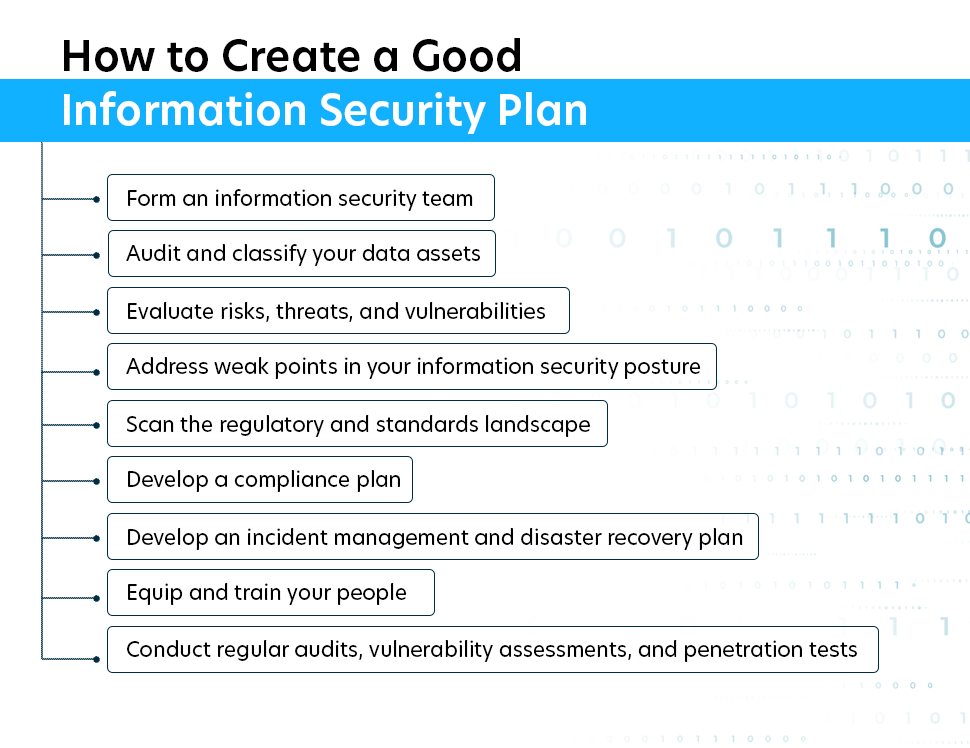
How Do You Create a Good Information Security Plan?
The following are the key steps to consider when developing an effective
information security plan:
Form an information security team
Hands down, this should be the first step for most organizations that have yet to develop an InfoSec plan. That’s because information security was meant to be something other than a solo venture. Stakeholders and IT security professionals must work together consistently to secure your company’s data and procedures. You need competent and dependable people to build and manage the information security infrastructure for your company, including a dedicated team tasked and trained to respond to security incidents (i.e., the Cyber Security Incident Response Team, or CSIRT).
Audit and classify your data assets
You can only protect something if you know what and where it is. Conduct a comprehensive inventory of your IT assets and the designated custodian for each. Include all hardware, software, databases, systems, and networks your organization uses (or is in possession of). Sort your data assets according to their nature, storage and access methods, and the risks, vulnerabilities, and current safeguards associated with them. Your InfoSec team must know where data is stored, who is authorized to access said data, how it is processed, and how it is protected. Additionally, some types of data need stronger protections, including PII (Personally Identifiable Information), PHI (Protected Health Information), and NPI (Non-Public Information).
Evaluate risks, threats, and vulnerabilities
To find, identify, and evaluate security flaws, hazards, threats, and vulnerabilities, thoroughly examine the networks and systems that handle and store data. Categorize and prioritize those risks and vulnerabilities. Outdated hardware, unpatched software, and insufficient IT security awareness training for employees are a few typical issues that need improvement. Your team should also assess the IT security measures your company already has in place.
You can use tools such as the Cybersecurity Framework developed by the National Institute of Standards and Technology (NIST) to help you cover all the essential grounds. Your cyber risk assessment must include not only your internal systems but also those of third parties that conduct business with your organization. Make a list of requirements/standards (such as SOC 2 compliance) that third-party entities need to meet before they can do business with your organization.
A 2026-ready security plan should also address risks related to cloud misconfigurations, SaaS access sprawl, AI-driven threats, compromised third-party libraries, and shadow IT. Modern risk assessments incorporate continuous monitoring tools rather than one-time evaluations to keep pace with rapidly evolving threats.
Address weak points in your information security posture
That is where you plug the holes in your defensive layer and improve your overall security posture. The objective is to eliminate risks that can be neutralized and to minimize those that can’t be removed completely, starting with the most serious threats and vulnerabilities down to the ones with the least potential impact on your business. MDR (managed detection and response) and security monitoring services are two solutions that may support and strengthen your information security policies, depending on your particular needs.
Many organizations now implement zero-trust architecture, cloud posture management (CSPM), and identity threat detection and response (ITDR) to reduce modern attack paths that did not exist a decade ago.
Scan the regulatory and standards landscape
Depending on your line of business, location, customer demographic, and other factors, your organization is subject to a number of regulatory mandates, industry benchmarks, and self-imposed standards. These include mandatory IT security practices required by The Health Insurance Portability and Accountability Act (HIPAA), The General Data Protection Regulation (GDPR), and the Payment Card Industry Data Security Standard (PCI DSS). Certain external stakeholders would also need particular compliance procedures and thorough documentation, including business partners, independent auditors, and possible investors performing due diligence. By closely evaluating the landscape, you may determine which regulations, standards, and requirements are applicable to your business.
Develop a compliance plan
Organizations must now create and implement a thorough and cohesive compliance program since regulatory compliance has become increasingly crucial and challenging over time. Given the tightening regulatory environment around the world, not doing so can be very costly.
Regulatory penalties continue to grow. For example, GDPR fines now routinely reach into the hundreds of millions, and U.S. regulators have increased scrutiny under updated SEC cybersecurity reporting rules. Effective compliance management is now essential to avoid costly penalties and maintain customer trust.
Develop an incident management and disaster recovery plan
In context, “incidents” refer to events and situations that can lead to any violation of the CIA triad for information security. Cyberattacks, natural catastrophes, human error, system failures, and other circumstances may result in corruption, unauthorized disclosure, or inadvertent data inaccessibility. A well-designed incident management and recovery plan outlines all potential risks, mapping each to the organization’s corresponding response strategy to minimize damage and resume normal operations as fast as possible when a major disruptive incident occurs.
Your team and other stakeholders can respond to any risk with composure, order, and confidence if you outline a response plan for each type of incident. Many organizations link this step with their overall Business Continuity Plan.
Equip and train your people
Your people remain your first line of defense when all has been said and done. Quite often, however, they can also be the weakest link in your security infrastructure, being the attack vector favored by most cybercriminals. Hence, staff training should be integral to any information security plan. By continually training your people in IT security, they can become effective assets in your fight against all sorts of information security risks.
Training should now include phishing simulation, secure use of AI tools, passwordless authentication practices, and guidance for safe use of cloud and SaaS platforms.
Conduct regular audits, vulnerability assessments, and penetration tests
A plan can be good or bad, sufficient or inadequate. But you would know once something puts your plan to the test. Would you rather have an actual, potentially disruptive incident – with all its unpredictable ramifications – prove your plan’s worth, or have an independent security firm objectively but safely test it for you?
Technology audits, configuration reviews, vulnerability assessments, penetration tests, and continuous attack-surface monitoring are critical for identifying weaknesses across both on-premise and cloud environments.
With threats evolving rapidly, many organizations now perform these activities quarterly or continuously rather than annually.
Final Takeaway
Many businesses find it extremely difficult to develop and publish an information security plan, particularly those needing help keeping up with the rapidly changing digital economy and the industry and regulatory requirements that accompany it.
You can have your team do all the heavy lifting or seek expert guidance from specialist service providers. A best practice-driven framework instead of an expensive trial-and-error method will expedite the process.
In the end, an information security plan should give you a general idea of how data within your network is secured and your team’s stance toward threats that compromise data confidentiality, integrity, and availability.
As digital ecosystems grow more interconnected and AI-driven threats emerge, organizations with structured, well-maintained information security plans will be far better positioned to prevent breaches, demonstrate compliance, and maintain customer trust.
Connect with us to discover how TrustNet can kickstart your cybersecurity journey.