



Cyber threats are evolving fast, putting your data, operations, and infrastructure at risk. Penetration testing is a powerful tool for mitigating these threats. By simulating real-world cyberattacks, it helps identify vulnerabilities that could leave your systems exposed. Pen Test also allows organizations to uncover weak points, strengthen defenses, and minimize the risk of costly breaches.
Here’s what we’ll cover to help you stay ahead of cyber risks:
- What is penetration testing? An introduction to how simulated cyberattacks work.
- Key phases of penetration testing. A step-by-step look at the process.
- Pen testing benefits. Why it’s essential for any organization’s defenses.
- Types of penetration testing. Exploring different strategies for diverse challenges.
- Why TrustNet? Learn how our expertise can enhance your security posture.
Organizations evaluating penetration testing services are no longer just looking for vulnerability lists; they need proof that security controls work under real-world attack conditions. This guide is designed for security leaders, compliance owners, and IT teams actively comparing pen-testing providers and delivery models.
What is Penetration Testing?
Penetration testing, or “pen test,” is a proactive cybersecurity measure. It involves authorized simulated cyberattacks to identify and exploit vulnerabilities in an organization’s systems, networks, or applications.
The goal is to uncover weak points before they’re exploited by malicious actors, allowing businesses to bolster their defenses and stay one step ahead of threats.
Here’s how penetration testing stands out:
- Penetration testing is more than vulnerability assessments. While vulnerability assessments highlight potential weaknesses, penetration testing goes further by actively exploiting them, providing a clear picture of real-world risks.
- Penetration testing includes realistic attack simulations. Ethical hackers use the same tools and techniques as cybercriminals. From phishing attempts to exploiting software vulnerabilities, they replicate adversarial tactics to evaluate your systems under real-world conditions.
This hands-on approach delivers valuable insights by uncovering gaps that might otherwise remain invisible. It’s essential in strengthening security, supporting compliance, and demonstrating your commitment to protecting sensitive data.
See How iTrust Delivers Human-Led PTaaS
Key Phases of Penetration Testing
Penetration testing involves a series of systematic phases to ensure a thorough examination of your organization’s security posture. Each phase plays a unique role in identifying, testing, and addressing vulnerabilities.
1. Reconnaissance
This initial phase involves gathering both passive and active intelligence. Pen testers collect publicly available data using Open-Source Intelligence (OSINT) tools, such as domain records and metadata. They map system architectures and analyze exposed services like open ports or outdated software. This step establishes the groundwork for the overall testing process.
2. Scanning
During scanning, testers interact with the organization’s systems to identify active hosts, running applications, and specific service configurations. Tools like Nmap help detect misconfigurations, weak security protocols, and open ports. Automated vulnerability scans are often used to streamline the process of detecting known flaws.
3. Vulnerability Assessment
Here, pen testers evaluate the scanning results to identify exploitable weaknesses. They examine the impact and risk of each vulnerability, such as cross-site scripting (XSS) or insecure direct object references (IDOR), creating a roadmap for targeted exploitation.
4. Exploitation
At this stage, testers attempt to exploit identified flaws using techniques like SQL injection, session hijacking, or privilege escalation. Advanced tools and customized payloads allow ethical hackers to demonstrate practical risks, such as data theft or system control.
5. Reporting
The final step documents the entire process, highlighting vulnerabilities by severity and providing actionable recommendations. Reports include technical findings, exploitation techniques, and strategies for strengthening security.
Each phase builds upon the last, creating a comprehensive and actionable evaluation to help organizations fortify their cybersecurity posture.
Benefits of Penetration Testing
Key benefits of pen tests include:
Identify Security Gaps:
- Discover hidden vulnerabilities like unpatched software, misconfigurations, or outdated systems.
- Take action to fix these flaws early, reducing the risk of a security breach.
Strengthen Defenses:
- Evaluate how well the existing security controls stand up to potential threats.
- Use test findings to enhance defense measures, adapting to evolving cyber risks.
Ensure Compliance:
Boost Customer Trust:
- Show clients and stakeholders your dedication to protecting sensitive data.
- Build confidence in your company’s commitment to minimizing risks and improving its security posture.
Conducting penetration tests regularly isn’t just about risk mitigation through pen tests; it’s about staying one step ahead in a constantly changing threat environment. These tests are a powerful tool for reinforcing security while fostering trust and accountability.
Types of Penetration Testing
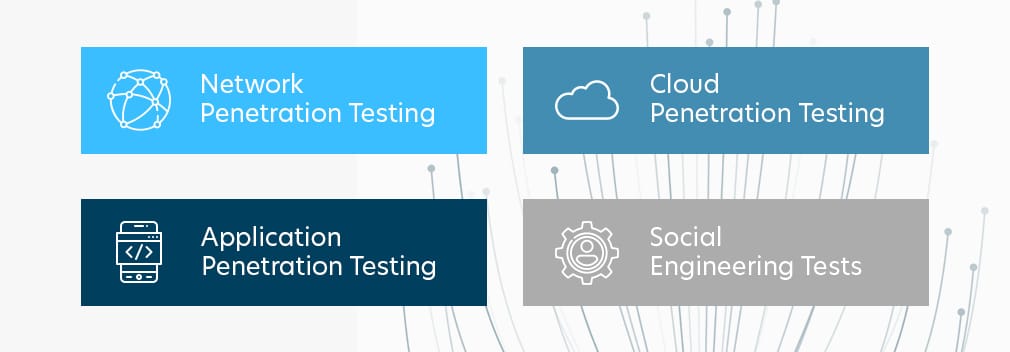
Here are the most common types of pen tests to consider:
Network Penetration Testing:
- Focuses on evaluating the security of both external and internal networks.
- Identifies risks such as misconfigured firewalls, exposed ports, and weak network protocols.
- Helps protect against threats that could compromise the network’s integrity.
Application Penetration Testing:
- Targets web and mobile applications to detect flaws in their design or code.
- Exposes vulnerabilities such as SQL injection, cross-site scripting (XSS), and insecure direct object references.
- Enhances software resilience by addressing application security risks.
Cloud Penetration Testing:
- Examines cloud infrastructures for misconfigurations or other weaknesses.
- Highlights risks like insufficient access controls or insecure data storage.
- Ensures configurations align with best practices to safeguard cloud environments.
Social Engineering Tests:
- Simulates real-world tactics like phishing to test employee awareness.
- Identifies gaps in human security processes, such as susceptibility to deceptive emails or calls.
- Reinforces the importance of security training and vigilance.
These types of penetration testing collectively strengthen your defenses by addressing threats across technology, infrastructure, and human factors.
Why Choose TrustNet for Penetration Testing?
TrustNet delivers human-led penetration testing powered by the iTrust platform, helping organizations identify real-world risk, not just theoretical vulnerabilities. Our experienced penetration testers validate exploitability, assess business impact, and provide clear remediation guidance so teams can act with confidence.
iTrust supports continuous and event-driven testing through centralized workflows, collaboration, retesting, and real-time reporting. Automation improves coverage and speed, while human expertise drives validation, exploitation, and analysis. This approach reduces false positives, shortens vulnerability lifetimes, and provides ongoing visibility as environments change.
With TrustNet and iTrust, penetration testing becomes an ongoing security capability, supporting compliance, development cycles, and risk reduction, rather than a one-time report delivered after the fact.
What Makes iTrust Pen Test Unique
iTrust is designed to support expert human penetration testing, not replace it. Automation is used for coverage, coordination, and speed, while human testers drive validation, exploitation, and risk analysis.
Key capabilities include:
Automation That Supports Coverage (Not Scanner Noise)
Automation helps streamline reconnaissance, scheduling, and workflow management so human testers can focus on validation and exploitation. The platform centralizes project management, evidence, and communication without flooding teams with unverified findings.
Consistency and Speed Across Testing Cycles
iTrust supports repeatable testing across applications, infrastructure, and cloud environments. This enables teams to test more frequently and respond faster as environments change, without sacrificing depth or accuracy.
Vulnerability Management With Human Context
Findings are validated by expert testers and delivered with exploitation context and prioritization. Teams can track remediation, request retesting, and confirm fixes quickly shortening vulnerability lifetimes instead of letting issues linger until the next annual test.
Reporting Built for Security and Stakeholders
iTrust delivers real-time dashboards and structured reporting that connect findings to workflows. Technical teams get actionable detail, while executives and auditors get clear visibility into risk, progress, and outcomes.
Assisted Remediation (Human-Driven, Platform-Supported)
The platform supports remediation with guided recommendations and collaboration features. Human testers remain responsible for validating exploitability and confirming fixes through retesting.
Who Can Benefit from iTrust
iTrust is designed for organizations that need ongoing visibility into real security risk, including:
- Teams with frequent application, infrastructure, or cloud changes
- Organizations frustrated by static pentest reports
- Security programs that require fast retesting and feedback
- DevSecOps and shift-left initiatives
- Businesses that want continuous audit readiness, not last-minute scrambles
iTrust supports a wide range of industries and roles, including CISOs, security leaders, compliance owners, and engineering teams, but is best suited for organizations that treat penetration testing as a continuous security function, not a once-a-year checkbox.
Why TrustNet and iTrust?
Proven Human Expertise
TrustNet’s penetration testing is led by experienced human testers who validate findings, perform exploitation, and assess real-world impact, going beyond surface-level scanning.
PTaaS Without Enterprise Bloat
iTrust combines human testing with a purpose-built platform that supports collaboration, retesting, and reporting, without unnecessary tooling complexity or scanner noise.
Actionable Outcomes, Not Just Findings
Validated vulnerabilities, clear remediation guidance, and fast retesting help teams reduce risk continuously instead of accumulating unresolved issues.
Request an iTrust Penetration Testing Demo